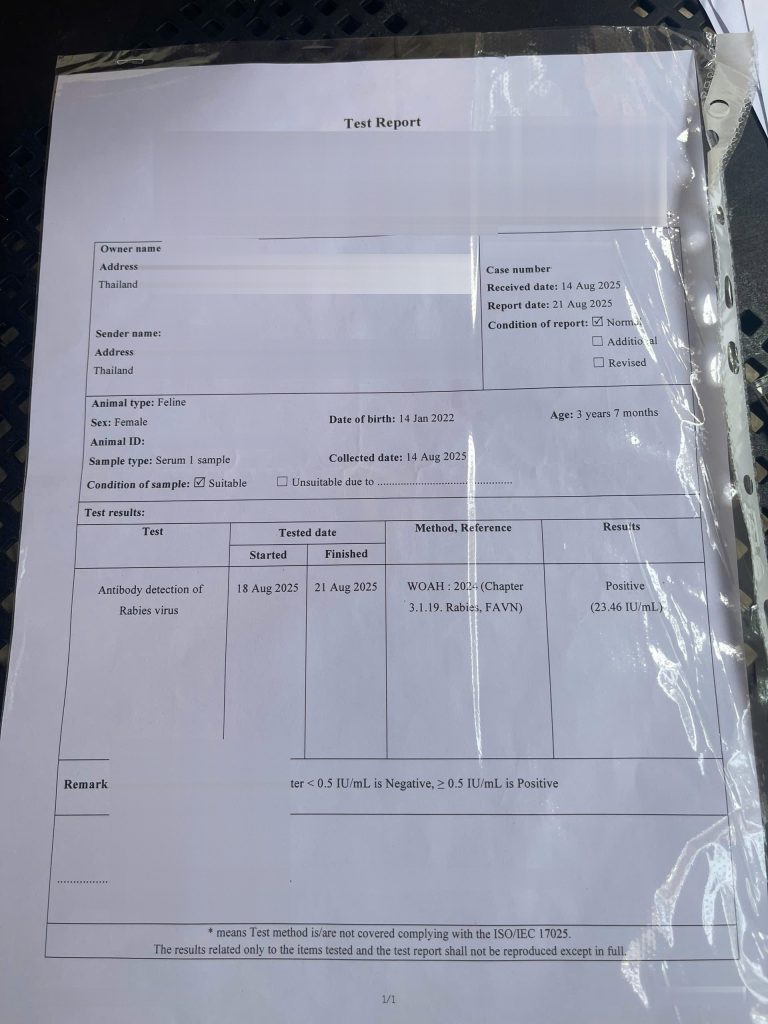
A rabies titer test is a blood test that shows your pet’s rabies vaccine has worked, with a pass mark of 0.5 IU/ml. The EU, the UK, Japan, South Korea, Taiwan, Singapore and the UAE require it for dogs and cats from Vietnam. The wait after the blood draw usually decides the flight date.
Rabies Titer Test from Vietnam: Short Answer
- What does it measure? Rabies antibodies in your pet’s blood. A result at or above the pass mark means the vaccine worked.
- Does my destination require it? Most strict destinations do for pets from Vietnam. The country table below gives the answer for each one.
- Can it be done in Vietnam? The vet draws the blood in Vietnam. The sample then goes to a laboratory the destination approves, which for most countries is a laboratory abroad.
- How long does it take? The blood draw comes at least 30 days after the rabies vaccination. When the sample is sent straight away, the result usually comes back within one to two weeks.
- When can my pet fly? Anywhere from no wait (South Korea, the UAE) to six months (Japan) after the blood draw.
What Does a Rabies Titer Test Measure?
The test measures rabies-neutralising antibodies in a blood sample. It does not look for the rabies virus. It shows whether your pet’s immune system answered the vaccine.
The World Organisation for Animal Health (WOAH) accepts two laboratory methods for pet travel: FAVN and RFFIT. The two methods give equivalent results. ELISA tests are not accepted for moving pets between countries (WOAH Manual, Chapter 3.1.18).
The pass mark is 0.5 IU/ml, short for international units per millilitre. Below it, the destination treats the pet as not protected. Results are often far higher: in our 2025–2026 cases they ranged from 1.15 to above 30.
RNATT is the general name for a rabies antibody test. FAVN is the laboratory method most often used for it. Destinations and vets use both names for the same test.
Which Countries Require a Rabies Titer Test for Pets from Vietnam?
Rabies still occurs in Vietnam. Countries that are free of rabies, or close to it, therefore ask pets from Vietnam to prove their immunity with a blood test.
| Destination | Titer test for pets from Vietnam | What to know |
|---|---|---|
| European Union | Required | Vietnam is not on the EU list of exempt countries. |
| United Kingdom | Required | Separate rules from the EU, same test. |
| Japan | Required | Two rabies vaccinations before the blood draw. |
| South Korea | Required | For pets 90 days old or older. |
| Taiwan | Required | The timing decides between 7 days of quarantine and none. |
| Singapore | Required | Quarantine on arrival as well. |
| United Arab Emirates | Required | Applies to pets from high-risk rabies countries. |
| United States | Dogs: needed to avoid quarantine | Without a valid result, a dog from Vietnam spends 28 days at a facility registered with the Centers for Disease Control and Prevention (CDC). Cats have no CDC titer rule. |
| Australia | Not directly | Pets from Vietnam cannot fly straight to Australia. On the usual route through Singapore, Australia does not ask for a titer test, but Singapore does. |
Not required for pets from Vietnam: Thailand, Canada (for vaccinated personal pets) and Peninsular Malaysia. Hong Kong works differently: pets from Vietnam face a quarantine of at least 120 days.
What Must Be Right Before the Blood Draw?
Three conditions decide whether the result will count. If one of them fails, the whole test has to be repeated.
- Microchip first. An ISO 11784/11785 microchip for international travel goes in before the rabies vaccination. The same visit is fine if the chip is implanted first.
- A valid rabies vaccination. The vaccine must be inactivated or recombinant and still valid on the day of the blood draw. The pet must be at least 12 weeks old when vaccinated, or 90–91 days for Japan, South Korea and Taiwan.
- Two doses for Japan. Japan requires two rabies vaccinations, the second at least 30 days after the first. The blood is drawn after the second dose.
- A one-month gap. The vet draws blood at least 30 days after the rabies vaccination. Singapore’s own rule is 28 days, but we plan the same gap for every destination.
How Is the Titer Test Done for a Pet in Vietnam?
Step 1: The Vet Draws the Blood
Who: a licensed vet.
In Ho Chi Minh City, Daisy Pet clients have the blood drawn at Belwee International Animal Hospital (Go Vap), a licensed veterinary hospital; Daisy Pet tracks the 30-day mark and coordinates the laboratory route. See who does what in the process.
Pets outside Ho Chi Minh City can have the blood drawn at a local veterinary clinic. The date of the draw must appear on the laboratory form.
Step 2: The Sample Goes to an Approved Laboratory
Who: Daisy Pet arranges the shipment; the vet prepares the sample.
The laboratory must be one the destination country approves. For most destinations, that laboratory is abroad. Send the sample the same week. In one of our cases, the sample reached the laboratory 60 days after the draw. It was still accepted, but the plan moved by two months.
Step 3: The Result Comes Back
Who: the laboratory issues the report.
When the sample is sent straight away, the result usually comes back 7 to 16 days after the draw. A supplementary report from some European laboratories can take longer. All 22 pets in the 16 titer cases we handled in 2025–2026 passed.
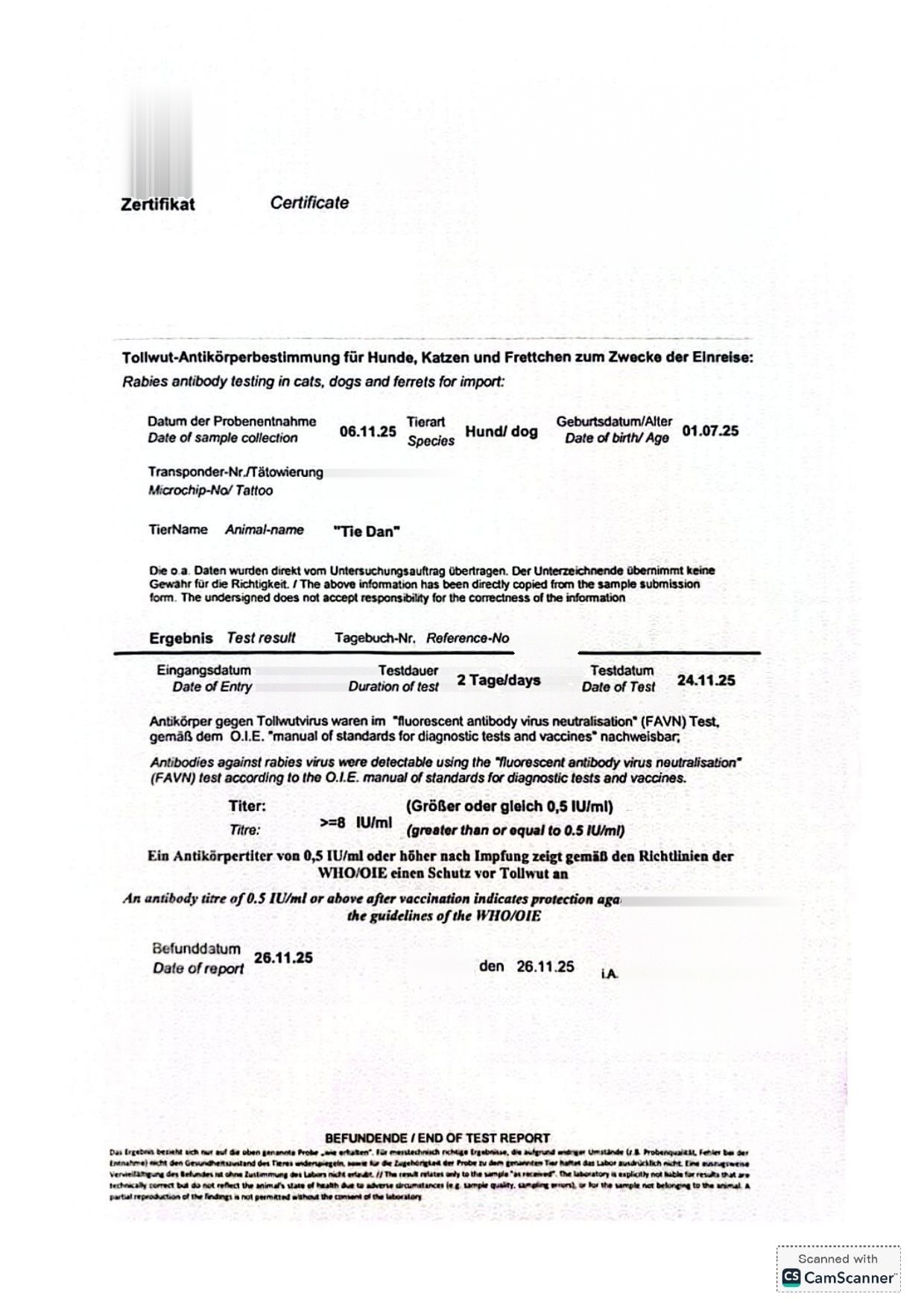
Step 4: Check Every Detail on the Report
Who: Daisy Pet and you.
The pet’s name, date of birth, microchip number and blood draw date must match every other document. In early 2026, a Taiwan application came back because the report showed a wrong date of birth and the vaccination booklet showed a wrong microchip number. Correcting the papers moved the arrival back by about three months.
How Long After the Blood Draw Can Your Pet Fly, and How Long Is the Result Valid?
For most destinations, the waiting time starts on the date of the blood draw, not the date the result arrives. The EU is the exception: it counts to the day the health certificate is issued.
| Destination | Wait after the blood draw | Result valid for |
|---|---|---|
| European Union | Sample at least 90 days before the health certificate is issued (rules in force since 22 April 2026) | No expiry if rabies boosters are never late |
| United Kingdom | 3 months from the blood draw | No expiry if boosters are never late |
| Japan | 180 days from the blood draw; notice to the Animal Quarantine Service at least 40 days before arrival | 2 years from the blood draw |
| South Korea | No wait | 24 months from the blood draw |
| Taiwan | Drawn 90 days to 1 year before arrival: 7 days of quarantine. Drawn 180 days to 1 year before: no quarantine | Up to 1 year from the blood draw |
| Singapore | Drawn at least 90 days and no more than 12 months before export, then at least 30 days in quarantine | Up to 12 months before export |
| UAE | No wait | 12 months from the blood draw, tied to the current vaccination |
| United States (dogs) | Drawn at least 28 days before entry | As long as rabies vaccinations stay current |
The official rules behind this table:
- EU: European Commission
- UK: Animal and Plant Health Agency (APHA) on GOV.UK
- Japan: Ministry of Agriculture, Forestry and Fisheries (MAFF)
- Singapore: Animal & Veterinary Service
- South Korea: Animal and Plant Quarantine Agency
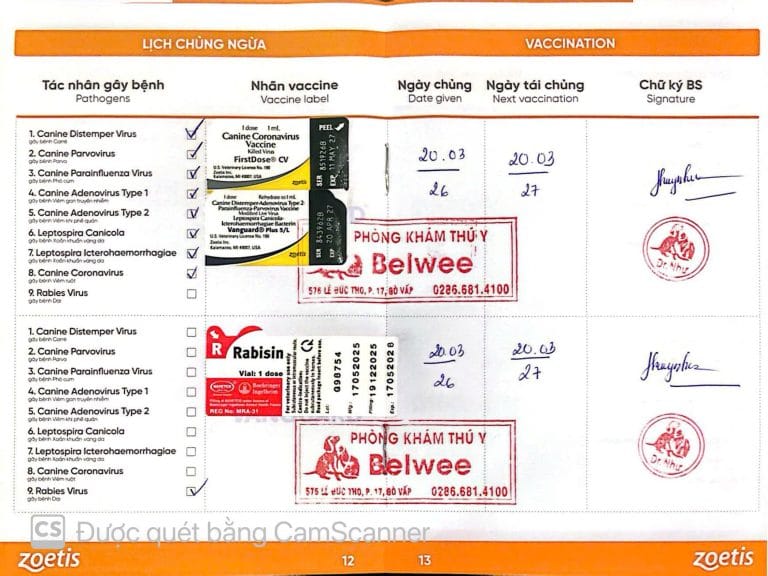
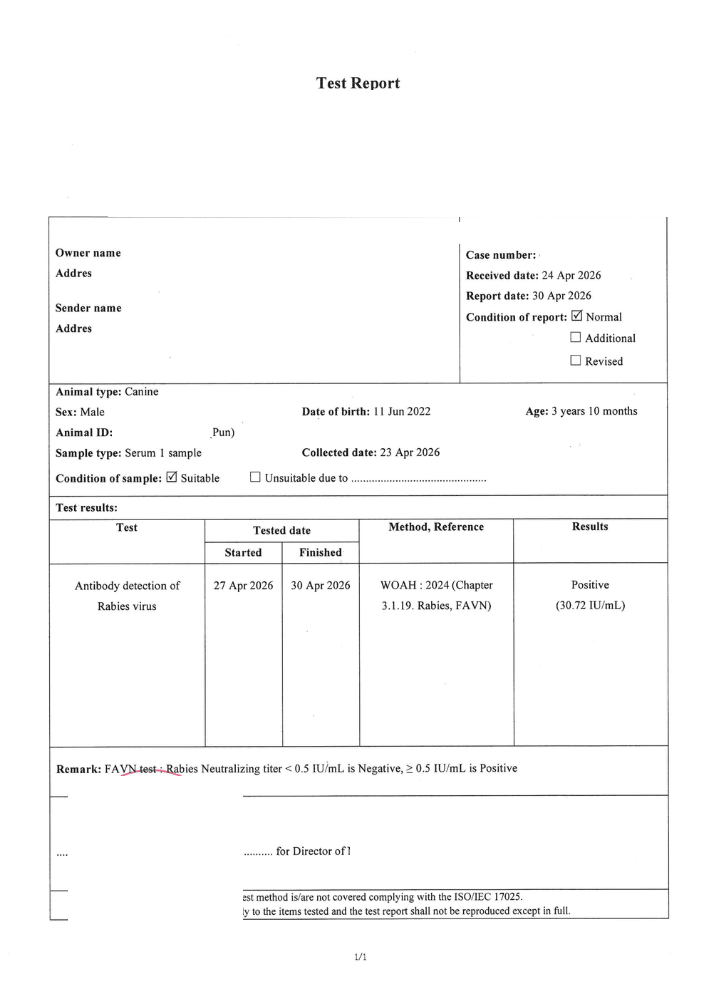
Pun, a dog we moved from Saigon to Houston in 2026, shows a short route. He had his microchip and rabies vaccination on 20 March. His blood was drawn about a month later, and the result of 30.72 came back on 30 April. He flew on 23 June. The full story is in Pun’s move from Saigon to Houston.
What Happens If the Titer Test Fails?
A result below the pass mark means the destination will not accept the pet yet. The steps are the same for every country:
- The vet gives a new rabies vaccination.
- The one-month gap starts again before a new blood draw.
- The waiting time counts from the new, passing blood draw.
For Japan, a pet that arrives before its waiting time is complete stays in quarantine until the time is served.
Which Mistakes Make You Repeat the Titer Test?
- Vaccinating before the microchip. In 2026, a dog we moved to Dubai had an expired rabies vaccination, and its older doses had been given before the microchip. The vet implanted the chip and vaccinated again, and the whole process started over.
- Letting a booster lapse. A booster given after the previous vaccination has expired counts as a first vaccination. For the EU and the UK, the titer test must then be repeated.
- Drawing blood too early. A sample taken before the one-month gap is over will not be accepted.
- Using a laboratory the destination does not approve. The report is rejected even when the result is high.
- Small errors on paper. A wrong date of birth or chip number on any document can send the application back.
FAQ: Rabies Titer Test for Pets from Vietnam
Is the FAVN test the same as the RNATT?
Yes. RNATT is the general name for a rabies antibody test, and FAVN is the laboratory method most often used for it.
Does my pet need a titer test to fly from Vietnam to Thailand?
No. Thailand asks for a rabies vaccination without a blood test. A first vaccination must be given at least 21 days before the flight.
Does the titer test ever need to be repeated?
Not for the EU or the UK, as long as boosters are never late. Japan and South Korea accept a result for 2 years, and Taiwan and the UAE for about 12 months.
Can the blood be drawn outside Ho Chi Minh City?
Yes. A local veterinary clinic can draw it, as long as the draw date is recorded on the laboratory form and the sample reaches an approved laboratory quickly.
How soon can my pet fly after the rabies vaccination?
It depends on the destination and on whether the current vaccination is still valid. Our guide to the waiting period after pet vaccination explains each case.
Last updated 17 Oct 2026
Compiled by our specialists from the regulations in force on the date above, for reference only. Rules may change after this date. Please verify with the competent authorities or contact us for the most accurate information.
Official sources cited in this guide
- WOAH Manual, Chapter 3.1.18woah.org
- European Commissionfood.ec.europa.eu
- Animal and Plant Health Agency (APHA) on GOV.UKgov.uk
- Ministry of Agriculture, Forestry and Fisheries (MAFF)maff.go.jp
- Animal & Veterinary Serviceavs.nparks.gov.sg
- Animal and Plant Quarantine Agencyapqa.go.kr