Your veterinarian told you the rabies vaccine is valid for three years. The vaccination certificate says the same. There’s still a year left before it expires.
Then your pet transport agent reviews the paperwork and says: “This vaccination is expired.”
This is not a rare scenario. At Daisy Pet Transport, we encounter this exact situation in roughly 1 out of every 4 international cases we handle. And when it’s caught late — after the health certificate has been issued, after the titer test has been drawn, after the flight has been booked — the cost of starting over can run between $1,000 and $3,000.
The question every pet owner asks is the same: “Is the rabies vaccine valid for 1 year or 3 years?”
The answer is: it depends on who’s counting.
Three parties, three different answers
To understand why your “valid” vaccination might be considered expired, you need to know that three separate parties have a say in your pet’s rabies vaccination status — and they don’t always agree:
| Party | Their perspective | What they care about |
|---|---|---|
| The manufacturer | Defines clinical validity based on immunology data | Was it given as a primary dose or a booster? Was there a prior vaccination? |
| Your veterinarian | Follows the manufacturer’s label and your pet’s medical history | Your pet’s welfare and immune protection |
| The importing country | Sets its own rules — and holds final authority | Can they verify, through official documentation, that the vaccine meets their specific requirements? |
The critical insight: the importing country holds the most weight. If their rules say the vaccination is expired, it doesn’t matter what the label says or what your vet believes. Your pet isn’t getting in.
When does a 3-year vaccine actually last 3 years?
Major manufacturers — Boehringer Ingelheim (Rabisin), Zoetis (Defensor), Merck (Nobivac Rabies), Elanco — produce both 1-year and 3-year rabies vaccine products. The 3-year product is clinically valid for 3 years, but only under specific conditions:
- It was administered as a booster — not as the pet’s very first rabies vaccination.
- The pet received a primary (first) rabies vaccination before this booster.
- The primary vaccination was given after the pet reached the minimum age (typically 12 weeks / 3 months).
If any of these conditions is not met — if the current vaccine was the pet’s first-ever rabies shot, or if there’s no documented primary vaccination — then the longest validity is 1 year, regardless of what the product label says.
Why this matters in practice: Many pet owners adopt adult dogs or cats with incomplete vaccination histories. The pet gets a “3-year” rabies vaccine, the vet records it as valid for 3 years — but because there’s no documented primary vaccination, most importing countries will only recognize it for 1 year.
The microchip trap — the most common mistake we see
This is where things get complicated — and where the most expensive mistakes happen.
For virtually all countries, a rabies vaccination is only considered valid for travel if it was administered after the pet was microchipped. The logic is straightforward: the microchip is the only way to verify that this specific pet received this specific vaccination on this specific date.
No microchip at the time of vaccination = no verifiable link between pet and vaccine = that vaccination doesn’t exist in the eyes of the importing country.
Here’s where it creates a cascade problem:
- Your pet received a primary rabies vaccination at 4 months old — before being microchipped.
- At 1 year old, the pet was microchipped and received a “booster” rabies vaccine (3-year product).
- Your vet correctly records it as valid for 3 years — because they know the primary dose happened.
- But the importing country is “blind” to any vaccination given before the microchip. From their perspective, the booster at 1 year old was actually the first vaccination — which means it’s only valid for 1 year.
This single issue — microchip timing vs. vaccination sequence — is responsible for more timeline resets than any other paperwork problem we handle.
Countries that only recognize 1 year — no matter what
Some countries have simplified the problem by refusing to recognize any rabies vaccination validity beyond 12 months. For these destinations, the question of “1-year vs. 3-year product” is irrelevant:
| Destination | Maximum rabies vaccine validity recognized | Note |
|---|---|---|
| Hong Kong | 1 year | Does not recognize 3-year validity under any circumstance |
| Japan | 1 year (with conditions) | Requires 2 separate rabies vaccinations + FAVN titer test + 180-day wait |
| Australia | 1 year | Requires RNATT titer test + extended quarantine protocol |
| Taiwan | 1 year | 1 rabies shot given 30 days–1 year before arrival + rabies antibody test + 7-day quarantine (waived if blood was drawn 180+ days before arrival) |
| Singapore | 1 year | Strict AVS protocol with titer test requirement |
Countries that recognize 3-year validity (with proof)
These popular destinations will accept the 3-year validity — but only if you can prove the complete vaccination chain back to the primary dose, all administered after microchipping:
| Destination | Accepts 3-year validity? | Condition |
|---|---|---|
| United States | Yes | Must follow CDC regulations; proof of primary vaccination required |
| EU countries | Yes | Must be administered per EU Regulation 576/2013; manufacturer’s recommendation followed |
| United Kingdom | Yes (with strict documentation) | Must prove vaccination was a booster following a documented primary dose |
| South Korea | Yes | Follows manufacturer recommendation; titer test still required from Vietnam |
Is your veterinarian wrong?
No — and this distinction matters.
Your veterinarian is responsible for your pet’s health and welfare. They may have valid clinical reasons to consider the vaccination effective for 3 years — because they administered the primary dose themselves, because they have the complete medical history, because immunologically, the pet is protected.
A pet transport professional is responsible for something different: ensuring your pet meets the importing country’s documentary requirements. These requirements are about verifiable proof, not clinical judgment.
Both perspectives are correct within their own domain. The problem arises when pet owners assume the vet’s clinical assessment automatically satisfies the importing country’s documentary requirements. It doesn’t.
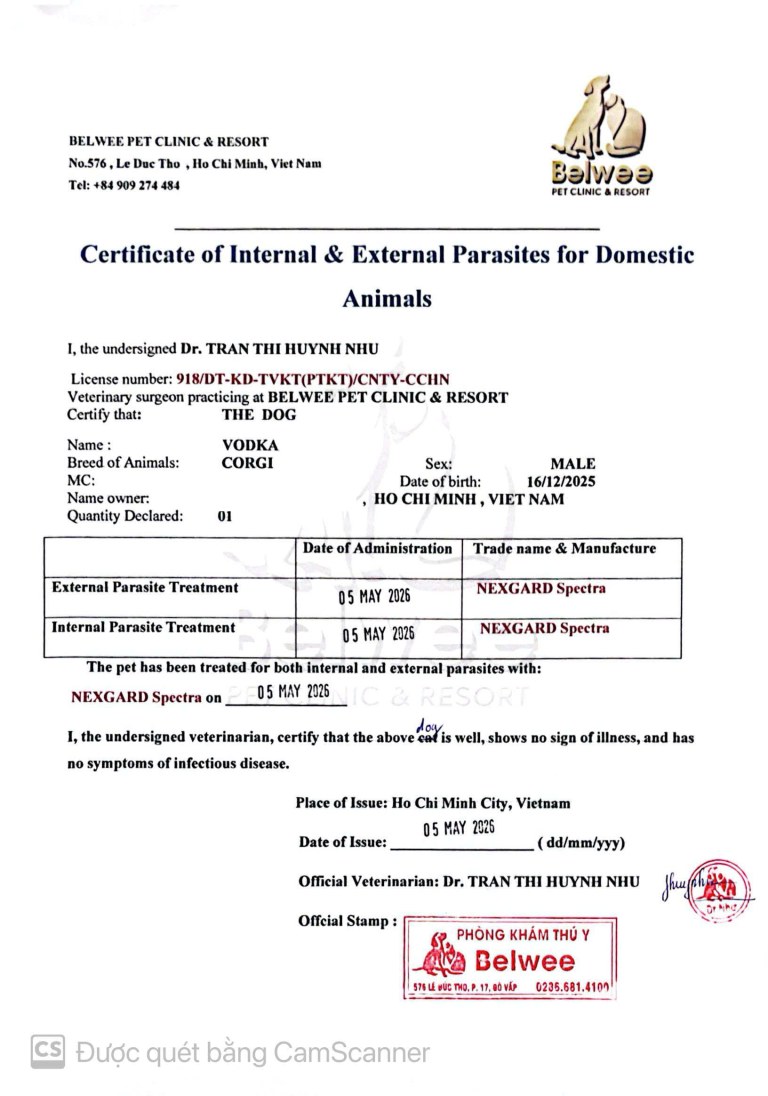
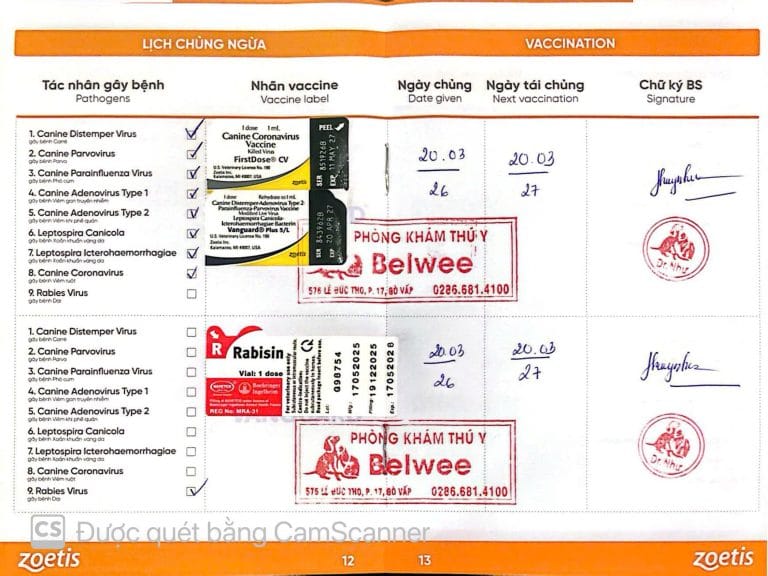
What should be on the rabies vaccination certificate?
Regardless of whether the vaccine is valid for 1 year or 3, the vaccination certificate must include these elements to be accepted internationally:
- Veterinary clinic details — Name, address, license number
- Pet identification — Name, breed, date of birth, sex, microchip number
- Vaccine details — Manufacturer name, product name, batch/serial number, product expiry date
- Vaccination dates — Date administered and valid-until date
- Veterinarian’s signature — Ideally in original ink, with license/registration number
Missing any of these fields can result in the certificate being rejected at the destination — even if the vaccination itself is perfectly valid. Catching these details before submission is exactly what a dedicated pet travel documentation service is built to do.
What to do right now
If you’re planning international travel for your pet, here is the practical checklist:
- Confirm microchip timing: Was your pet microchipped before its first rabies vaccination? If not, any vaccination given before the microchip may not count.
- Locate the primary vaccination record: Can you prove your pet received a primary rabies dose (after microchipping) before the current “booster”? If not, treat the current vaccine as a 1-year vaccine.
- Check your destination’s rules: Does the importing country recognize 3-year validity at all? If they cap it at 1 year, the question is moot.
- Check timing against the titer test: If a titer test is required, it must be drawn after a valid vaccination. An expired vaccine invalidates the titer test — and the 180-day waiting period resets.
- When in doubt, revaccinate: A fresh rabies vaccination is inexpensive ($15–$30 in Vietnam). A timeline reset due to an invalid vaccination chain can cost months and thousands of dollars.
The bottom line: A $20 revaccination today can prevent a $2,000 timeline reset tomorrow. If there is any ambiguity in your pet’s vaccination history — any gap in the documentation chain, any question about microchip timing — the safest decision is to start fresh.
Last updated 18 Oct 2026
Compiled by our specialists from the regulations in force on the date above, for reference only. Rules may change after this date. Please verify with the competent authorities or contact us for the most accurate information.