The Daisy Pet Standard: How We Work
A closer look at how Daisy Pet Transport operates — from documentation accuracy to travel crate preparation. Transparency in every detail.
A closer look at how Daisy Pet Transport operates — from documentation accuracy to travel crate preparation. Transparency in every detail.

Three principles guide every relocation we manage.
Every rule, sourced from the authority that made it. Import regulations come from multiple bodies at once — the exporting country’s veterinary bureau, the destination’s biosecurity agency, the airline — and they change with little notice. We cross-check each case against the latest published rules before we submit anything.
Official processes only — no shortcuts. Every permit and certificate goes through the proper government channel, never an informal arrangement. If your pet isn’t ready to travel yet, we’ll tell you directly and help you get there — not around it.
Checked and prepared before every flight. We review temperament, travel history, and health status, provide a crate acclimatization guide, and work with Belwee International Animal Hospital, our licensed veterinary partner in Ho Chi Minh City, to confirm your pet is fit to fly.
Each step of the file is carried out by the party licensed for it: veterinary work by veterinarians, official certificates by the state Animal Health Office, and transport by Daisy Pet. We do not practise veterinary medicine. We coordinate the file around the people who are licensed to. See who does what, step by step.
Six rules that decide how a pet travels — applied to every case, whatever the route or the deadline.
IATA and IPATA both advise against it, and a pet known to be sedated can be refused at the counter. Six weeks of crate conditioning does that work instead — the animal arrives used to the box, not drugged into tolerating it.
Most carriers refuse live-animal cargo when ground temperature at any airport on the route falls outside 7.2°C to 29.4°C — lower still, about 24–27°C, for flat-faced breeds. Ho Chi Minh City and Hanoi sit above that line for much of the year in daylight, which is why summer departures are booked after 6 PM.
Flat-faced dogs and cats cannot be cleared by eye. A licensed partner clinic issues the BOAS certificate, and IATA’s extra rules for these breeds then apply: a larger crate, and tighter limits on flight conditions.
A compliant crate is hard to source in Vietnam, especially in larger sizes, so it is treated as part of the file rather than an afterthought — with a written guide on choosing it and getting the pet used to it.
Whether a senior pet or one with a heart condition can fly is never settled by judgement. A licensed clinic examines the animal and issues the certificate, and the booking rests on that document.
When a pet falls ill before departure, treatment comes first and the flight waits. Asking an airline to accept a pet that is not yet well is not something we will do on an owner’s behalf.
A live-animal checklist is signed at check-in confirming the pet was offered food and water within four hours of check-in. Feeding instructions are fixed to the crate, a copy travels with the shipping documents, and 24 hours of food goes with the shipment where a transit feed may be needed.
The owner-side timeline that keeps the stomach light without dehydrating the animal:
24 hours before
normal meals, no new foods.
12 hours before
last full meal.
4–6 hours before
no solid food.
2 hours before
a few sips of water or ice cubes.
At departure
empty stomach, light hydration.
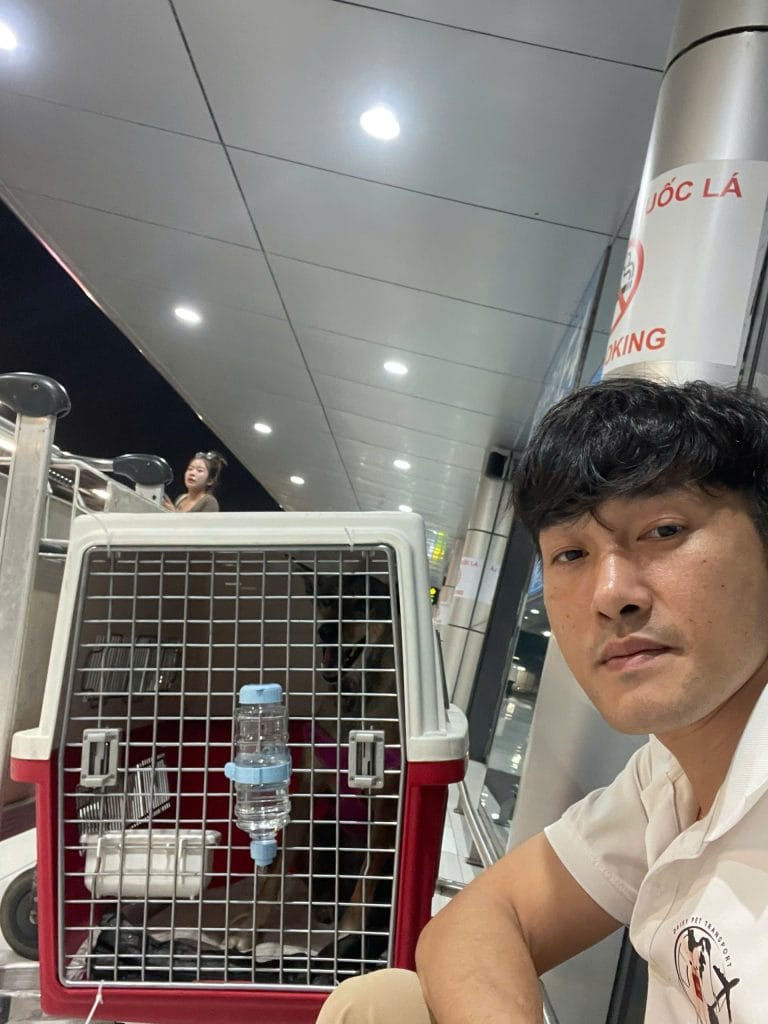
The crate quoted separately above is the single most important piece of equipment in your pet’s journey — here’s what it has to meet.
Spacious enough for your pet to stand, turn, and lie down comfortably.
Fiberglass, metal, rigid plastics, welded wire mesh, or solid wood/plywood meeting IPPC standards.
Openings on all 4 sides for plenty of airflow, with spacer bars so other freight can’t block them.
Rigid plastic containers securely bolted together with metal nuts and bolts.
Clearly marked with “Live Animal” and your contact details.
Every case is assessed for risk before it is accepted. These four conditions end a booking, whatever it is worth.
Three things are checked before every departure: weather on the route, the technical status of the aircraft, and the pet’s health that day. Any one of them failing stops the shipment. The size of the booking does not enter the decision.
The capability to push a borderline file through exists. Using it does not. If an airline judges a pet unfit at the counter, arguing it onto the aircraft is not a favour to that pet — and a forced file leaves the owner legally exposed. What is offered instead: rebuild the file correctly, in the shortest time the rules allow.
A steady stream of requests to export two- and three-month-old puppies has been turned down, because the only way to make those files pass is to misstate the age. It is a profitable segment. It is not one we work in.
Files are planned and the plan is followed. When something genuinely breaks late, industry relationships are used to solve it — but rushed documentation is never sold as a normal way of working, because speed at that stage is paid for in risk the pet carries.
What happens behind the scenes to keep every case on track — and what we do when it isn’t.
Every file is checked twice — once by machine, once by people.
Every engagement is governed by a signed service agreement covering scope, responsibilities, fees, and cancellation terms — signed at our office or digitally.
A red invoice is issued under Vietnamese law for every case, and liability sits in the contract rather than in a message.
A commitment that is not in the contract is not a commitment. This is the line between the two.
Every quote is an itemized breakdown of every cost — nothing hidden.
All formal communications — quotes, schedules, regulatory updates — go through email, so there is always a written record. Every quote is a formatted document with itemized costs; we do not send pricing through chat messages.
General questions: acknowledged within 24 business hours (daily, 6:00–23:00, Vietnam time). A formal quote: 24 to 72 hours, since each one is checked against the current rules for the departure country, destination country, and airline before we send a price. Once we send the information, we step back.
Relocating a pet means sharing information most people would rather keep private — home address, travel dates, financial details, sometimes photos of your family. We understand that, and we handle it the way we’d want our own handled: used only for what your case requires, never sold, and never shared beyond the parties who actually need it to get your pet home — airlines, government authorities, and quarantine facilities.
Photos and videos of pets and owners are only used publicly with the owner’s consent. Your personal information, travel plans, and financial details stay strictly confidential at all times.
Daisy Pet Transport Co., Ltd is a registered Vietnamese company specializing in international pet relocation. We are based in Ho Chi Minh City and available for in-person meetings and contract signing.
| Tax Code | 0317713063 |
|---|---|
| Office | B66 Bach Dang, Tan Son Hoa Ward, Ho Chi Minh City 72122, Vietnam |
| Hotline | +84 34 793 7779 |
| support@daisypettransport.com |
Our office is open for visits. You are welcome to review our documents and sign your agreement in person if that gives you greater peace of mind.
This page reflects our operating standards as of July 2026.
Straight answers to the questions clients most often ask about how we operate.
Tell us about your pet and destination. Our team will review your case and provide a clear, tailored quotation.
Ready to Relocate Your Pet?