VietnamEU

Pet Shipping from Vietnam to the European Union (EU) 2026 Expert Guide

Under EU Regulation, Vietnam is classified as an Unlisted Third Country. Importing dogs and cats to the EU requires a strict protocol, including international blood testing and a mandatory 90-day waiting period.

Last updated 18 Oct 2026i

Philip the Weimaraner next to his travel crate before flying to Poland
The 90-Day Wait
Know this first

Key Facts Before Shipping a Pet to the EU

Understanding these rigorous biological and bureaucratic hurdles is essential to ensure a successful entry into the EU

01

Extended Timeline

Vietnam is not on the EU’s list of countries exempt from the titer test, so a Rabies Titer Test (RNATT) is legally required. The blood sample must be taken at least 90 days before the health certificate is issued.

02

No Local Labs

There are absolutely no EU-approved testing laboratories in Vietnam. Your pet’s blood serum must be carefully prepared and shipped internationally to a laboratory on the EU’s designated list.

03

The 5-Day Rule Trap

If your pet travels more than 5 days before or after your own flight, the movement no longer counts as non-commercial and falls under commercial rules, which are considerably more complex.

DG SANTE Regulatory Framework

Compliance with the European Commission’s technical standards is mandatory for all dogs and cats entering EU from Vietnam.

1. ISO Microchip Validation

The pet must be identified with a 15-digit ISO 11784/11785 compliant microchip. Crucially: The microchip must be implanted before or on the exact same day as the rabies vaccination.

2. Primary Rabies Vaccination

Pets must be at least 12 weeks (84 days) old when vaccinated against rabies. The vaccine becomes legally valid only after 21 days have passed since the completion of the manufacturer’s primary vaccination protocol.

3. Rabies Titer Test (RNATT)

Blood for the neutralization antibody titration test must be drawn at least 30 days after the rabies vaccination. Samples must be sent to an EU-approved laboratory, with antibody levels verifying a minimum protective threshold of 0.5 IU/ml.

4. Biological Waiting Period

By law, pets coming from a non-listed country like Vietnam must wait at least 90 days from the blood draw before the health certificate can be issued. The count starts on the date the blood was drawn, not when the results are received.

5. EU Health Certificate

The pet travels on the EU Animal Health Certificate in the new model under Regulation (EU) 2026/705, written in the language of the first EU country of entry plus English, valid for 10 days until the entry check and officially endorsed by Vietnam’s Department of Animal Health (DAH), alongside a signed Owner’s Declaration of Non-Commercial Movement.

6. Traveller’s Point of Entry (TPOE)

Non-commercial pets from Vietnam must enter the European Union through designated airports known as TPOEs (e.g., Frankfurt, Paris CDG, Amsterdam Schiphol) for mandatory checks. See the approved airlines and routes for shipping pets to Europe.


Step by step

The 4–5 Month Roadmap to Europe

Standard expert protocol to successfully navigate the EU’s Unlisted Country import regulations.

01

Microchip & Vaccination

Implant a 15-digit ISO chip. Administer a primary rabies vaccine at ≥ 12 weeks of age. We then wait exactly 30 days for antibodies to develop.

02

Blood Titer Test (RNATT)

On Day 30+, venous blood is drawn, spun into serum, packed in cold-chain transport, and shipped internationally to an EU-approved laboratory for analysis.

03

The 90-Day Wait

Once the lab reports a pass (≥ 0.5 IU/ml), the pet remains in Vietnam until at least 90 days have passed since the blood draw.

04

Final Export Certificates

Within 10 days of the EU entry check, we secure the EU Health Certificate on the new 2026/705 model, endorsed by Vietnam’s Department of Animal Health.

05

Echinococcus Tapeworm Treatment

Dogs only

If traveling to Finland, Ireland, Malta, or Norway, dogs must receive a vet-certified tapeworm treatment exactly 24 to 120 hours prior to arrival.

06

EU TPOE Arrival

Upon landing, EU border veterinarians verify the microchip identity and audit the original health documentation before granting clearance.

The Reality Check: Practical Hurdles

Beyond theoretical EU laws, these practical risks are where most DIY pet relocation attempts from Vietnam fail.

1

National Breed Bans

There is no EU-wide breed law. If you import a Pit Bull-type or Staffordshire-type dog into Germany, it is a federal offense and the dog will be refused entry immediately. France requires specific LOF pedigrees for powerful breeds. You must strictly check national laws before booking flights.

2

Certificate Language

The health certificate must be written in the language of the first EU country where the pet is checked, plus English. A pet flying Vietnam to Frankfurt and on to Warsaw is checked in Frankfurt, so the certificate needs German, not Polish.

3

Tapeworm Timing on Connections

Dogs entering Finland, Ireland, Malta or Norway need an Echinococcus treatment 24 to 120 hours before arrival. If the route connects through one of these countries, time the treatment inside that window too, so the dog stays covered if it has to clear entry there.

4

International Titer Serum Shipping

Without an approved lab in Vietnam, your local vet must ship the blood serum abroad to a laboratory on the EU’s designated list. Poor cold-chain packaging or incorrectly completed submission forms frequently lead to laboratories discarding the sample, forcing you to redraw blood and restart the 90-day wait from the new draw date.

Three Shipping Methods for a Long-Haul Route

Europe is a long-haul route, so most pets travel checked baggage or cargo rather than in-cabin.

Poodle in a soft-sided travel bag at the airport

In-Cabin (PETC)

Travels in the cabin with the owner, in a soft-sided carrier under the seat.

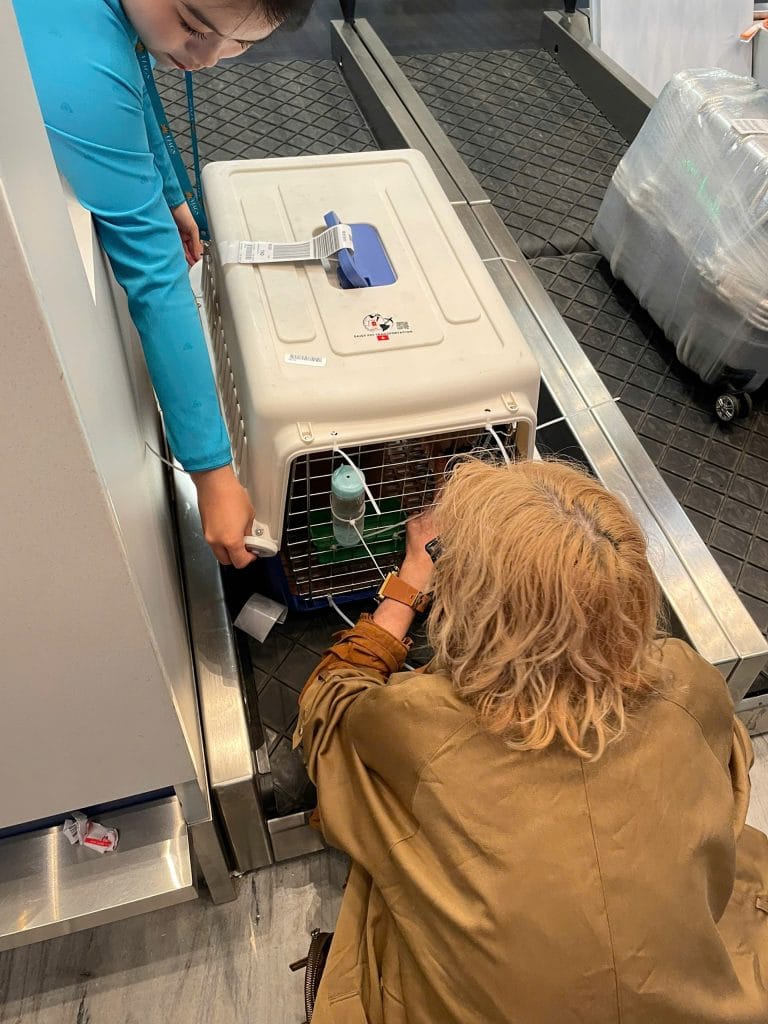
Pet owner checking in a dog crate at the airline counter

Checked Baggage (AVIH)

Flies on the same flight as the owner, in the temperature-controlled hold.

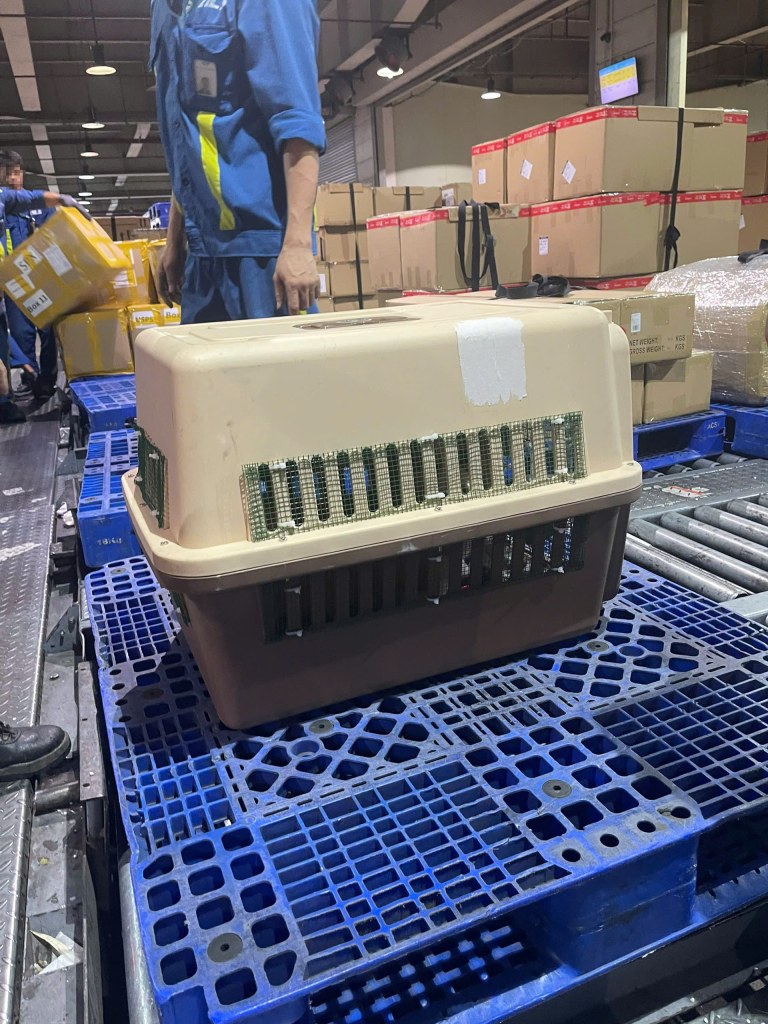
Pet crate on a pallet in the airport cargo warehouse

Manifest Cargo

Does not fly with the owner, with fewer limits on weight and size.

Welfare Standards That Apply

Applied to every pet flying the Europe route.

Age and Cabin Limits Vary by Carrier

Eight weeks and fully weaned is the floor for carriage, and some airlines set it higher. Cabin allowances count pet and crate together. Pregnant animals are not accepted.

Sedation Is Not Used

IATA and IPATA both advise against sedation, and a pet known to be sedated can be refused at the counter. Crate conditioning on a six-week schedule does that work instead.

Relocation Case: Vietnam to Europe

Every journey is different — see how we handled real relocation cases for pets traveling between Vietnam and Europe.

One of Fuji and Yuki, orange Pomeranian puppies, portrait photo

Fuji and Yuki: SGN to Paris

Two Pomeranian puppies born two days apart, whose blood had to fly to a lab in Europe for a titer test before a 90-day EU waiting period could even start counting down.

Philip, a Weimaraner, standing next to his travel crate on a Ho Chi Minh City street

Philip: An 11-Day Vietnam Stopover

A Weimaraner already holding a valid EU pet passport, whose journey from Uganda to Poland ran through an 11-day stay in Vietnam — and the full Vietnamese import file that came with it.

How We Support Your EU Relocation

Pet owners enjoy peace of mind while we take full responsibility for the complex EU timeline.

PET OWNER SERVICE

  • Flight schedule planning to designated TPOEs ensuring adherence to the EU 5-Day Rule.
  • Preparation of EU Health Certificates on the 2026/705 model and Owner Non-Commercial Declarations.
  • Advising on complex national-level issues, such as German/French specific breed laws.

PET LOGISTICS

  • Complete management of the RNATT Titer: drawing blood, serum preparation, and international cold-chain lab shipping.
  • Executing critical time-sensitive steps like the 24-120 hour Echinococcus worming treatments.
  • Origin customs clearance at Noi Bai/Tan Son Nhat and secure cargo lodge-in.

Absolute Pricing Transparency

EU pet relocation involves multi-step biological and global logistics. We provide an honest breakdown of every cost up front.

What is Included

  • Flight & Logistics: Pet booking, Airwaybill (AWB), and Airline Freight charges
  • Medical Protocol: International RNATT shipping fees and EU laboratory lab costs
  • Export Docs: EU Health Certificates & Government Endorsements in Vietnam

What is NOT Included

  • Travel crate: Custom IATA-compliant crates (Quoted separately based on dog/cat size)
  • Import Taxes & Fees: Destination customs clearance charges applied by EU authorities at the border
  • Onward Travel: Specialist ground transport from the EU arrival airport to your final residence

Official EU 2026 FAQs

The questions EU-bound pet owners ask us most — titer thresholds, the 90-day wait, breed restrictions, and what happens at the EU border post.

Can I bring my unvaccinated 10-week-old puppy to the EU?+
No. The European Commission states that young unvaccinated animals cannot be brought into the EU from a non-EU country for any purpose. Because Vietnam is an Unlisted Third Country, the absolute minimum age for a pet to enter the EU is approximately 7 months old (after completing the vaccine, titer test, and 90-day waiting period).
What happens if the titer test result is below 0.5 IU/ml?+
If your pet fails to reach the 0.5 IU/ml threshold, the test is invalid. Your pet must be re-vaccinated against rabies, wait an additional 30 days, have blood drawn again, and then re-start the entire 90-day biological waiting period from the date of the new successful blood draw.
Will my pet be put in quarantine upon arrival in the EU?+
Unlike Japan or Taiwan, the EU does not have a systematic post-arrival quarantine detention system. As long as your pet arrives with compliant documentation (valid microchip, a passing titer test drawn at least 90 days before the certificate was issued, endorsed EU health certificate or a valid EU Pet Passport for returning pets), they will be cleared at the airport to go home with you immediately.
Do I ever have to repeat the Rabies Titer Test?+
No. A successful EU RNATT result never expires, provided that you keep your pet’s rabies booster vaccinations strictly up to date according to the manufacturer’s validity recommendations. If you miss a booster deadline, the entire titer process and 90-day wait must be restarted. If you already have an authorized EU Pet Passport, rabies boosters can be recorded directly in it.
Can I import my Pitbull to Germany or France?+
If you are relocating to Germany, Pit Bull Terriers, American Staffordshire Terriers, Staffordshire Bull Terriers and Bull Terriers, plus their crosses, are federally banned from import. They will be rejected at the border without exception. For France, a Category 1 dog (resembling a Pitbull without an official pedigree) is illegal to import or own. However, countries like the Netherlands or Italy currently do not enforce a national breed import ban.
Do these EU rules apply to the UK?+
No. Great Britain is outside the EU and has its own rules. From Vietnam, a pet enters Great Britain only as cargo, and the owner must arrive within 5 days of the pet. See pet shipping from Vietnam to the UK.

Last updated 18 Oct 2026

Compiled by our specialists from the regulations in force on the date above, for reference only. Rules may change after this date. Please verify with the competent authorities or contact us for the most accurate information.