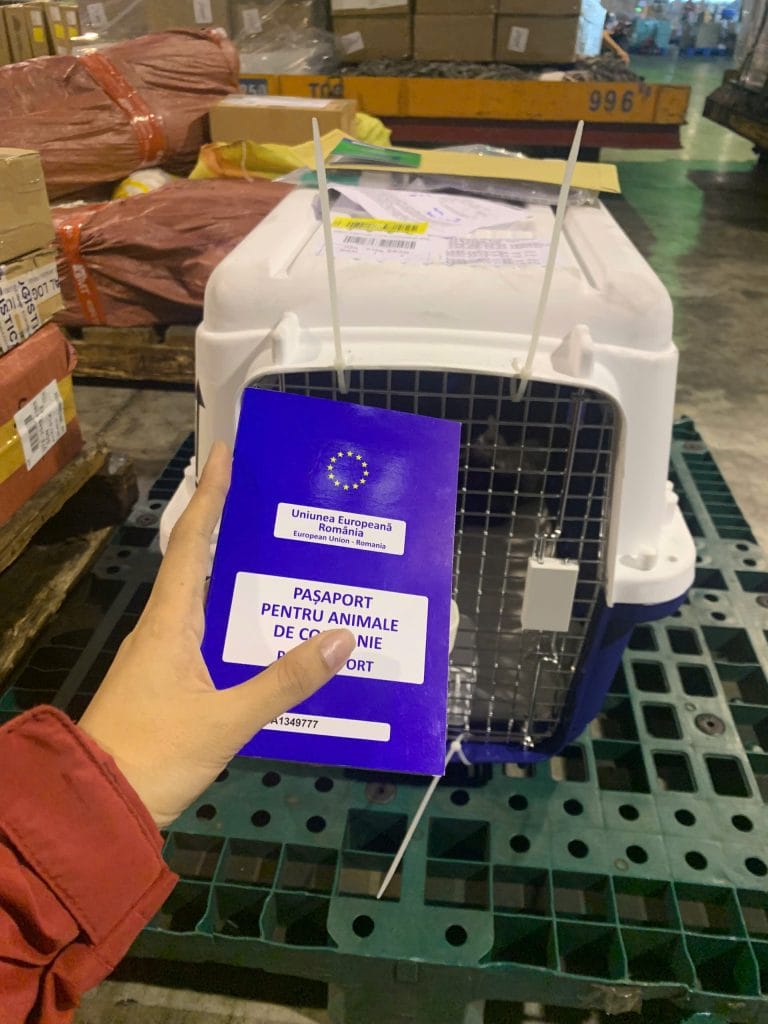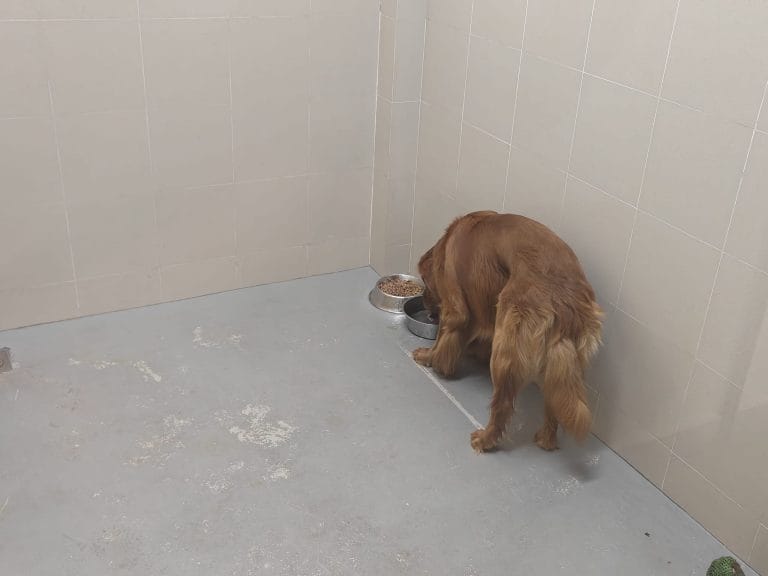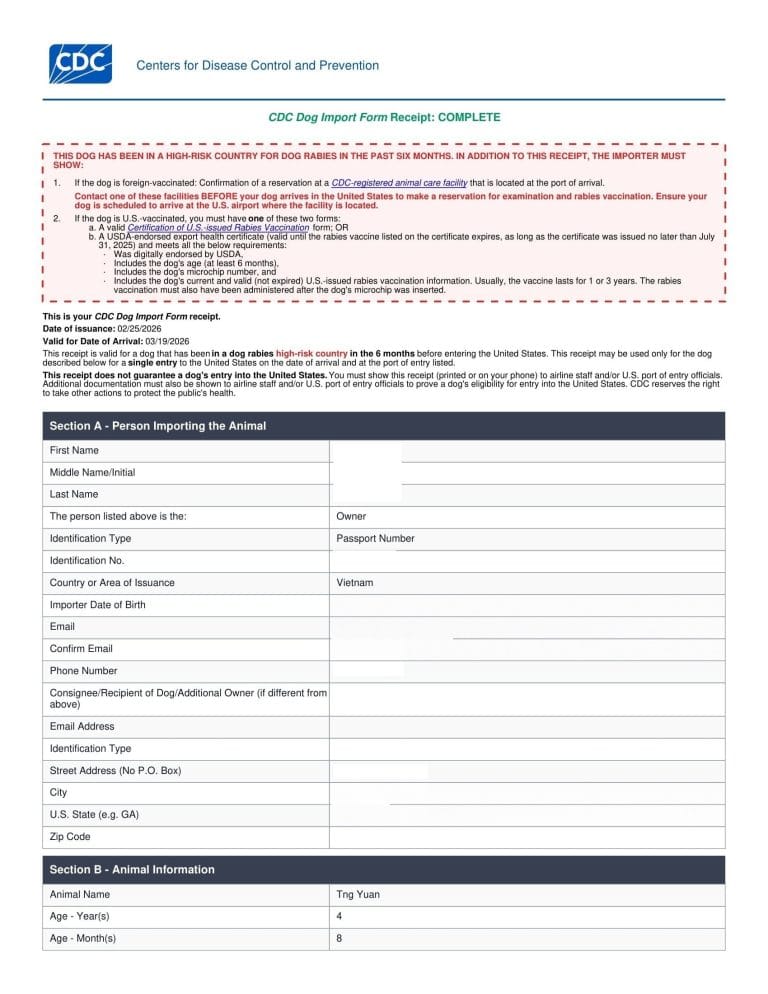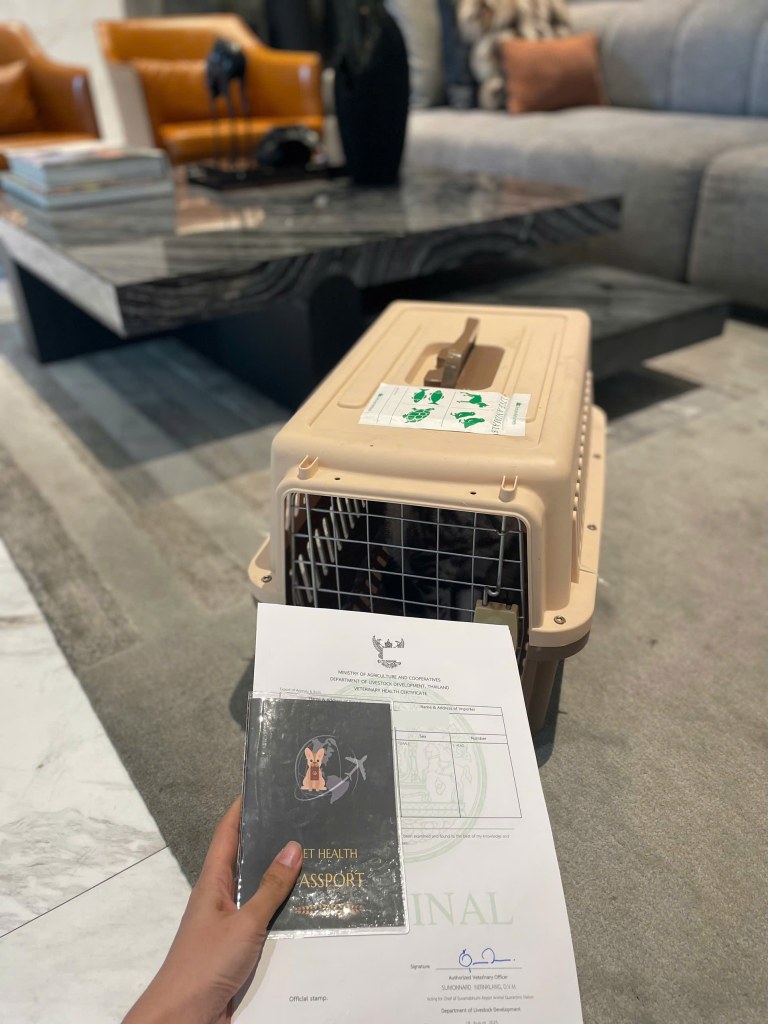
Planning to relocate your dog or cat from Vietnam to the United States? Below are 15 expert answers covering the CDC’s 2026 import regulations, required documentation, airline logistics, costs, and preparation timelines — updated for the rules effective August 2024 and fully verified as of May 2026.
Looking for the other direction? This guide covers shipping a pet FROM Vietnam TO the USA. If you need to bring a pet INTO Vietnam instead, see our complete Vietnam Pet Import Guide.
I. NEW CDC REGULATIONS (2026 UPDATE)
1. What is the minimum age for a dog to enter the USA from Vietnam in 2026?
The CDC now strictly requires all dogs entering the United States from high-risk countries like Vietnam to be at least 6 months old. This is non-negotiable and strictly enforced at all authorized U.S. ports of entry.
2. Is an ISO-compliant Microchip mandatory for all pets?
Yes. Every dog and cat must have an ISO-compliant Pet Microchip implanted BEFORE the rabies vaccination is administered. If the vaccination was done before the chip, it must be redone. Check our guide on Pet Vaccination Preparation.
3. What does the Rabies Titer Test (FAVN) involve for US-bound dogs?
The blood draw must satisfy two conditions simultaneously: at least 30 days after the first valid rabies vaccination (administered after microchip implant), and at least 28 days before the planned US entry date. Both conditions must be met — meeting only one is not sufficient. The sample is sent to a CDC-approved lab and the result must show ≥ 0.5 IU/mL to proceed. Once achieved, the RNATT result is valid for the dog’s lifetime as long as the vaccination schedule is never interrupted. More details: Rabies Titer Test (FAVN) Guide.
4. Does my cat need the same CDC Rabies Titer Test?
No. The CDC’s 2026 requirements for dogs do not apply to cats. Cats entering the USA from Vietnam have no federal health certificate requirement from either the CDC or APHIS — they simply need to appear healthy upon arrival. Any health certificate requirement for cats comes from the airline or the destination state, not from the US federal government. There is also no rabies titer test, no CDC Dog Import Form, and no ACF restriction on ports of entry for cats.
II. DOCUMENTATION & LEGAL REQUIREMENTS
5. What specific documents are needed for the Department of Animal Health (Vietnam)?
You need a bilingual Animal Health Certificate endorsed by the Vietnam Department of Animal Health no more than 10 days before flight. For dogs from a high-risk country like Vietnam, you also need the “Certification of Foreign Rabies Vaccination and Microchip” form — typed (not handwritten), signed by a licensed veterinarian, and officially endorsed (wet seal or electronic) by the government veterinary authority. Important timing: this Certification is valid for US entry for 30 days from the date the veterinarian signs it. If the flight is delayed beyond 30 days from signing, the form must be reissued. For a complete list, visit Required Documents from Vietnam.
6. Do I need an Import Permit for my dog?
Since the CDC’s August 2024 overhaul, there is no longer a separate “import permit.” The current requirement is the CDC Dog Import Form — a free online declaration that generates a barcode receipt used for airline acceptance, the ACF reservation, and CBP clearance. Any guidance still referring to an “import permit” reflects the pre-2024 system and is out of date. See our CDC Dog Import Form guide or the full 2026 USA Guide for the correct pathway.
7. What is the CDC Dog Import Form?
The CDC Dog Import Form is a free online application required for ALL dogs entering the USA. Submit it at the official CDC portal — you receive a barcode receipt via email approximately 15 minutes after verifying your email address. The receipt is then used to book your ACF slot and must be presented to the airline and CBP. The CDC form requires exactly one photo of your dog showing its face and full body (.jpg, .jpeg, or .png, maximum 10 MB). Dogs under 12 months must use a photo taken within 15 days of the flight. Note: the CDC form does not require a dental photo. A photo of your dog’s teeth is a separate requirement from the ACF facility to verify age (≥ 6 months) — prepare it separately and include it when contacting the ACF. For step-by-step instructions, see our CDC Dog Import Form Guide and ACF Reservation Guide.
III. LOGISTICS, AIRLINES & COST
8. Which airlines are pet-friendly for Vietnam to USA routes?
Korean Air is the most established and popular carrier for this route, with strong live-animal handling via Seoul Incheon (ICN) — but note that under Korean Air’s own policy, dogs vaccinated in a high-risk country such as Vietnam may only enter the US on Korean Air at 2 of the 8 CDC ACF airports: Washington Dulles (IAD) and Atlanta (ATL). China Airlines and EVA Air (via Taipei) and All Nippon Airways / Japan Airlines (via Tokyo) are also solid alternatives, but each has specific Airline Rules for Vietnam–USA Routes regarding kennel sizes and temperature restrictions. Check our Restricted Breeds list if you own a snub-nosed breed.
9. Can my pet fly in the cabin (In-cabin)?
In-cabin travel is possible on the Vietnam–USA route, but only on the specific airlines that permit it for transpacific flights, and only within that carrier’s weight and carrier-size limits — typically small pets under 8kg including the bag. Most airlines flying this route still require checked baggage or manifest cargo for the international leg, so confirm the specific carrier’s in-cabin policy before booking. Learn more: Pet Transport Methods Explained.
10. What are the IATA requirements for a travel crate?
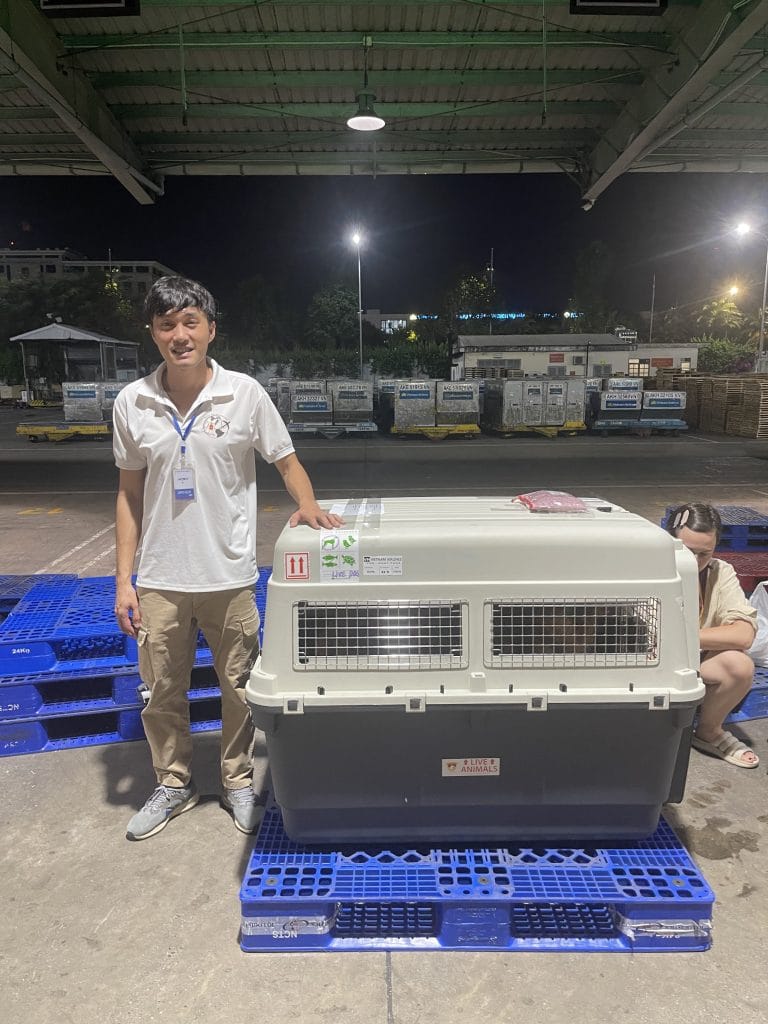
The crate must be large enough for the pet to stand, turn around, and lie down comfortably. It must have 4-way ventilation and fixed water bowls. See our IATA Crate Standards.
11. How much does it cost to ship a pet from Vietnam to the USA?
Costs vary widely by pet size and weight. A typical small dog runs $3,000–$4,500, while larger breeds can exceed $6,000, driven mainly by air freight, the RNATT titer test, and the $1,000–1,500 ACF fee. Cats are simpler and cheaper — usually $1,500–$2,500. Read more: Cost Analysis Vietnam to USA (2026).
12. What happens if there is a layover (e.g., in Tokyo or Seoul)?
Most airlines handle pets during layovers, ensuring they have water and are kept in a temperature-controlled area. For long transits, specialized care is provided. See How Pets are Handled During Layovers.
IV. TIMELINE & PREPARATION
13. How far in advance should I start the process?
For dogs starting from scratch — no microchip, vaccination, or RNATT titer yet — plan for 4–6 months; the RNATT process alone takes 8–12 weeks between the vaccination wait and lab results. If your dog already has a current rabies vaccination and a valid lifetime RNATT result, the remaining paperwork (CDC form, ACF reservation, health certificate) can be completed in as little as 3–4 weeks. Cats need only about 3–4 weeks regardless, since none of the CDC dog-specific requirements apply to them. Review our Shipping Timeline to the USA.
14. What happens if my pet is denied entry by the CDC?
Denied pets may be deported at the owner’s expense or quarantined. To avoid this, ensure 100% compliance with our Denied Entry Protocol.
15. Can I guarantee my pet will be on the same flight?
While we strive for the same flight, airline baggage limits apply. It’s safer to confirm booking 14 days in advance. More on Flight Guarantee Policies.
16. Does Vietnam’s FMD status affect my dog’s import to the US?
Yes — Vietnam is classified as FMD-affected by APHIS. For household pets, this means the transport crate and bedding must be thoroughly cleaned before departure, and the dog should show no signs of FMD (blistering of feet, mouth, or nose). For pets with no livestock contact, this is primarily a cleanliness requirement rather than a quarantine.
Last updated 20 Oct 2026
Compiled by our specialists from the regulations in force on the date above, for reference only. Rules may change after this date. Please verify with the competent authorities or contact us for the most accurate information.
Official sources cited in this guide
- survey.1cdp.cdc.govsurvey.1cdp.cdc.gov