Search for banned breeds in the Netherlands and you expect a list of dogs. There is none. The Dutch government has said in writing that banning breeds does not reduce bite incidents, so no dog breed is barred from entry or from being kept. The breed ban that does exist is aimed at cats: since 1 January 2026, hairless and fold-eared cats — Sphynx and Scottish Fold among them — cannot be kept, and no certificate changes that. The full route for a pet from Vietnam is in the Netherlands pet shipping guide; this page separates the rules that stop an animal from the ones that only sound like they would.
Dogs: No Breed Is Banned in the Netherlands
No dog breed is banned from entering or being kept in the Netherlands, including the bull-type breeds owners ask about most. In its written answer to Parliament of 1 July 2026, the State Secretary for Agriculture said that breed-specific measures taken abroad, such as banning breeds, do not reduce the number of bite incidents. The full text is in Parliamentary answer 2440.
Dutch policy follows the individual dog instead. A mayor can order a leash and muzzle for a dog that has shown dangerous behaviour, and the government is working on making that order valid outside the municipality too. It is also preparing a theory course for future dog owners and has commissioned research into physical traits linked to bite risk — research, not a rule.
Three Dog Rules That Are Not Breed Bans
Three Dutch rules or plans touch particular kinds of dog. None of them creates a list of banned breeds in the Netherlands, and none stops a dog from entering, which is the distinction that matters when planning a move.
| Rule | What it restricts | Stops a dog entering? | Status on 28 September 2026 |
|---|---|---|---|
| Short-snouted dogs | Breeding only | No — keeping and importing are allowed | Breeding ban in force; research on a possible keeping ban reports in early 2028 |
| Cropped ears or tails | Showing the dog | No — a dog cropped legally abroad can be kept | Draft decree extends the show ban to dogs cropped abroad; no start date published |
| “Risk dog” list | Owner obligations, such as a behaviour course | No — not law yet | Breed list announced for early 2027 by press reports; no legal text or date |
The short-snouted rule is the one most likely to move. NVWA states that breeding with dogs whose snout is too short is banned, and in January 2026 the government wrote that no valid trait exists yet on which a keeping ban could rest. In a March 2026 answer to Parliament it also declined to require the breeding measurement form at import, noting that the form is not an official document. NVWA’s import pages list no requirement about snout length, but the topic is live in Parliament, so check the current position before booking a short-snouted dog.
Cropped ears and tails work the same way. The Dutch government’s draft decree of 19 December 2025 extends the show ban to dogs cropped legally abroad, names imported dogs as its main target, sets a €1,500 fine and has no transition period. No start date had been published at the time of writing, so plan as if it applies: the dog can live in the Netherlands, but it cannot be shown.
One watch item sits behind the risk-dog list. The January 2026 letter expects a pedigree certificate for dogs with certain physical traits around 2027 to 2028. If it arrives, dogs without papers, such as many crossbreeds, could be affected.
Cats: Sphynx and Scottish Fold Cannot Be Kept
Cats are the only banned breeds in the Netherlands, and the only place where Dutch law names breeds. Since 1 January 2026 it has been illegal to keep hairless or fold-eared cats, and the rule applies equally to a cat arriving from abroad.
Which Cats the Ban Covers
The Dutch business agency RVO names the breeds directly. The ban covers two groups, and both are defined by a physical trait rather than a pedigree.
| Group | Breeds RVO names | The trait behind the ban |
|---|---|---|
| Hairless cats | Sphynx, Bambino Sphynx, Peterbald | A non-functional coat that does not protect the skin |
| Fold-eared cats | Scottish Fold, Highland Fold, Foldex | A cartilage growth disorder that affects joints throughout the body |
RVO’s list is introduced with “such as”, so it is not exhaustive. For Sphynx and Scottish Fold cats the breed name settles the question, and because the law is written around the trait, a mixed-breed cat with folded ears or no functional coat should be treated as covered too.
Why Paperwork Cannot Fix It
The Dutch government’s reasoning is direct: these cats suffer because of how they look. Fold-eared cats carry a gene change that causes a cartilage disorder, not only in the ears but in the whole body — thick, stiff joints in the legs and tail, pain, and a limp. Hairless cats struggle to regulate body temperature, are prone to skin irritation and infection, and often lack whiskers.
That is the logic to hold onto for everything on this page. Rabies rules deal with a disease, and a valid certificate shows the risk has been handled. This ban deals with the animal’s condition, which no certificate can change. So the law asks a single question: was the cat already here, born and microchipped, before the ban began?
It is also why a complete file does not settle anything. Nothing in the EU pet import protocol bans these breeds — the restriction is Dutch, so a file that satisfies the EU can still belong to a cat that may not be kept.
The One Route: Born and Microchipped Before 1 January 2026
Cats that were already living before the ban fall under transitional rules. The Dutch government’s wording is exact: the cat must be born before 1 January 2026 and demonstrably microchipped before that date. Cats born on or after 1 January 2026, and cats without a chip, fall under the ban.
The rule applies equally to a cat arriving from abroad. RVO’s page on the keeping ban, last checked by the agency on 11 March 2026, confirms it also covers a temporary stay such as a holiday.
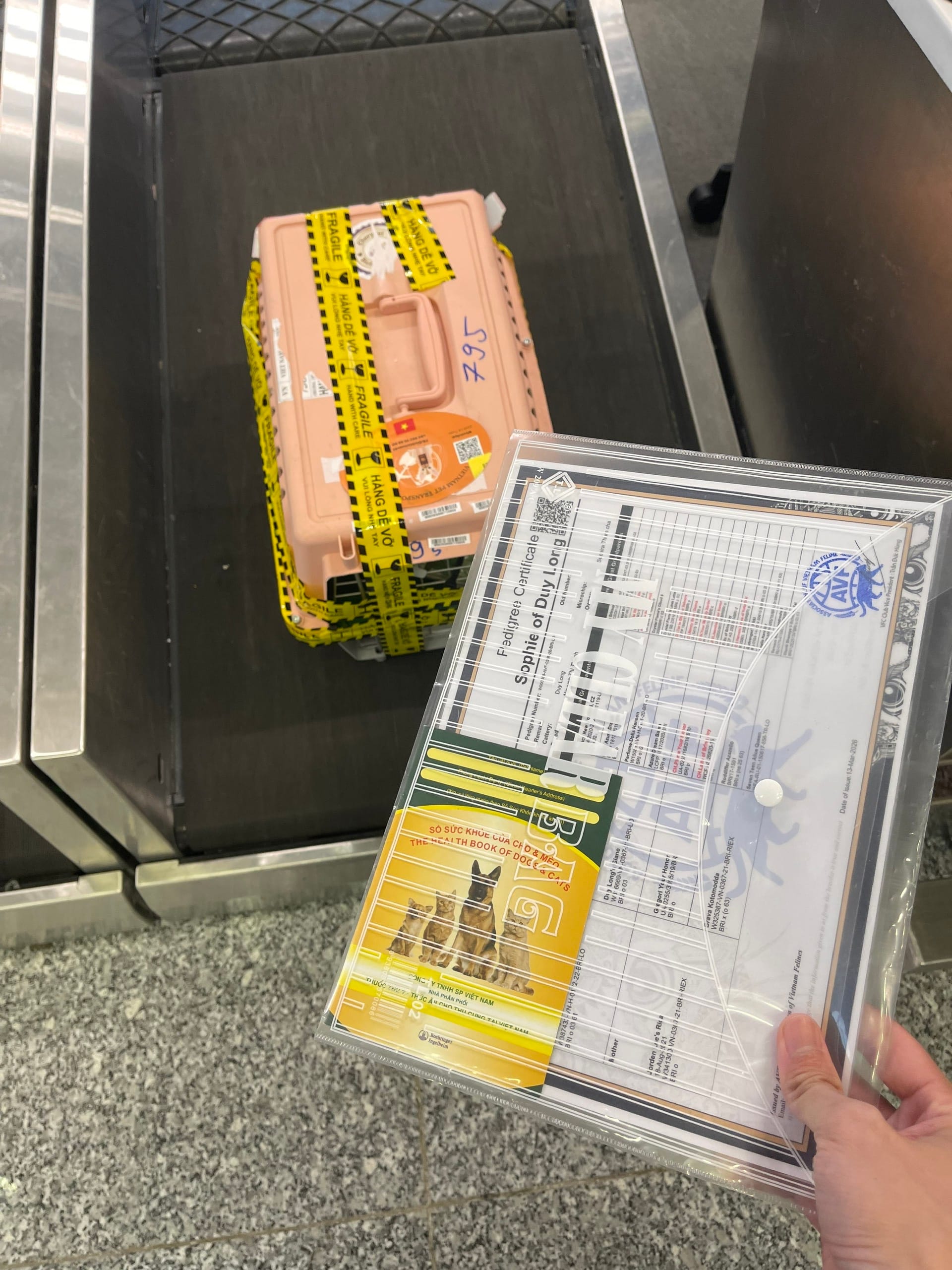
The proof RVO accepts is written evidence showing the chip date — for example a registration record in a pet database, or a vet’s record of the implant. Three illustrative cases show how the dates work:
| Case | Born | Chip implanted | Outcome |
|---|---|---|---|
| 1 | March 2025 | April 2025 | Transitional rules apply — the chip date can be proven |
| 2 | November 2025 | January 2026 | Ban applies — born before the cutoff, but chipped after it |
| 3 | February 2026 | Any date | Ban applies — born after the cutoff |
For owners in Vietnam, one detail matters more than it looks: a microchip number carries no date. What counts is a dated record — the clinic’s implant entry or the database registration. If the clinic that chipped the cat still holds it, ask for a copy now. If no dated record exists, the chip date cannot be shown and the transitional route is closed. Why the chip anchors every other document is covered in the microchip guide for international travel.
The same date also appears on the official paperwork. The EU animal health certificate must state the implant date, so the date on the certificate has to match the clinic’s record exactly.
What Still Applies to a Cat That Qualifies
Qualifying under the transitional rule only settles the keeping question. The cat still needs the full import sequence: the chip before the rabies vaccine, a rabies titer test, a 90-day wait, a minimum age of 7 months and the EU health certificate.
Every step of that sequence is set out in the Netherlands pet import rules.
Two limits stay with the cat for life. A cat under the transitional rule cannot enter shows or competitions, with a €500 fine for breaking that rule. It can, however, be sold or passed on within the Netherlands.
Transit Through Amsterdam: Why Owners Should Route Around It
Amsterdam is a common hub between Vietnam and the rest of the world, and the rule text does not address an owner passing through with a cat that does not qualify. RVO lists exceptions for shelters, vets, animal traders and transporters — the transport exception lasts a maximum of 4 working days — and for emergency transport. Each describes a professional or an emergency, not a passenger on a connecting flight.
The Dutch food authority NVWA adds a second point: when the connection is in the Netherlands, the EU import check happens there. Its guidance on connecting flights with a pet allows a narrow exception, at the owner’s own risk, if the pet stays in the international area and has no contact with other animals or people.
The practical takeaway: no written exception covers passenger transit. Sphynx and Scottish Fold cats that would not qualify for the transitional rule should fly a route that avoids Dutch airports until an authority confirms otherwise in writing. That is caution, not a legal finding. What happens to a pet on any connection is covered in the guide to how pets are handled during layovers.
Penalties and Who Checks
The Landelijke Inspectiedienst Dierenwelzijn, the Dutch animal welfare inspectorate, has checked for the keeping ban since 1 January 2026. Keeping a banned cat carries an administrative fine of €1,500. Owners have no duty to report a banned cat, and vets may treat, chip or sterilise any cat without reporting it.
The ban was published in the Staatsblad, the Dutch official gazette, on 31 October 2025. The government announcement sets out the transitional rule in the wording used above.
Airlines Set Their Own Breed Limits
Dutch law and airline policy are two separate filters. Carriers restrict short-snouted breeds in the hold for breathing-safety reasons whatever the Netherlands allows, so a dog can be legal to import and still not be accepted on a given flight. The guide to breed restrictions for flying pets explains which breeds carriers commonly limit and why.
How each carrier handles live animals on the Europe routes is covered in the airline rules for pets flying to Europe.
Before You Book Anything
- Dogs, breed: no Dutch breed check applies at entry, so the airline’s breed list is the one to read first.
- Dogs, cropped ears or tails: the dog can enter and live in the Netherlands, but expect to be barred from shows.
- Cats, birth date: a Sphynx or Scottish Fold born on or after 1 January 2026 cannot qualify, whatever the paperwork.
- Cats, chip date: get a dated clinic record or database registration in writing, and match the implant date on the EU certificate to it.
- Cats, route: for a cat that does not qualify, avoid Dutch airports, including connections.
- Re-check before booking: the Dutch government is studying further breed and trait rules for dogs and cats, so confirm the current position before paying for a flight.
A pet that qualifies still has to land and settle in — the first 14 days in the Netherlands guide covers what happens after arrival.
Last updated 30 Sep 2026
Compiled by our specialists from the regulations in force on the date above, for reference only. Rules may change after this date. Please verify with the competent authorities or contact us for the most accurate information.
Official sources cited in this guide
- Parliamentary answer 2440tweedekamer.nl
- open.overheid.nlopen.overheid.nl
- eerstekamer.nleerstekamer.nl
- RVO’s page on the keeping banrvo.nl
- nvwa.nlnvwa.nl
- rijksoverheid.nlrijksoverheid.nl