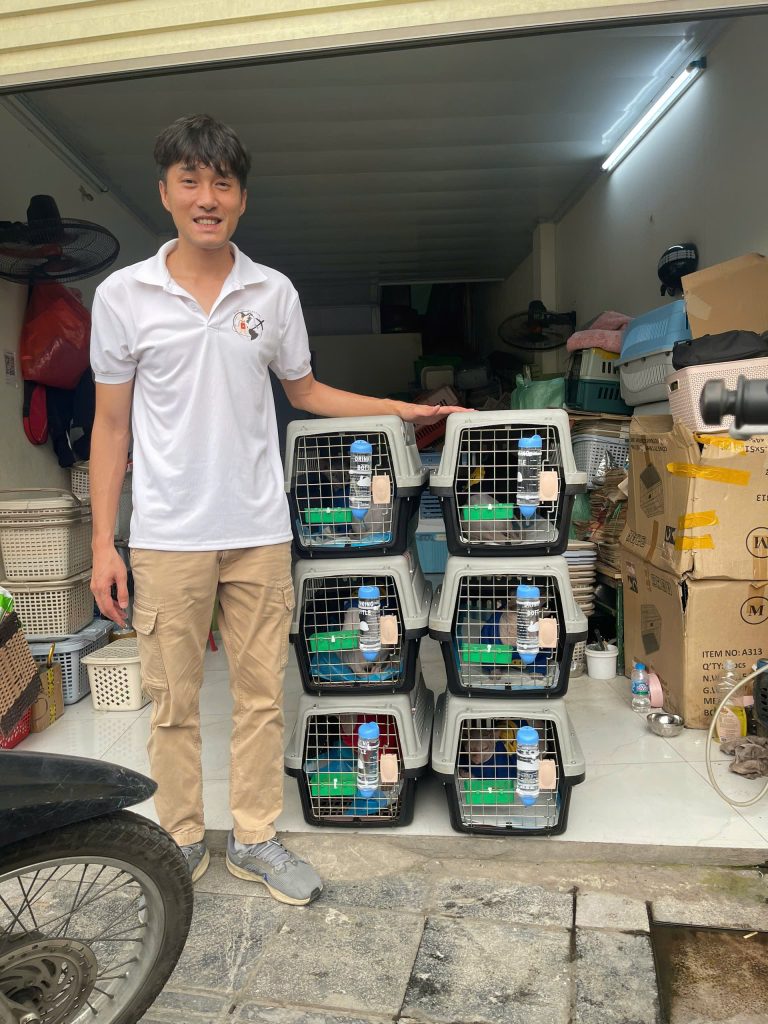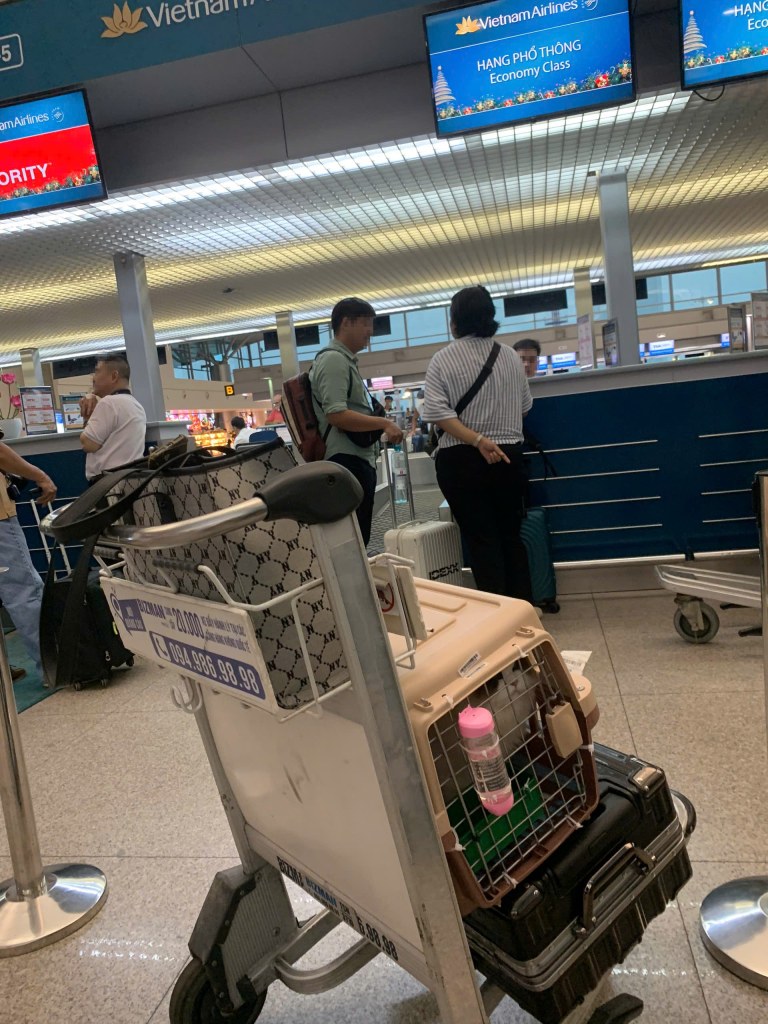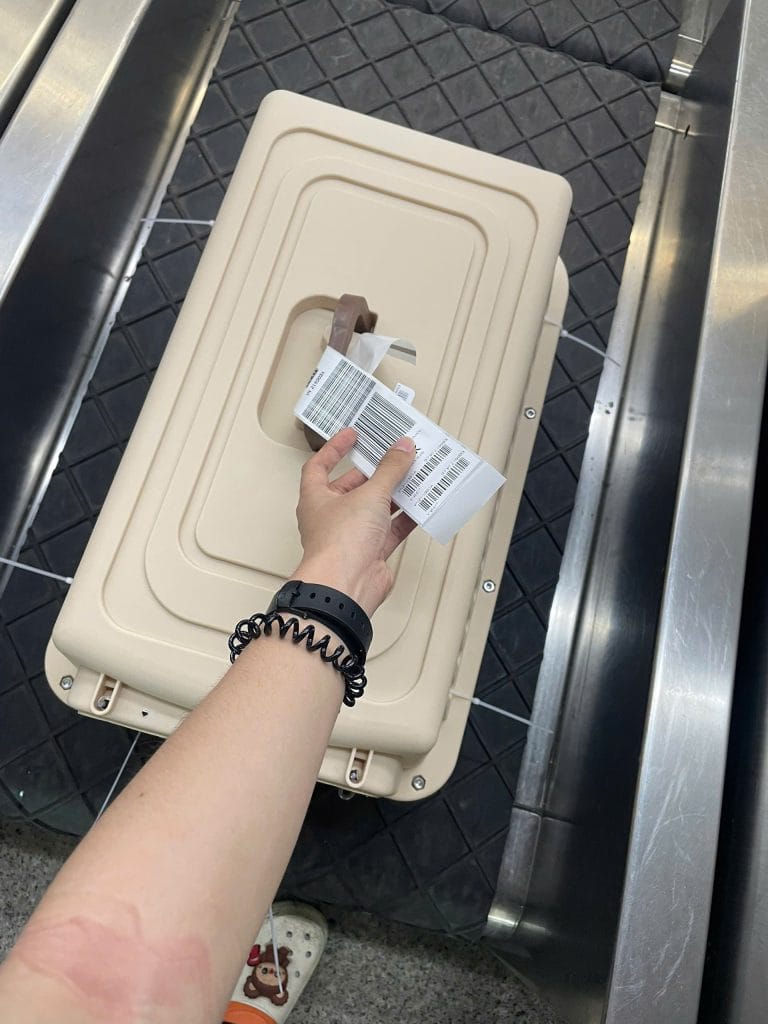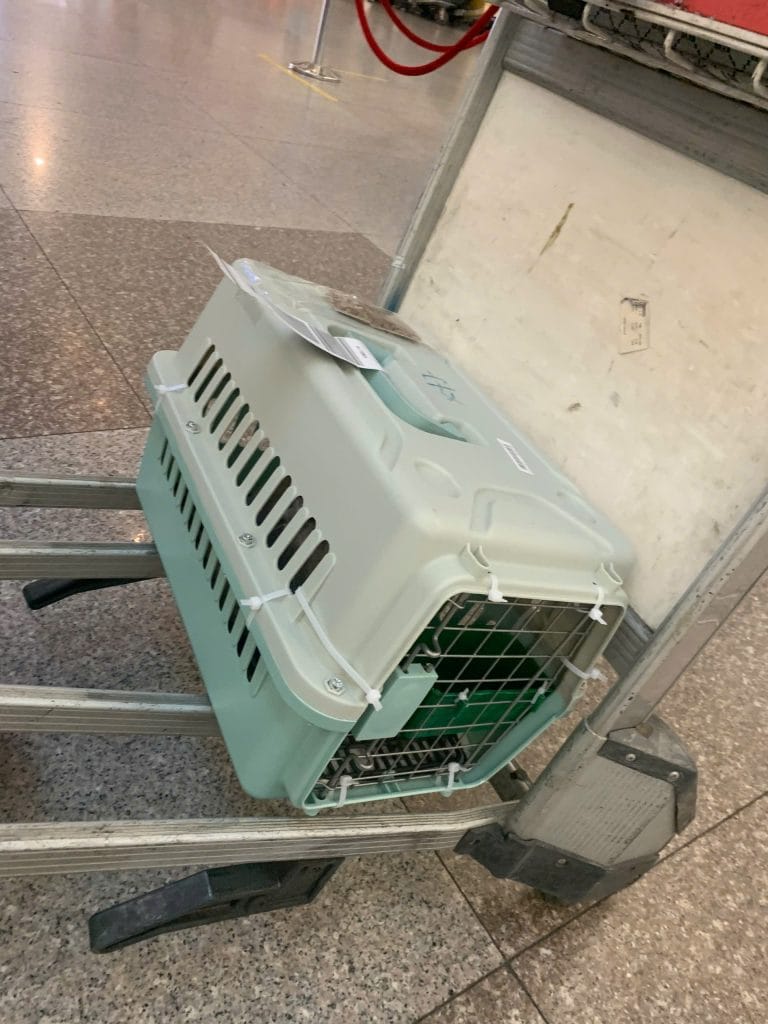
A pet shipping timeline from Vietnam to Taiwan has to satisfy three sets of rules: Taiwan’s import rules, Vietnam’s export certificate and the airline’s conditions. Taiwan’s rabies rules set the pace. Without quarantine, the pet lands at the earliest 211 days (about seven months) after its rabies vaccination; with seven days of quarantine, about four months after it.
Short Answer: How Long Does It Take to Ship a Pet from Vietnam to Taiwan?
- Quarantine-free: at least 211 days from the rabies vaccination. The blood test must be at least 180 days old on arrival day.
- Faster, with quarantine: about four months (121 days). The blood test only needs to be 90 days old, and the pet then stays seven days at the Guanyin quarantine station.
- How does the pet fly? In the cabin, as checked baggage or as cargo, depending on its weight and the airline.
- Who does what? In Vietnam: a vet, a laboratory abroad and the regional animal health office at the airport. In Taiwan: the importer files the permit with the Animal and Plant Health Inspection Agency (APHIA).
- What decides the date? The day the blood sample is taken. Every later deadline is counted from it.
Our overview of pet shipping to Taiwan explains the service and the route as a whole.
What Must Be True Before Day 1?
Check these points first. If one fails, the whole plan moves.
- Age. The pet must be at least 90 days old when it receives the rabies vaccination. With the waiting periods, it lands in Taiwan at about ten months old without quarantine, or about seven months old with quarantine.
- Breed. Taiwan bans the American Pit Bull Terrier, the American Pit Bull and the American Staffordshire Terrier. A Bengal cat must be fifth generation (F5) or later, with an official pedigree.
- Airline limits. Snub-nosed breeds, very large dogs and heavy crates narrow the choice of flights. Read about breed restrictions on flights before you pay for vet work.
- An importer in Taiwan. The permit form asks for a Taiwan phone number and the Taiwan address where the pet will live. Decide early who will be the importer, or who you will authorize to apply for you.
The full list of Taiwan’s conditions, with the article numbers, is in our guide to Taiwan pet import regulations.
The Two Timelines at a Glance
Both plans start with the rabies vaccination on Day 1 and the blood test on Day 31.
- Quarantine-free plan: permit filed by Day 91 (120-day route) or by Day 191 (20-day route) · export certificate around Days 204–208 · arrival from Day 211.
- Faster plan with quarantine: permit filed by Day 101 · export certificate around Days 114–118 · arrival from Day 121 · seven days at Guanyin.
The steps below follow the quarantine-free plan. The faster plan uses the same steps with earlier dates.
Step 1 (Day 1): Microchip and Rabies Vaccination
Who: a vet in Vietnam.
The vet implants a microchip before or on the same day as the rabies vaccination. A vaccination given before the microchip is treated as invalid by APHIA. Daisy uses a 15-digit ISO microchip for international travel, because the same number must appear on every document.
The vaccine must be inactivated, or licensed for use in Taiwan. The most recent shot must be at least 30 days and no more than 1 year old on arrival day. A three-year label still counts as one year for Taiwan.
Step 2 (Day 31): Blood Test for Rabies Antibodies
Who: a vet in Vietnam takes the sample; a laboratory abroad tests it.
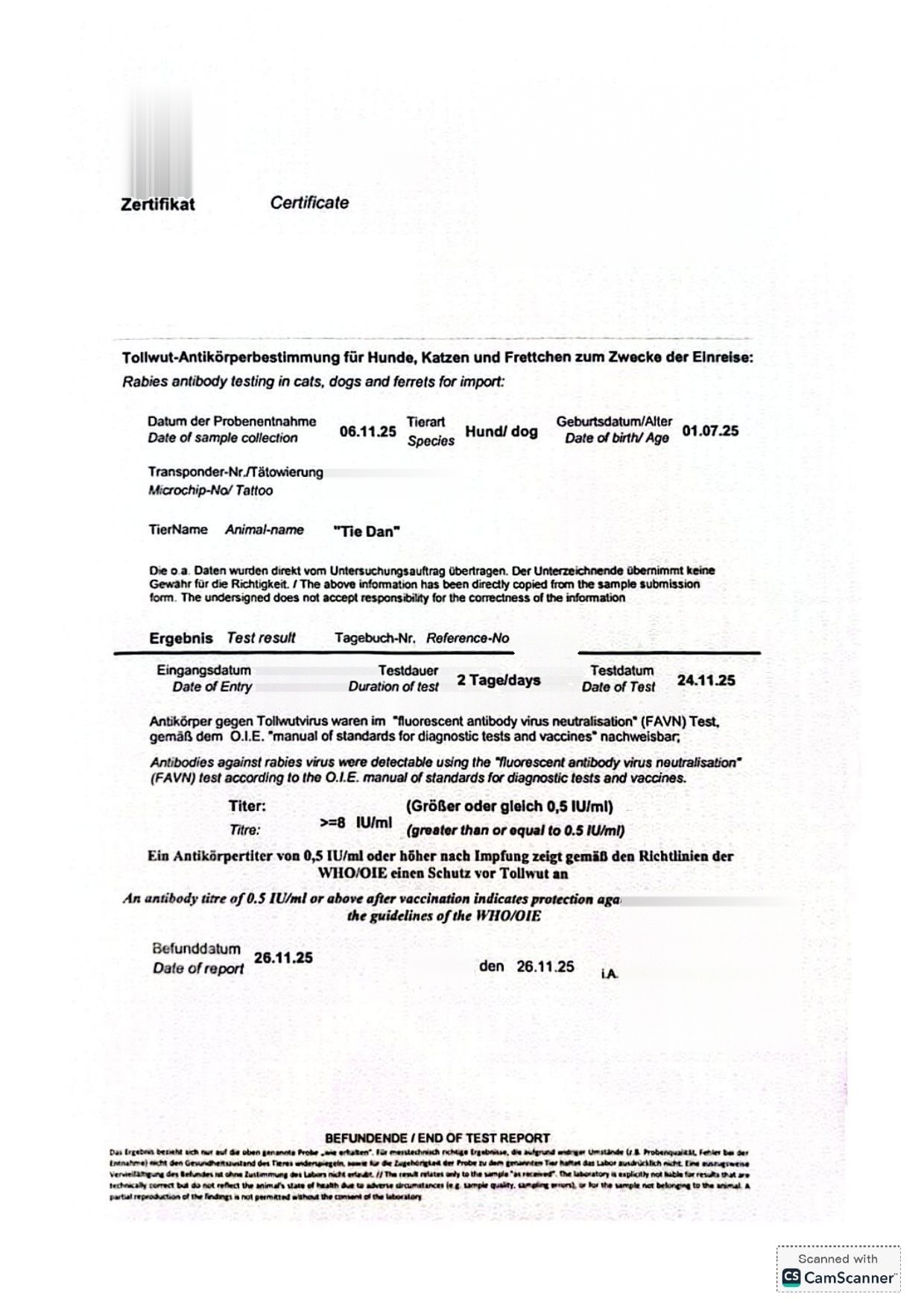
Daisy waits at least 30 days after the vaccination before taking blood, so antibodies have time to build. This 30-day gap is our working rule, not a number in Taiwan’s law. The result must reach at least 0.5 IU/ml.
The test must be done by a rabies reference laboratory of the World Organisation for Animal Health or a laboratory designated by APHIA. No laboratory in Vietnam is on that list, so the sample is sent abroad. Our rabies titer test guide explains the test itself.
Step 3 (When the Result Arrives): Choose How APHIA Receives It
Who: the laboratory, or Vietnam’s veterinary authority.
To skip quarantine, the blood test must be 180 days to 1 year old on arrival day. APHIA must also receive the result in one of two ways.
- 120-day route: the permit application is filed at least 120 days before arrival.
- 20-day route: the laboratory emails the report straight to rabiesreport@aphia.gov.tw, or Vietnam’s veterinary authority emails a signed test declaration. The application can then be filed as late as 20 days before arrival.
The inbox accepts one pet per email, with the microchip number as the subject. It sends an automatic reply. No reply means the email did not arrive. These rules are in APHIA’s import FAQ for dogs and cats.
Step 4 (By Day 91 or Day 191): Apply for the Import Permit
Who: the importer in Taiwan, or the person they authorize.
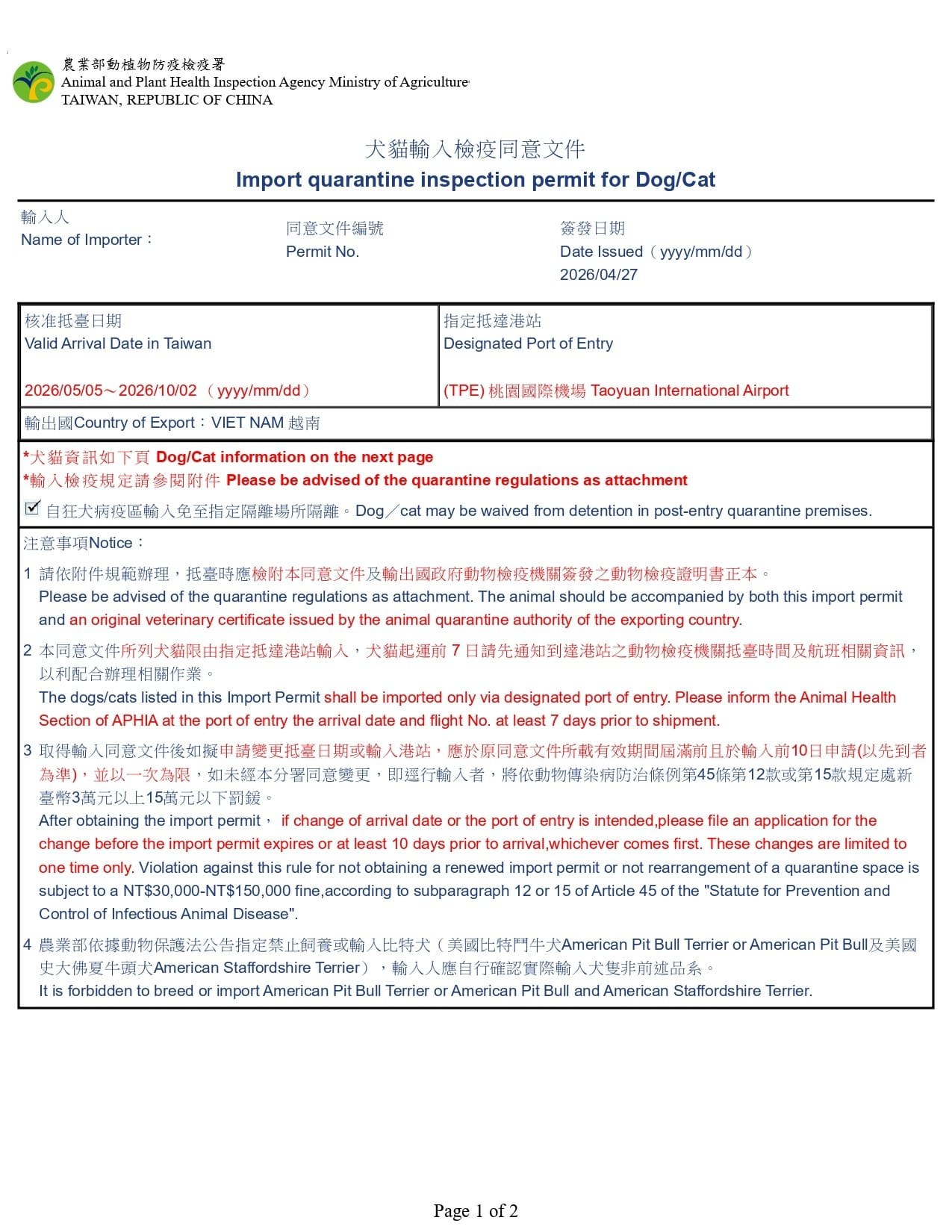
The application is filed online on APHIA’s dog and cat import permit system. There is no application fee. The form asks for the pet’s weight, length, microchip, vaccination dates and blood test date, with scans of each document.
The permit names one port of entry and a window of arrival dates. You can fly on any day inside that window. Since 5 January 2026, APHIA issues permits in a new format; the old format stops being valid on 1 January 2027. The form, field by field, is in our Taiwan import permit guide.
Step 5 (Days 191–204): Book the Flight and Notify APHIA
Who: you book the flight; Daisy books cargo if the pet flies alone.
Vietnam Airlines, EVA Air and China Airlines all fly non-stop between Vietnam and Taoyuan (TPE). EVA Air also flies to Kaohsiung (KHH). Each airline accepts pets differently.
- Vietnam Airlines: the only one of the three with a cabin option. Dogs and cats from 10 weeks old, under 6 kg with the carrier, carrier up to 35×30×20 cm. Heavier pets go as checked baggage up to 32 kg (Vietnam Airlines pet rules).
- EVA Air: no cabin. Checked baggage up to 45 kg, but not on Airbus A321 flights. Snub-nosed breeds are refused all year on flights to and from Southeast Asia.
- China Airlines: no cabin. Checked baggage only, and not on Boeing 737-800 or Airbus A321neo aircraft (China Airlines pet transport).
A pet that is too large for checked baggage, or flies without its owner, travels as cargo. The difference between the three ways is in our page on cabin, checked baggage and cargo.
Once the flight is booked, send APHIA’s branch at your port the arrival date and flight number. Do this at least 7 days before the pet leaves Vietnam, or earlier if your permit says so. Start crate training at least six weeks before the flight, as in our crate training guide.
Step 6 (Days 204–208): Export Health Certificate in Vietnam
Who: the regional animal health office at Noi Bai or Tan Son Nhat; Daisy files the request.
The office examines the pet and issues Vietnam’s export health certificate, Form 13a. It also signs Taiwan’s own certificate, Form 002, which carries the same certificate number. Taiwan sets no validity period for these certificates. In practice they are issued 3 to 7 days before the flight; in one May 2026 shipment to Taipei, they were issued 6 days before departure.
Daisy also treats every pet for internal and external parasites before departure. Taiwan does not require it.
Step 7 (Day 211 or Later): Arrival in Taiwan
Who: you, APHIA’s officer at the airport, and customs.
You take the pet to APHIA’s animal quarantine counter with three documents: the original export certificates, a copy of the permit, and your air waybill or customs declaration. The officer scans the microchip and compares it with every document. You pay a NT$100 processing fee in cash. You then declare the pet at customs through the red channel.
A pet that meets the quarantine-free conditions goes home with you the same day.
What Happens If the Pet Has to Stay in Quarantine?
A pet on the faster plan, or one that misses a quarantine-free condition, stays seven days at APHIA’s Guanyin station in Taoyuan. The permit already reserves the space. Inspection at the airport must be finished before 13:30 (12:30 at Taipei Songshan); otherwise the pet waits at the airport, and that waiting time does not count toward the seven days.
On a 2026 permit we handled, transport from Taoyuan to Guanyin cost NT$1,480 on weekdays and the seven-day stay cost NT$6,625. The full arrival process is in our guide to Taiwan pet quarantine.
What If a Date or Document Goes Wrong?
- Blood test under 90 days old: the pet is not refused on arrival. It stays in quarantine until 97 days after the blood sampling date.
- Species, sex or age wrong on the certificate: 30 days of quarantine.
- Microchip or certificate problem: no microchip, no original certificate, or a number that does not match. The pet can be returned, destroyed, or held in quarantine for a long period, depending on the case.
- Rabies vaccination expires during quarantine: APHIA gives a booster and the owner pays for it.
- New flight date: apply before the permit expires and at least 10 days before the new date. This change is allowed only once.
In one 2026 case, six cats from Hanoi were booked to land 104 days after their blood test. APHIA offered two choices: seven days of quarantine, or a later flight on or after the 180-day mark. The owner moved the flight to April, and all six landed without quarantine.
How Much Does Each Stage Cost?
The vet work and the blood test are paid in Vietnam in the first month. Airline fees are paid when the flight is booked. Taiwan’s fees are paid in cash on arrival. Price ranges for cats and dogs are in our pet relocation cost to Taiwan guide.
Can the Pet Come Back to Vietnam Later?
Yes. Vietnam does not require a blood test for pets arriving from Taiwan. The pet needs a valid rabies vaccination and an export certificate from APHIA, issued after an inspection at the branch for your departure airport. The steps are in our guide to bringing a pet from Taiwan back to Vietnam.
Frequently Asked Questions About the Vietnam to Taiwan Timeline
How long does it take to ship a pet from Vietnam to Taiwan?
At least 211 days from the rabies vaccination to arrive without quarantine, because the blood test must be 180 days old on arrival. With seven days of quarantine at Guanyin, the pet can arrive about 121 days after the vaccination.
Can my pet fly to Taiwan in the cabin from Vietnam?
Only on Vietnam Airlines, and only if the pet and carrier together weigh under 6 kg. EVA Air and China Airlines accept pets as checked baggage, not in the cabin.
When should the export health certificate be issued?
Usually 3 to 7 days before the flight. Taiwan sets no validity period for Form 13a and Form 002; the rabies vaccination and blood test dates are what must still be valid on arrival day.
Can I change the arrival date after the permit is issued?
Inside the arrival window on the permit, you do not need to ask. For a date outside it, apply before the permit expires and at least 10 days before the new date. You can change the date only once.
Is there a laboratory in Vietnam for Taiwan’s rabies blood test?
No. The test must be done by a rabies reference laboratory of the World Organisation for Animal Health or a laboratory designated by APHIA, and none is in Vietnam. The blood is taken in Vietnam and the sample is sent abroad.
Last updated 16 Oct 2026
Compiled by our specialists from the regulations in force on the date above, for reference only. Rules may change after this date. Please verify with the competent authorities or contact us for the most accurate information.
Official sources cited in this guide
- pet-epermit.aphia.gov.twpet-epermit.aphia.gov.tw
- Vietnam Airlines pet rulesvietnamairlines.com
- China Airlines pet transportchina-airlines.com