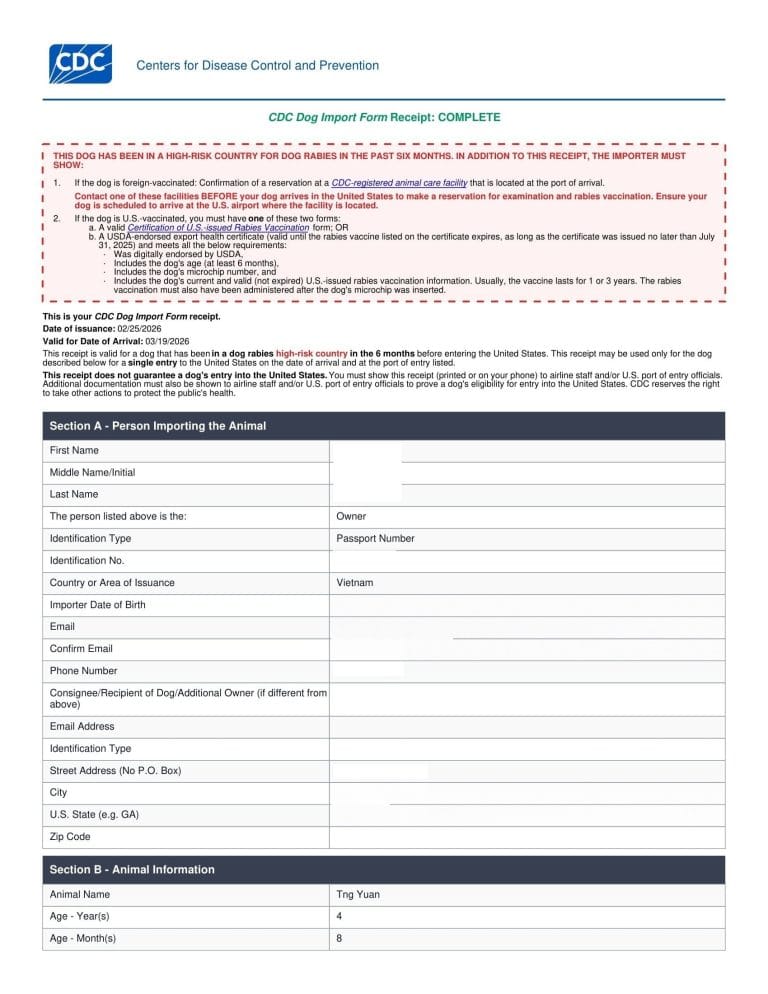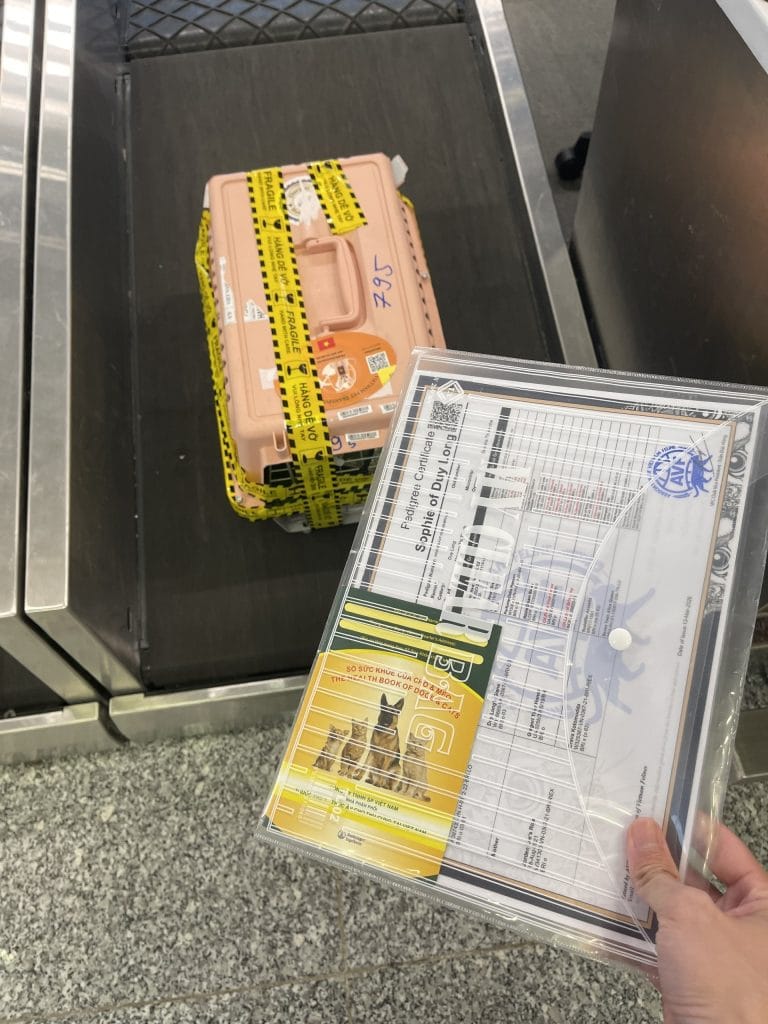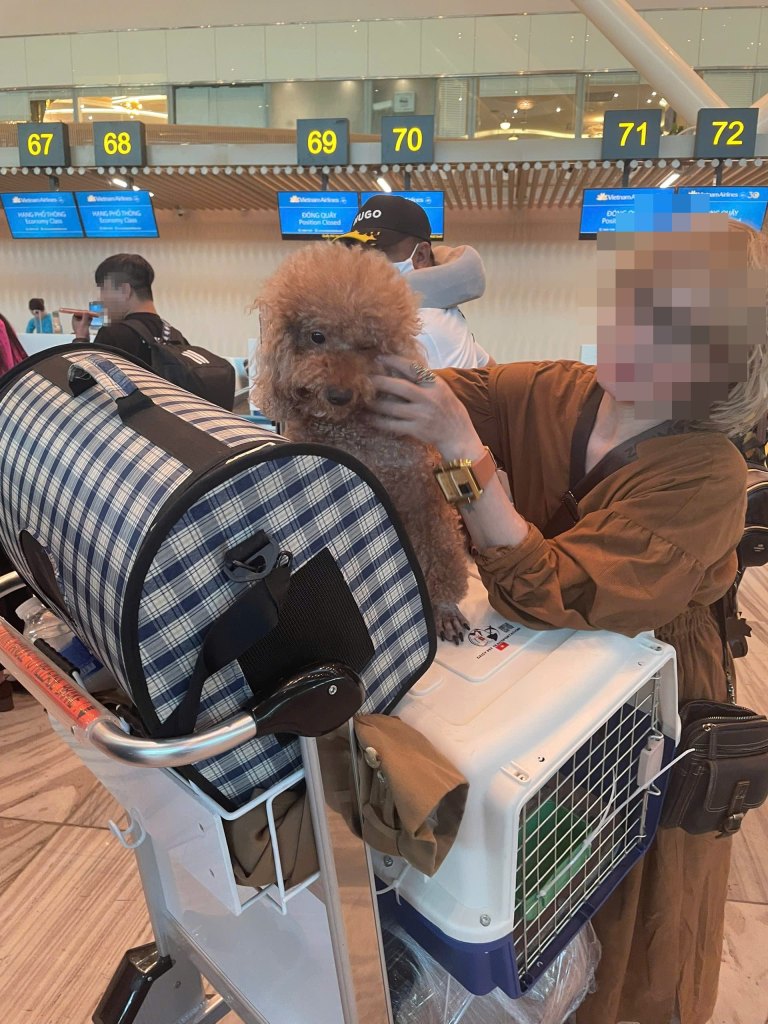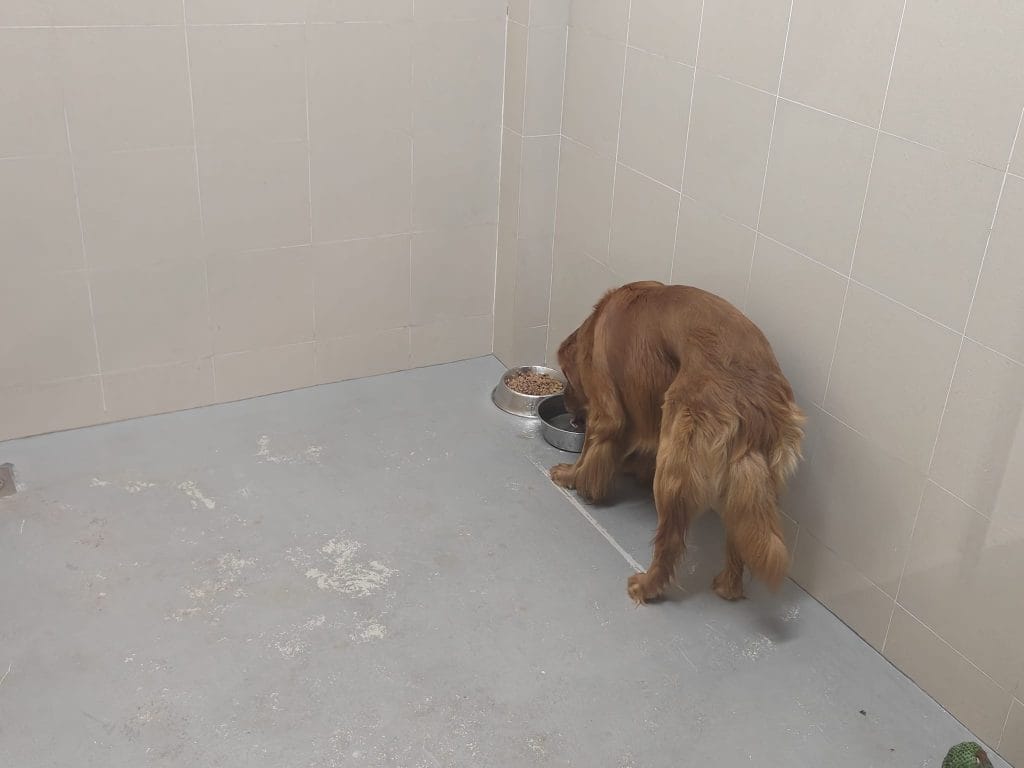
Dogs vaccinated in Vietnam — a CDC high-risk country for dog rabies — cannot simply land at any US airport. They must arrive at one of exactly eight airports that host a CDC-registered Animal Care Facility (ACF). To book a slot, you must first obtain your CDC Dog Import Form barcode receipt, then submit a reservation request to the facility — the exact method varies by ACF, from a structured online form to a simple email. This guide opens with the full list of the nine ACF facilities across eight airports, then walks through a real step-by-step example of the online booking form used by Rue’s Kennels at LAX, and covers what the ACF is and what to prepare beforehand.
The ACF reservation is one step in the full compliance chain for the Vietnam–USA route. For the complete regulatory overview, see our USA Pet Import Laws 2026 guide. For CDC form instructions (the step that comes before contacting the ACF), see our CDC Dog Import Form guide.
Part 1: The Eight CDC-Registered ACF Airports
As of 2026, there are eight airports in the United States that host CDC-registered Animal Care Facilities. Dogs from Vietnam must land at one of these airports — direct or connecting. Domestic connecting flights within the USA after clearing one of these airports are permitted, but the initial US landing must be at an ACF-equipped airport.
| Airport | IATA Code | ACF Facility Name | Notes |
|---|---|---|---|
| New York JFK | JFK | The ARK Pet Oasis | info@arkjfk.com | Largest and most frequently used for international pet cargo. China Airlines serves JFK from Vietnam via Taipei. Recommend booking at least 21 days in advance. |
| Los Angeles LAX | LAX | 2 separate facilities — choose either: Kennel Club LAX | Quarantine@kennelclublax.com | (213) 933-8935 Rue’s Kennels @ LAX | dogimportreservation@rueskennelsatlax.com | (310) 692-0843 |
Two independent facilities at the same airport; most used for flights from Asia via Pacific routing. EVA Air, China Airlines, and others serve LAX. |
| Miami MIA | MIA | Pet Limo at MIA | QSMiami@petlimo.com | (305) 889-8908 | Primarily used for Latin America and Caribbean routes. Limited direct flights from Vietnam transit options. |
| Atlanta ATL | ATL | Dandie Scottie Kennel | HighRiskImports@petsconnectatl.com | Serves the southeastern US. Korean Air offers ATL connections via ICN from Vietnam. |
| Philadelphia PHL | PHL | Gateway Animal Care Center | reservations@gatewayacc.com | (215) 516-5201 | Smaller facility. Limited direct cargo connections from Vietnam transit hubs. |
| Washington Dulles IAD | IAD | Pender Pet Retreat | acfreservations@penderpetretreat.com | (703) 537-7356 | Located in Northern Virginia. Dogs must land at IAD specifically — not Reagan National (DCA) or Baltimore (BWI). Along with ATL, one of only 2 airports where Korean Air accepts dogs vaccinated in Vietnam. |
| Dallas-Fort Worth DFW | DFW | DFW Pet Lounge & Quarantine | reservation@dfwpetlounge.com | (817) 393-3315 | Added to the CDC list in 2026. Dogs must land at DFW specifically. |
| Seattle SEA | SEA | Dog Gone Taxi | info@doggonetaxi.com | Added to the CDC list in 2026. Cargo-only reservations — dogs arriving in-cabin or as checked/excess baggage cannot use this facility. Exception: Dog Gone Taxi states that trained service dogs may still travel in-cabin with their handler, consistent with DOT’s Air Carrier Access Act protections for service animals — confirm directly with the facility before booking. |
For most Vietnam–USA shipments, JFK and LAX are the primary destinations due to the direct flight connections available from Seoul Incheon (ICN) and Taipei Taoyuan (TPE) hubs. ATL is a viable alternative for owners based in the southeastern US. For airline routing details, see our airlines for pet shipping Vietnam to USA guide.
Part 2: How to Make the ACF Reservation — Step by Step (Example: Rue’s Kennels, LAX)
The exact reservation process differs by facility. This walkthrough follows the real online form used by Rue’s Kennels, one of the two ACF facilities at LAX — the screenshots below are from an actual Daisy Pet booking (SGN–LAX, EVA Air, August 2026). The other seven ACF airports (JFK, MIA, ATL, PHL, IAD, DFW, SEA) likely run their own reservation systems, some by email rather than an online form. Always confirm the exact method with your specific facility — the information required is broadly the same everywhere, only the submission method differs.
Before You Start: What to Prepare
Gather everything below before opening the reservation form. Having it ready in one place avoids the back-and-forth that can cost you a slot during busy periods.
- Owner and passenger details: the owner’s full legal name, email, and phone number, plus the full name of the person physically accompanying the dog if different from the owner (as it appears on their ID).
- Origin and destination addresses: the full address in Vietnam and the full US address where the dog will reside.
- Flight details: confirmed arrival date, airline, and inbound flight number. Arriving within 72 hours of booking usually triggers a mandatory rush-processing fee, so book as early as possible.
- Per-dog details: name, microchip number, date of birth or approximate age, breed, weight, sex/neuter status, color/description, and any behavioral or medical concerns. There is no fixed limit on how many dogs can go on one reservation.
- Four photos per dog: a front-teeth (incisor) photo, a side-teeth (canine/premolar) photo, a full-body profile photo, and a face portrait. Why the teeth photos matter: dental development is one of the few things that cannot be falsified on paper. ACFs ask for these because some owners have submitted incorrect or altered age documentation in the past, and a dog’s true age is very hard to verify any other way — a puppy’s teeth look different from an adult dog’s regardless of what the paperwork claims.
- Documents: the CFRVMR (Certification of Foreign Rabies Vaccination and Microchip), the vaccination booklet or pet passport, the RNATT/FAVN titer lab report if available, a photo of the owner or passenger’s passport (and visa, if applicable — this is required for CBP release, not just the ACF), and the CDC Dog Import Form barcode receipt.
- A payment card for the non-refundable deposit (see Part 5).
Step-by-Step: The Online Reservation Form
Rue’s Kennels takes reservations through an online form at cognitoforms.com/VIV2/HighRiskRabiesReservationRequest. It has eight steps.
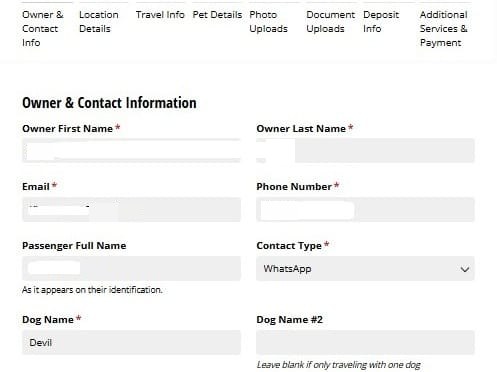
Step 1 — Owner & Contact Info
Enter the owner’s name, email, and phone, the passenger’s full name, a preferred contact method (WhatsApp, WeChat, or domestic text — this is the channel the facility will use to reach you on arrival day), and the dog’s name (add more dogs if travelling with additional ones — there is no fixed cap).
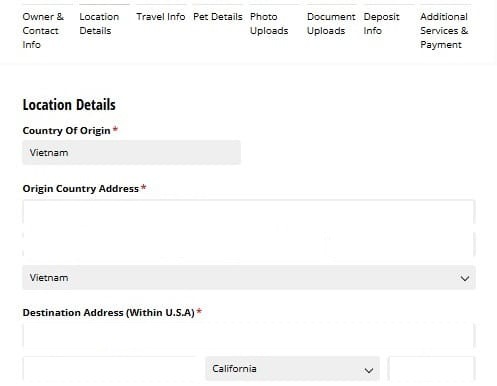
Step 2 — Location Details
Enter the full origin address in Vietnam and the full destination address in the USA.
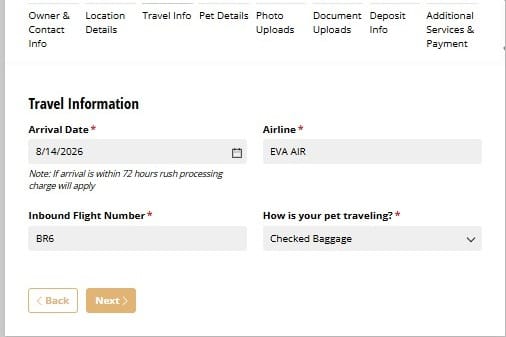
Step 3 — Travel Info
Enter the arrival date, airline, and inbound flight number, then select how the dog is travelling. The dropdown covers all standard methods — in-cabin, checked baggage, and manifest cargo — not just one.
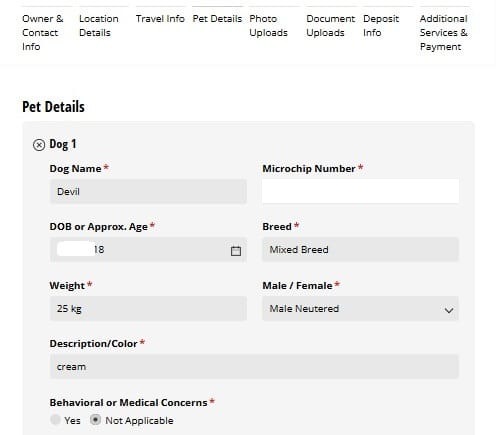
Step 4 — Pet Details
Enter the microchip number, date of birth or approximate age, breed, weight, sex/neuter status, color, and any behavioral or medical concerns for each dog on the reservation.
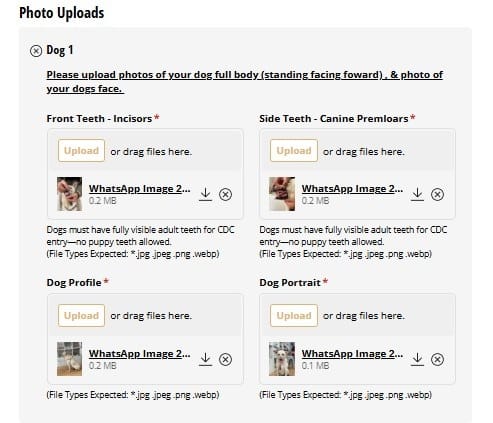
Step 5 — Photo Uploads
Upload the four required photos per dog: front teeth, side teeth, full-body profile, and portrait.
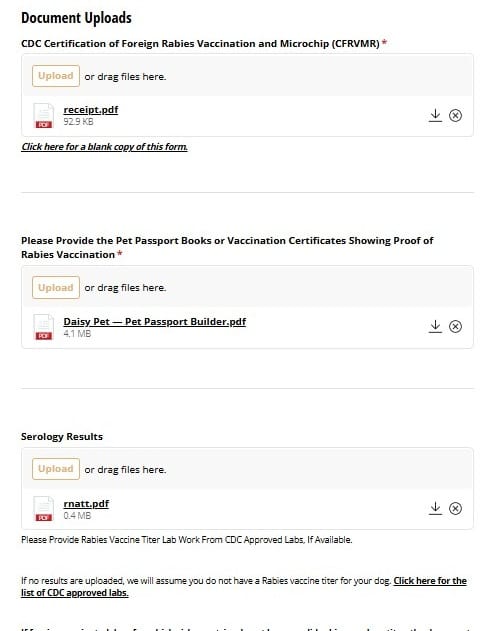
Step 6 — Document Uploads
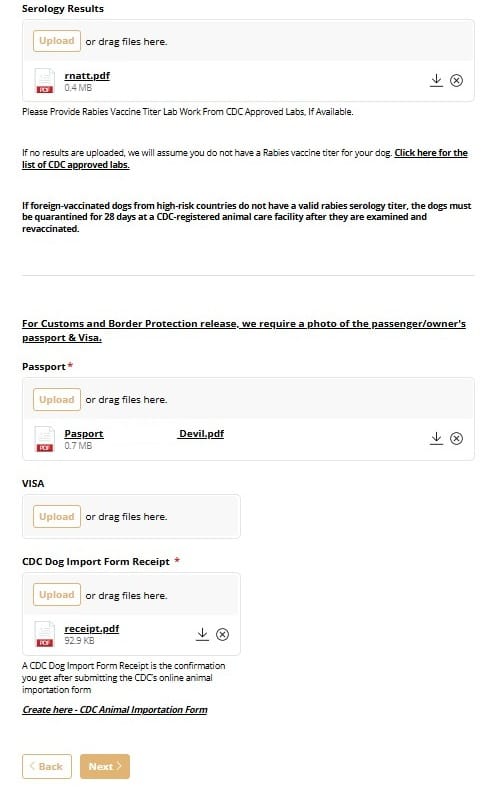
Upload the CFRVMR, the vaccination booklet or pet passport, and the RNATT/titer lab report. If you skip the titer result, the ACF will assume no valid titer exists and the reservation defaults to the 28-day quarantine pathway — upload it if you have it. Then upload a photo of the owner or passenger’s passport (and visa, if applicable) and the CDC Dog Import Form receipt.
Step 7 — Deposit Info
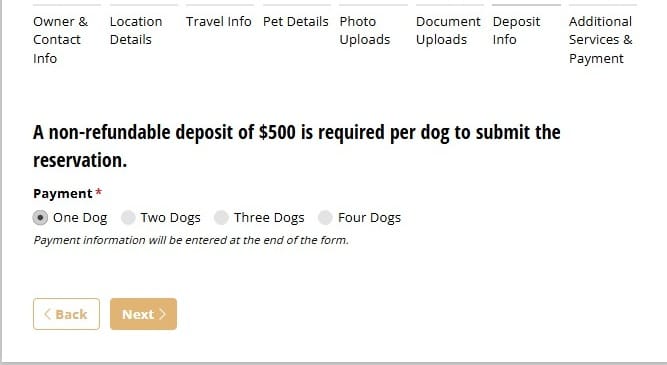
Select the number of dogs on the reservation. A non-refundable deposit of $500 per dog is required to submit the form. Confirm with the facility whether this deposit is credited toward the total inspection fee described in Part 5, or charged separately.
Step 8 — Additional Services & Payment
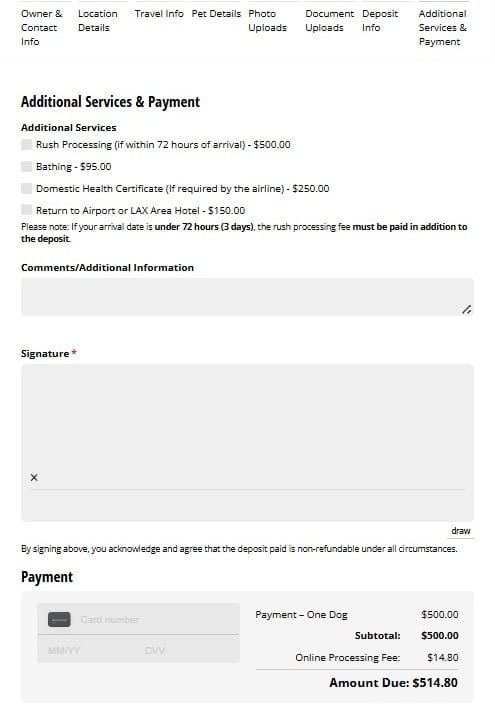
Choose any optional add-ons (see Part 5 for pricing), add comments if needed, sign digitally to confirm the deposit is non-refundable, and pay by card. An online processing fee (roughly 2.96%) is added on top of the deposit.
Once submitted, the facility reviews the reservation and confirms it in writing, typically by email. Keep this confirmation — you may be asked to present it to CBP on arrival.
Part 3: What the ACF Is and Why It Is Mandatory
A CDC-registered Animal Care Facility is a licensed animal holding and veterinary care facility located within the perimeter of a specific US airport. When a foreign-vaccinated dog from a high-risk country (which includes Vietnam) arrives in the USA, US Customs and Border Protection transfers the dog directly from the cargo area to the ACF for mandatory examination and rabies revaccination by a licensed veterinarian. The dog cannot be released to the owner until the ACF process is complete and CDC clearance is granted.
The ACF reservation is not a courtesy booking — it is a regulatory requirement. Without a confirmed reservation, CBP will not clear the dog through customs and the ACF will not receive the animal on arrival. The reservation must be in place before the dog departs Vietnam. The correct sequence is: obtain the CDC Dog Import Form barcode receipt first, then use that receipt together with the flight ticket and documentation to submit your reservation request — by online form or email, depending on the facility — and book the slot.
There are two distinct types of ACF stay, depending on whether the dog has a valid rabies serology titer:
- Inspection and revaccination (short stay): The dog has a valid FAVN/RNATT titer result ≥ 0.5 IU/mL from a CDC-approved laboratory. The ACF vet examines the dog, administers a US-issued rabies vaccination, and clears the dog — typically within a few hours of arrival.
- 28-day quarantine: The dog does not have a valid titer result. After examination and revaccination at the ACF, the dog must remain in quarantine for 28 days to allow the new vaccination to take effect and be verified. This significantly increases cost and complexity.
For dogs from Vietnam, completing the FAVN/RNATT titer test well in advance — at least 6 months before the planned departure date, since a 30-day waiting period after vaccination is required before the blood draw is valid — is the standard approach to avoid the 28-day quarantine pathway. See our FAVN/RNATT titer guide for the full protocol.
Part 4: Timing — 21 Days Minimum, 30+ Days Recommended
ACF facilities are not infinite in capacity. The eight designated airports serve all foreign-vaccinated dogs entering the entire United States from high-risk countries — including those arriving from South and Southeast Asia, Africa, Eastern Europe, and Latin America. During peak periods, slots at JFK and LAX fill weeks in advance.
The CDC and individual ACF facilities recommend beginning the outreach process at least 21 days before the intended arrival date. In practice, experienced pet relocation operators in Vietnam submit the CDC form and target the ACF email 30–45 days ahead to allow flexibility if the first-choice facility is full. If the preferred airport’s ACF is unavailable for the target date, the entire routing — airline, transit hub, and final US destination — may need to be adjusted.
Plan the ACF timing early — even before the CDC form is submitted. Once you have your barcode receipt in hand, you should be ready to email the ACF immediately with the full document package. Delays in the ACF email after receiving the receipt are avoidable and can compress your pre-departure timeline unnecessarily.
Part 5: Costs at the ACF
ACF fees are charged directly by the facility and are not included in standard airline cargo rates. The costs vary by facility, dog size, and length of stay. ⚠️ The deposit, add-on fees, and warehouse fee below are documented specifically from Rue’s Kennels at LAX. Daisy Pet does not yet have confirmed fee schedules for the other seven ACF airports (JFK, MIA, ATL, PHL, IAD, DFW, SEA) — treat these figures as an LAX example, not a nationwide standard, until we have data from another facility.
- Inspection and revaccination (same-day or overnight): Typically USD 1,000–1,500 — this is the CDC third-party inspection fee charged directly by the ACF facility, and it applies to every dog from a high-risk country regardless of how quickly it is released. The fee covers the veterinary examination, US-issued rabies vaccination, and holding until CDC clearance is granted.
- 28-day quarantine: Significantly higher — typically USD 2,000–5,000 or more depending on the facility, the dog’s size, and the full 28-day boarding period. This cost is in addition to the flight, cargo handling, and all other shipment fees.
- Reservation deposit: Rue’s Kennels (LAX) requires a $500 non-refundable deposit per dog, paid by card when the reservation form is submitted, plus a small online processing fee (roughly 2.96%). Confirm with your specific facility whether this deposit is credited toward the inspection fee above.
- Optional add-ons (Rue’s Kennels example): Rush Processing $500 (mandatory if arrival is within 72 hours), Bathing $95, Domestic Health Certificate $250 (if a connecting airline requires one), and Return to Airport or a LAX-area Hotel $150.
- Airline cargo warehouse fee (accompanied dogs only, In-Cabin/Checked Baggage): a separate charge of roughly $300–500, paid to the airline’s cargo warehouse before the ACF can release the dog — a CBP policy change confirmed at LAX in September 2026. This does not apply to manifest cargo. See our arrival process guide for details.
For a full breakdown of all costs associated with the Vietnam–USA route, including ACF fees in context, see our USA pet shipping cost guide 2026.
Part 6: What Happens at the ACF on Arrival Day
When the cargo flight lands at the US airport, the Air Waybill and CDC barcode receipt are transferred to CBP. CBP scans the barcode, cross-references the dog’s details, and confirms the ACF reservation is in place. The dog’s crate is then transported under CBP supervision directly to the ACF — owners cannot access the dog in the cargo terminal before ACF clearance.
At the ACF, a licensed veterinarian examines the dog for signs of illness, verifies microchip number against documentation, and administers a US-issued rabies vaccination (required regardless of prior vaccination history). If the titer result is valid, CDC clearance is typically granted within a few hours and the dog is released to the owner or freight forwarder. This describes the manifest cargo pathway. If the dog is travelling In-Cabin or as Checked Baggage, an additional step now applies: as of September 2026, the dog is first sent to the airline’s cargo warehouse rather than being handed to the ACF at the terminal, adding a separate airline handling fee (see Part 5). For the full account of both pathways from landing to release, see our guide on what happens when your dog arrives at the US airport.
Managing the ACF Booking as Part of a Full Relocation
At Daisy Pet, we submit the CDC Dog Import Form first to obtain the barcode receipt, then immediately assemble the required photos and documents and complete the reservation with the chosen facility — whether that means an online form like the one above or an email package. We select the appropriate facility based on the owner’s US destination and confirm the slot in writing before departure is finalised. Owners do not need to navigate ACF facilities independently; the ACF booking is one step in our end-to-end pet shipping from Vietnam to the USA service.
========
Last updated 15 Oct 2026
Compiled by our specialists from the regulations in force on the date above, for reference only. Rules may change after this date. Please verify with the competent authorities or contact us for the most accurate information.
Official sources cited in this guide
- The ARK Pet Oasisarkjfk.com
- Kennel Club LAXtailwindglobalpet.com
- Rue’s Kennels @ LAXcognitoforms.com
- Pet Limo at MIApetlimo.com
- Gateway Animal Care Centergatewayacc.com
- Pender Pet Retreatpenderpetretreat.com
- DFW Pet Lounge & Quarantinedfwpetlounge.com
- Dog Gone Taxidoggonetaxi.com