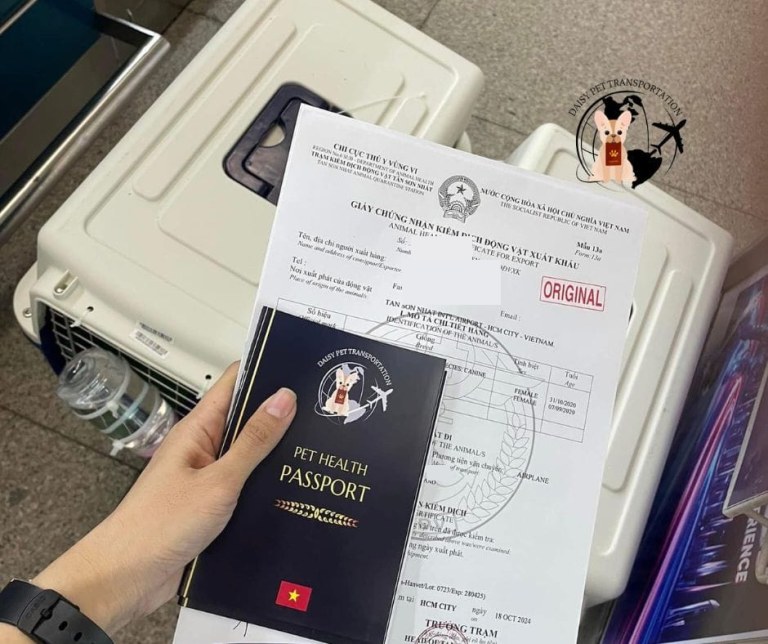
An animal health certificate is the government document that lets a dog or cat leave Vietnam. In Vietnam it is Form 13a (Mẫu 13a), issued by the animal quarantine station at the departure airport. A government vet issues it after examining the pet and scanning its microchip.
It is the last document in the file. The application goes in about 3–7 days before the flight, once every vaccine, test and permit is done.
Quick answers about the animal health certificate
- What is it? Form 13a, the Animal Health Certificate for Export. It states that the pet showed no sign of contagious disease on the day of shipment.
- Who issues it? The airport animal quarantine station: Tan Son Nhat in Ho Chi Minh City, Noi Bai in Hanoi. A private clinic cannot issue it.
- When do you apply? About 3–7 days before the flight, with the application Form 2a (Mẫu 2a).
- How long is it valid? The destination’s limit decides. The EU allows 10 days to its border check, and Singapore 7 days from issue.
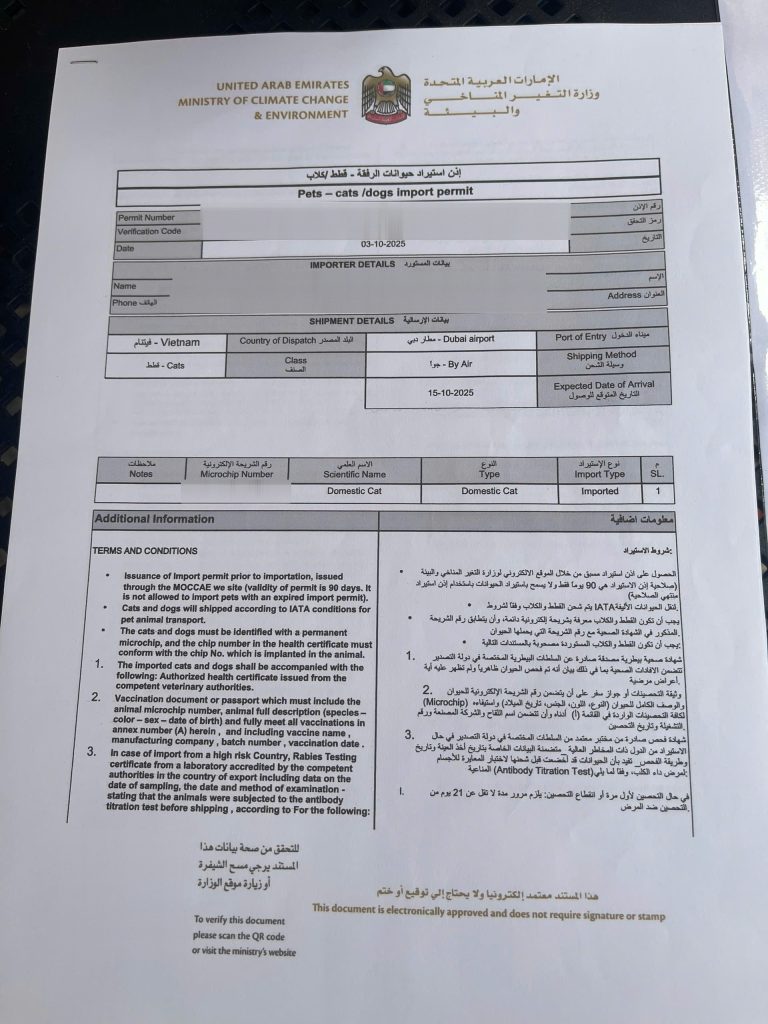
- Is it enough on its own? Often not. The UAE, Taiwan, Japan, the EU, the UK and the US each add their own form.
What is an animal health certificate, and how is it different from other pet papers?
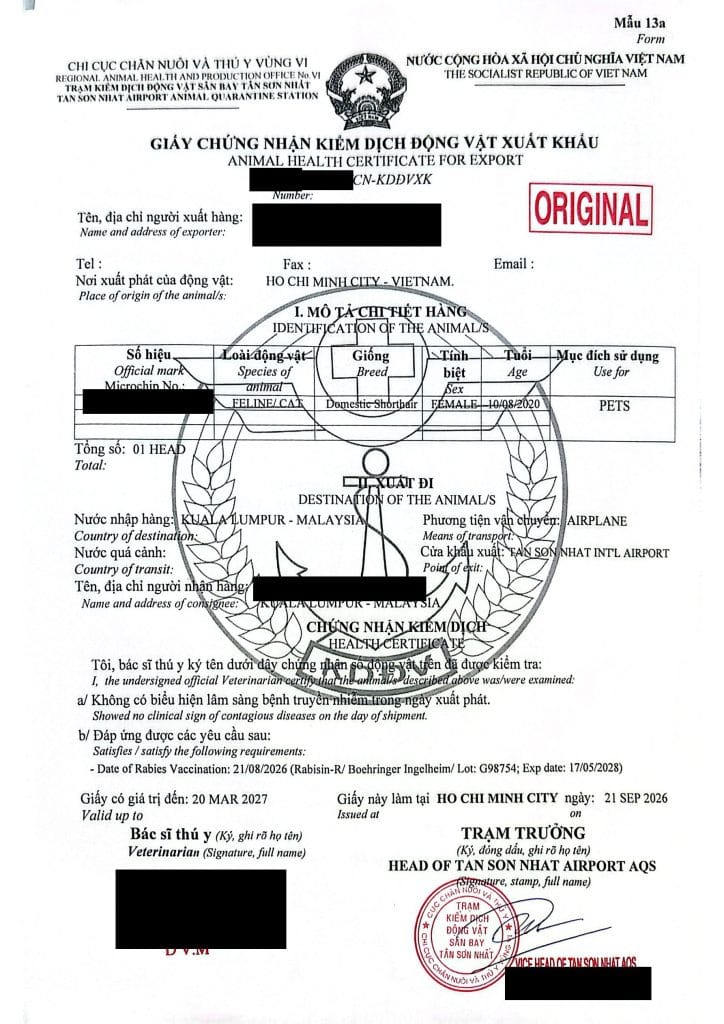
Form 13a is a bilingual Vietnamese–English certificate. The government vet certifies two things on it. First, the pet showed no clinical sign of contagious disease on the day of shipment. Second, the pet meets the requirements listed in section b/, such as the rabies vaccination date and the rabies antibody result.
Owners often confuse it with other papers in the file. Each one has a different job.
| Document | Issued by | Its job in the export file |
|---|---|---|
| Form 13a (export animal health certificate) | Airport animal quarantine station, Vietnam | The government certificate the airline and the destination check |
| Destination’s own form (EU certificate, Japan Form AC, UAE Annex 3, Taiwan Form 002) | A vet fills it in; the Vietnamese government vet signs and stamps it | Proves the destination’s own conditions, alongside the government certificate |
| Clinic health check | A licensed private vet | Medical examination that supports the government certificate |
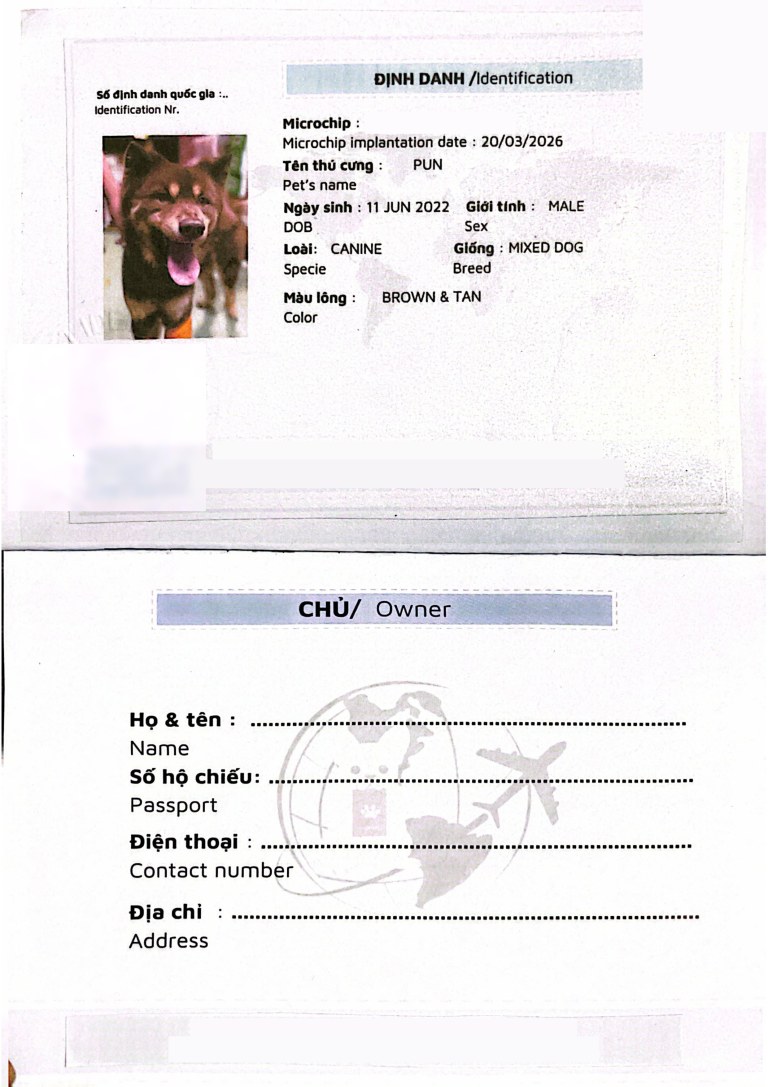
| Vaccination booklet | The vet clinic | Vaccine history and microchip number; a supporting document only |
| EU pet passport | Vets inside the EU, for pets of EU residents only | Not available to pets living in Vietnam; they travel on a health certificate |
Who issues the animal health certificate in Vietnam?
The certificate comes from the animal quarantine station at the airport the pet flies from. Each station belongs to a regional office of the Department of Livestock Production and Animal Health (Cục Chăn nuôi và Thú y).
- Ho Chi Minh City (SGN): Tan Son Nhat Airport Animal Quarantine Station, 521/1 Hoang Van Thu, Tan Son Nhat Ward, Ho Chi Minh City. It belongs to Regional Animal Health and Production Office No. VI (Chi cục Chăn nuôi và Thú y vùng VI).
- Hanoi (HAN): Noi Bai Airport Animal Quarantine Station, at Noi Bai International Airport. It belongs to Regional Animal Health and Production Office No. I (Chi cục Chăn nuôi và Thú y vùng I).
- Da Nang (DAD): the regional animal health office that covers Da Nang airport.
A private clinic’s stamp is not a government certificate. Clinics do the medical work before export. In Ho Chi Minh City, Daisy Pet clients have this examination done at Belwee International Animal Hospital (Go Vap), a licensed veterinary hospital; Daisy Pet prepares the forms for the veterinarian’s signature. See who does what in the process.
What has to be done before you can apply?
The quarantine station checks what is already in the file. It cannot add a missing step. Finish each item below, in this order, before the application goes in. The complete document checklist for leaving Vietnam shows how each paper fits.
- Microchip: an ISO 11784/11785 chip, implanted before or on the same day as the rabies vaccine. Our microchip guide for international travel explains the order.
- Rabies vaccine: given after the chip. Its date, product and batch go onto the certificate.
- Rabies antibody test, if required: the result must be in hand before you apply. Some destinations add a wait after the blood draw, such as 180 days before arrival in Japan. See the rabies titer test process.
- Destination approval, if required: an import permit or an advance notice, such as Japan’s notice at least 40 days before arrival. Our pet import permit guide lists who asks for one.
- Parasite treatment: inside the destination’s time window where one applies. Daisy Pet treats every pet for internal and external parasites before export, whether or not the destination asks.
How do you get Form 13a? Four steps and who does each one
The work runs over roughly the last 10 days before the flight.
Step 1 (about 10 days before the flight): prepare the destination’s form and the vet check
Who does it: the owner or their agent, with a licensed vet.
Each destination form must be the current version and filled in before the government vet signs it. A licensed vet examines the pet and completes the medical sections. Japan’s Animal Quarantine Service (AQS) suggests emailing a draft of Form AC before the government endorsement. After endorsement, only the exporting government can correct it.
Step 2 (3–7 days before the flight): file Form 2a
Who does it: the owner or their agent.
Form 2a (Mẫu 2a) is the application for export animal quarantine. It goes to the airport quarantine station with these documents:
- The original vaccination booklet showing the microchip number.
- A copy of the owner’s passport.
- The original rabies antibody test report, if the destination requires one.
- The destination’s own certificate form, and its import permit if there is one.
Step 3 (after filing): the government vet examines the pet
Who does it: the government vet at the quarantine station. The owner or agent brings the pet.
The vet scans the microchip and compares the number with every document. The vet then checks the pet for signs of contagious disease. A sick pet or a chip that does not match stops the process here.
Step 4 (a few days before the flight): receive Form 13a and check every line
Who does it: the station issues the certificate. The owner or agent checks it.
The station issues Form 13a and signs and stamps the destination’s form at the same time. Under Circular 01/2026/TT-BNNMT, each certificate comes as 3 originals and 2 copies, stamped “ORIGINAL” or “COPY” in red. The office keeps 1 original and the owner receives 2. The owner pays the state quarantine fee.
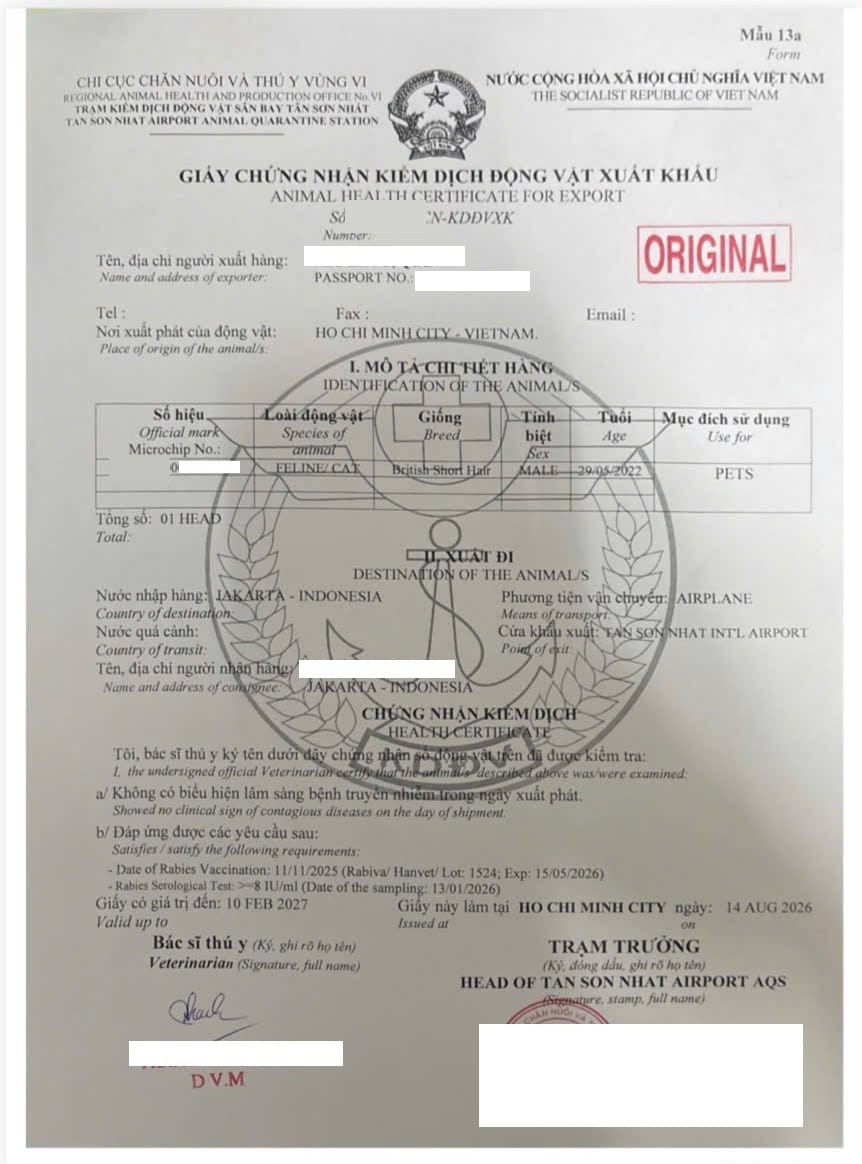
Before leaving the office, compare the chip number, dates and owner name on every page. On flight day, carry the originals in hand luggage. The airline checks them at check-in, so make sure every original comes back to you.
How long is an animal health certificate valid?
Two dates matter. Vietnam prints a “Valid up to” date on each certificate. A cat certificate issued in Ho Chi Minh City on 21 September 2026 showed 20 March 2027, about 6 months later. The destination’s own limit is usually much shorter, and that limit sets your dates.
| Destination | Time limit for the health certificate |
|---|---|
| European Union | 10 days from issue to the check at the EU entry point, then up to 6 months for travel inside the EU |
| Japan | Vet examination within 10 days before departure |
| Singapore | Certificate within 7 days of issue when the pet arrives |
| China | Examination and certificate within 14 days before arrival |
| United Kingdom | Great Britain pet health certificate: 10 days from issue to arrival |
| United States (dogs) | Parasite and screwworm inspection by a government vet within 5 days before export |
| Taiwan | No limit set by Taiwan; the vaccine and blood-test dates must still qualify on arrival |
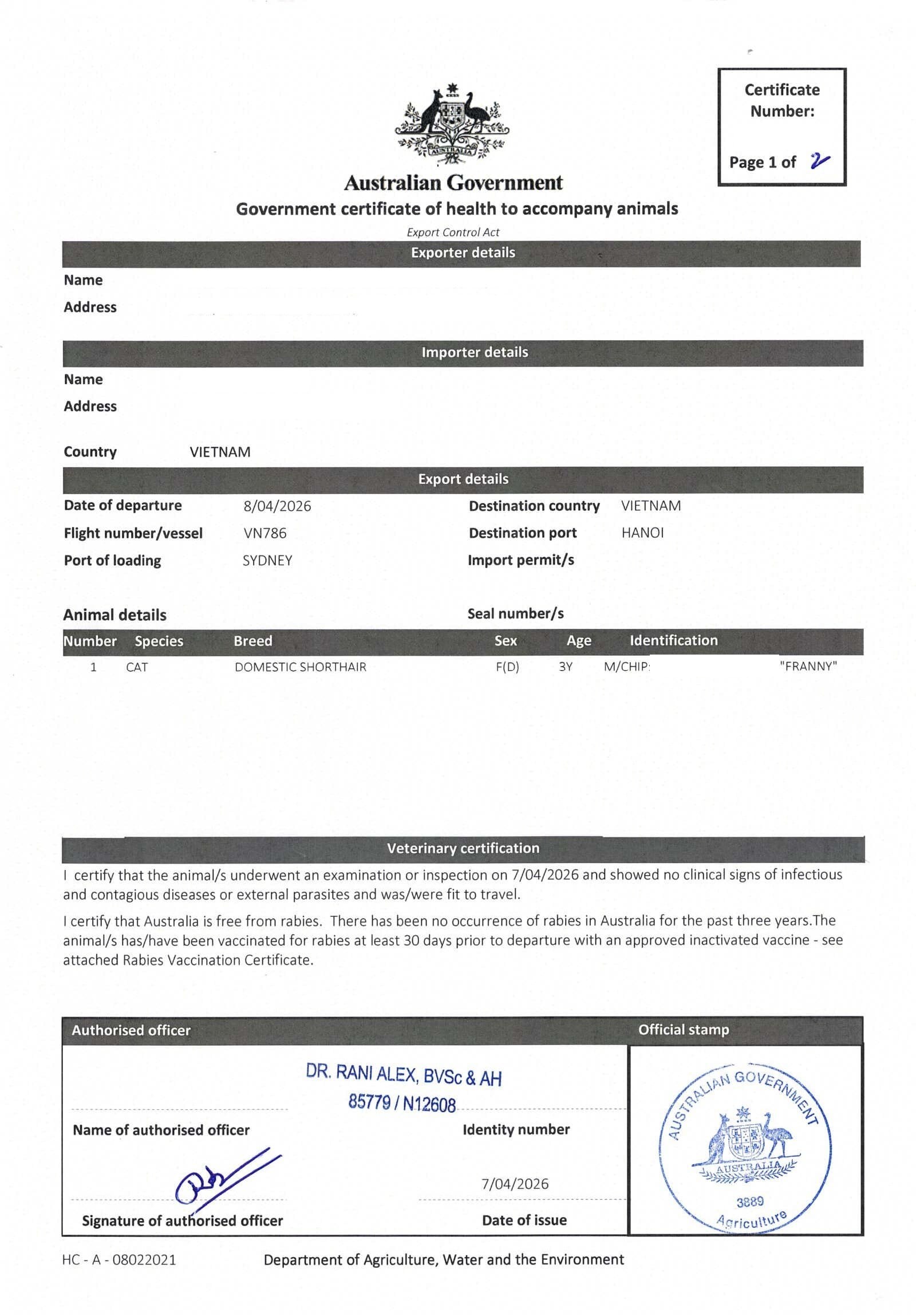
| Australia | No direct export from Vietnam; the certificate is issued in the approved country where the pet lived, within 5 days before export |
Cats entering the United States need no federal health certificate. Most airlines still ask for one issued within 10 days of the flight. Official sources: European Commission, Japan MAFF, US CDC and Australia DAFF.
Which destinations add their own form to Form 13a?
Many destinations accept Form 13a only together with their own form. The Vietnamese government vet signs and stamps that form at the same time.
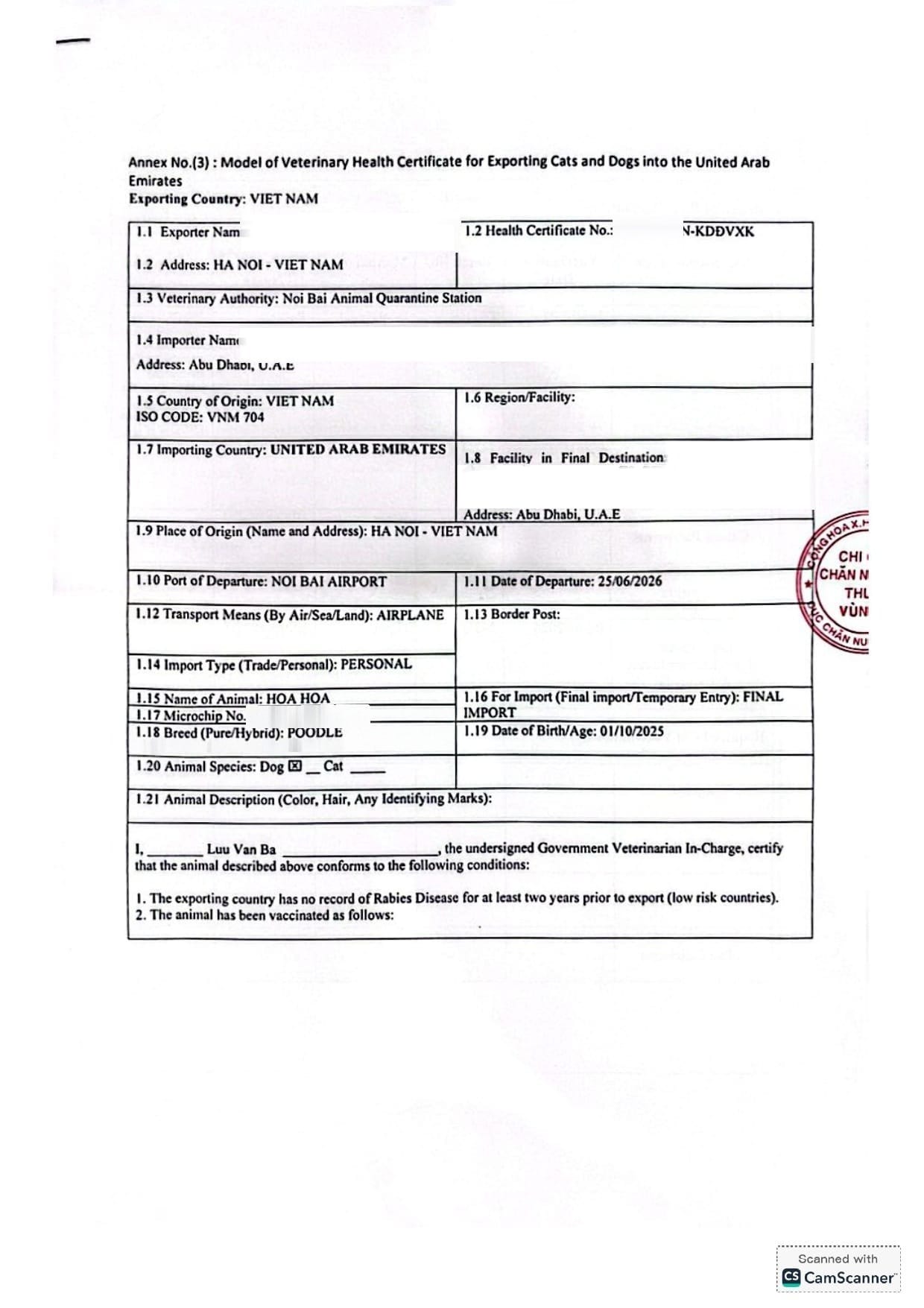
- UAE: Annex 3, the model health certificate of the Ministry of Climate Change and Environment (MOCCAE). It is printed after the import permit is issued and needs a wet stamp. On a Hanoi file in June 2026, it named Noi Bai Animal Quarantine Station as the veterinary authority.
- Taiwan: Form 002. On a Hanoi file in May 2026, it carried the same certificate number as Form 13a.
- European Union: the animal health certificate in Annex III of Regulation (EU) 2026/705. It must use a language of the first EU country the pet enters, plus English.
- Japan: Form AC. A vet fills it in, and the government vet endorses it with a signature, office name, stamp and date.
- United Kingdom: the Great Britain pet health certificate.
- United States (dogs): the Certification of Foreign Rabies Vaccination and Microchip, stamped by the regional office together with the health certificate.
What gets an animal health certificate rejected?
- A chip number with one wrong digit. In October 2026, a clinic’s parasite treatment certificate in a Daisy Pet file showed the chip number with one wrong digit. It was caught before the flight. Read every digit on every page, not only on the government certificate.
- An owner name that differs from the passport. The name on vaccine records and certificates must match the passport of the person flying.
- A missing test result. The certificate lists the rabies antibody result for destinations that require it. The result has to exist before you apply.
- A certificate issued too early. A certificate that is still valid in Vietnam can be too old for the EU, Singapore or Japan.
- A correction after endorsement. Japan accepts corrections only from the exporting government, with a new endorsement.
- The wrong language. The EU certificate must include a language of the first EU country of entry.
Two Daisy Pet files: Ho Chi Minh City to Kuala Lumpur, and Hanoi to Taipei
A cat flew in the cabin from Ho Chi Minh City to Kuala Lumpur on Vietnam Airlines VN679 on 23 September 2026. Tan Son Nhat Airport Animal Quarantine Station issued Form 13a on 21 September, 2 days before the flight. Section b/ listed one requirement: the rabies vaccination of 21 August 2026, with vaccine name, batch and expiry. The Malaysian import permit was already in the file.
A dog flew from Hanoi to Taipei on 20 May 2026. The regional office in Hanoi issued Form 13a and Taiwan’s Form 002 on 14 May, under one certificate number. Form 13a showed a “Valid up to” date of 9 November 2026. Taiwan sets no time limit of its own, so issuing 6 days early caused no problem.
Bringing a pet into Vietnam: which health certificate do you need?
The direction reverses. The pet needs an export health certificate from the government vet authority of the country it leaves, such as a USDA-endorsed certificate from the United States. A clinic certificate without a government stamp is not accepted.
Daisy Pet files Form 3 (Mẫu 3) with the arrival airport’s quarantine station about 48 hours before landing. The station inspects the pet on arrival and issues Form 15a (Mẫu 15a), the import quarantine certificate. Our page on bringing pets to Vietnam covers the full process.
FAQ about the animal health certificate
Is a vet clinic’s health certificate enough to fly a pet out of Vietnam?
No. The airline and the destination need the government’s Form 13a. A clinic certificate supports it but does not replace it.
How many days before the flight should I apply for Form 13a?
Daisy Pet files Form 2a about 3–7 days before the flight. Check the destination’s limit first: the EU allows 10 days to its border check, and Singapore 7 days from issue.
Is a veterinary certificate the same as an animal health certificate?
In pet travel, the two terms usually mean the same document: the government-signed health certificate for export. In Vietnam it is Form 13a.
Who issues the animal health certificate in Ho Chi Minh City?
Tan Son Nhat Airport Animal Quarantine Station, 521/1 Hoang Van Thu, Tan Son Nhat Ward. It belongs to Regional Animal Health and Production Office No. VI.
Does my cat need a health certificate to enter the United States?
Not under federal rules. Most airlines still ask for one issued within 10 days of the flight, and some states have their own rule.
Last updated 18 Oct 2026
Compiled by our specialists from the regulations in force on the date above, for reference only. Rules may change after this date. Please verify with the competent authorities or contact us for the most accurate information.
Official sources cited in this guide
- European Commissionfood.ec.europa.eu
- Japan MAFFmaff.go.jp
- US CDCcdc.gov
- Australia DAFFagriculture.gov.au