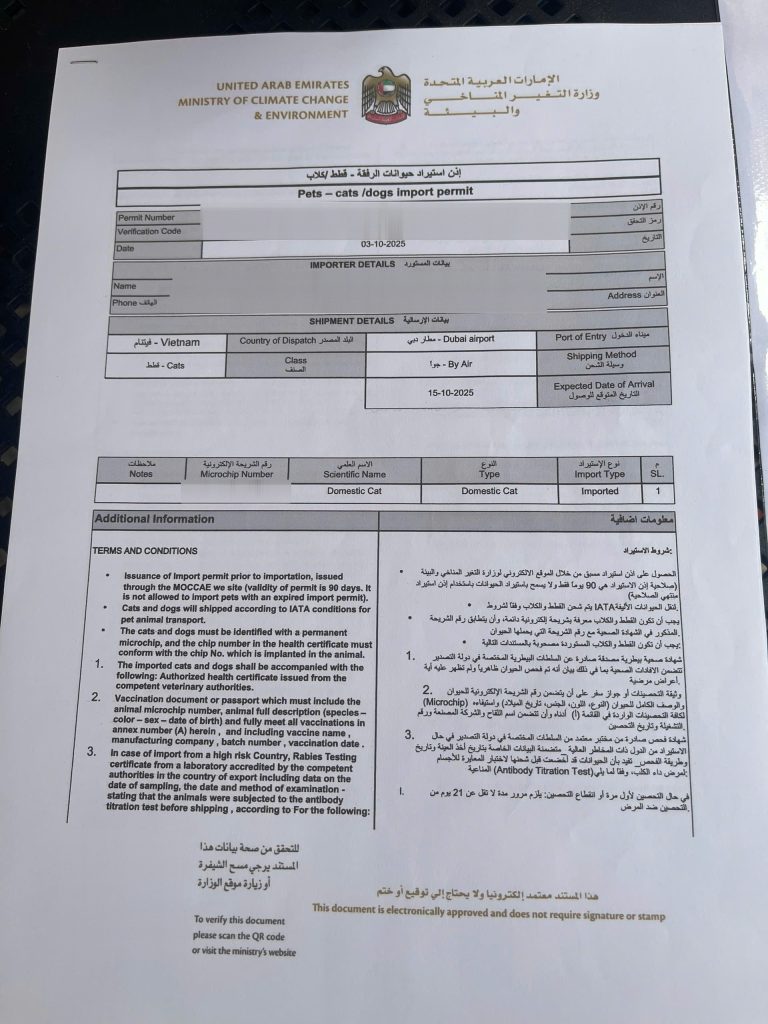
A pet import permit is the destination government’s written approval for one specific pet to enter, issued before the pet flies. Not every country uses one.
From Vietnam, the UAE, Taiwan, Singapore, Malaysia, Laos, Thailand, Indonesia and Hong Kong issue permits. Japan wants an advance notice instead. The EU, the UK, South Korea, China and the US issue no import permit for a pet dog or cat.
Quick answers about the pet import permit
- What is it? The destination’s approval for a named pet, tied to its microchip number. It is issued in the destination, not in Vietnam.
- Who needs one? Pets going to the UAE, Taiwan, Singapore, Malaysia, Laos, Thailand, Indonesia, Hong Kong or Australia.
- How long does it take? From 1 day in Malaysia to 20–40 working days in Australia.
- When can I book the flight? After the permit is approved and its dates fit the flight.
- Does it expire? Yes. The UAE permit lasts 90 days, Malaysia’s 30 days, and the Laos permit in one 2026 file only 15 days.
What is a pet import permit, and how is it different from a health certificate?
The import permit and the health certificate come from different governments and do different jobs.
- Import permit: issued by the destination before departure. It says the destination agrees to receive this pet, at this airport, within these dates.
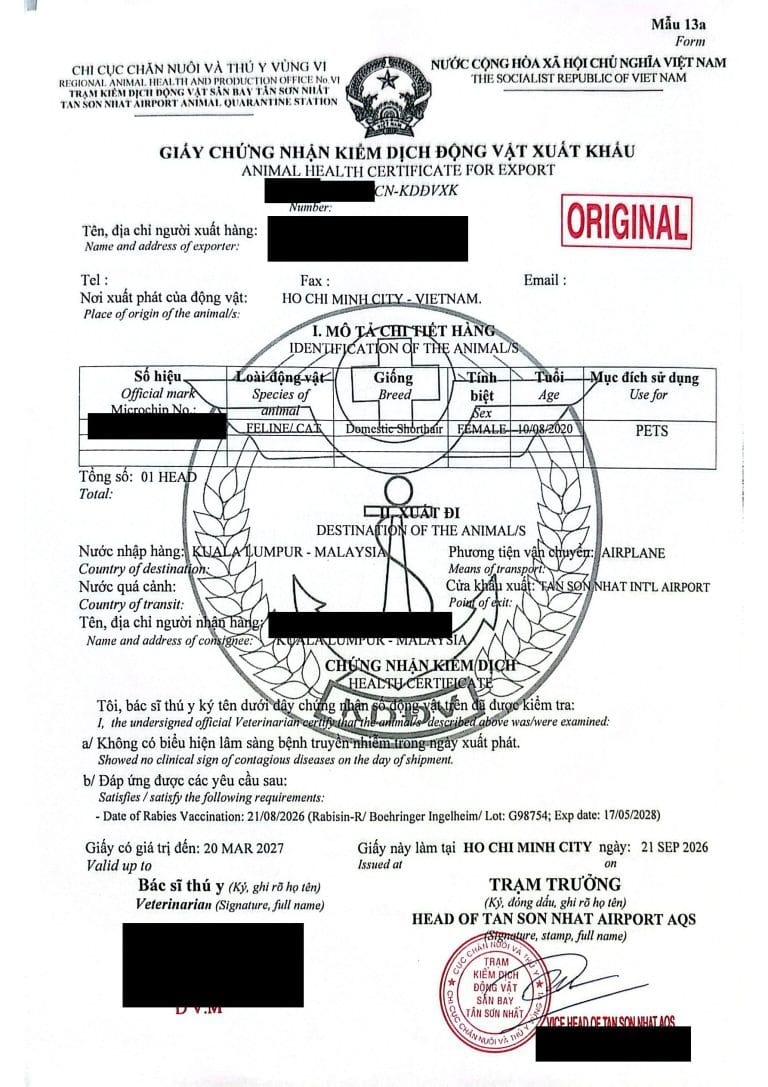
- Health certificate: issued by Vietnam a few days before the flight. It says the pet is healthy and meets the destination’s conditions. In Vietnam it is Form 13a. Our animal health certificate guide covers how it is issued.
One cannot replace the other. A destination that requires a permit can refuse a pet with a perfect health certificate but no permit.
Why do some countries want approval before the pet flies?
A permit lets the destination check a pet on paper before it arrives, rather than at the border. Three reasons explain why some countries insist on it.
- Disease control: Vietnam is a high-rabies-risk origin for most destinations. The permit lets officials confirm the vaccine and blood test before the pet travels.
- Quarantine space: Australia admits pets only through the Mickleham facility, and Taiwan’s quarantine station is at Guanyin. Space is planned before arrival.
- Case-by-case review: breed, origin and route can change the answer. Taiwan’s permit, for example, prints the ban on American Pit Bull Terriers.
A pet that arrives without a required permit can be refused, held in quarantine or sent back at the owner’s cost. Our article on what happens when a pet is denied entry explains each outcome.
Which countries require a pet import permit for pets from Vietnam?
The table lists destinations Daisy Pet files for most often. Rules change, so the issuing authority’s site is the final word.
| Destination | What you need | Issued by | Timing and validity |
|---|---|---|---|
| UAE | Import permit, plus a release permit paid on arrival | Ministry of Climate Change and Environment (MOCCAE) | AED 200 per pet; valid 90 days from issue |
| Taiwan | Import quarantine permit with an arrival window and a set airport | Animal and Plant Health Inspection Agency (APHIA) | Apply at least 20 days before arrival; free |
| Singapore | Pet licence (PALS), then an import licence | Animal and Veterinary Service, through GoBusiness | Apply at least 30 days ahead; S$50 (S$100 express); valid 90 days |
| Malaysia | Import permit, after booking quarantine space | MAQIS, through a licensed import agent | RM5 per pet; issued in about 1 day; valid 30 days |
| Laos | Animal importation permit | Department of Livestock and Fisheries | About 5 working days once the file is complete |
| Thailand | Import permit | Department of Livestock Development (DLD) | Apply at least 7 working days ahead |
| Indonesia | Import permit | Directorate General of Livestock Services | Issued no more than 3 months before arrival; pets may not enter or transit at Bali |
| Hong Kong | Special permit (form AF240) | Agriculture, Fisheries and Conservation Department (AFCD) | Quarantine space is arranged as part of the process |
| Australia | Import permit through BICON | Department of Agriculture, Fisheries and Forestry (DAFF) | 20–40 working days, up to 123; $626 for the first pet. Not possible directly from Vietnam |
Australia does not approve Vietnam as an origin country, so the pet must first live at least 180 days in one it approves, such as Singapore. The Australian permit is applied for from there.
Thailand’s DLD can issue a permit on arrival for pets in the cabin or checked baggage. In 2026, though, an airline refused to board a pet in Vietnam that had no permit yet. Applying in advance avoids that risk.
Which destinations need no import permit?
Some destinations ask for other steps instead of a permit. The pet still needs the full health file.
- Japan: an advance notification to the Animal Quarantine Service (AQS) at least 40 days before arrival, by email or the NACCS system. The AQS then sends an approval to show at departure.
- European Union: no permit. The pet travels on the EU animal health certificate and enters through a designated point of entry.
- United Kingdom: no permit for a pet arriving with its owner. For a pet sent as cargo, a UK agent files a pre-notification (IPAFFS) and handles customs.
- South Korea: no import permit for personal pets. Up to 9 dogs or cats need no advance notice; 10 or more need an import declaration filed with APQA in advance.
- China: no permit; one pet per person.
- United States: no permit. A dog needs a CDC Dog Import Form receipt and, from Vietnam, a booking at a CDC-registered animal care facility (ACF). Cats need neither.
How do you apply for a pet import permit?
The steps are similar everywhere. The permit comes after the vaccines and blood test, because most applications ask for their results.
Step 1: confirm what the destination needs
Who does it: the owner or their agent.
Check the issuing authority’s own site, not a forum or an old blog. Note whether the permit must be in hand before the flight or can be issued on arrival.
Step 2: prepare the supporting documents
Who does it: the owner or their agent, with the vet.
Most applications ask for the same set:
- The pet’s ISO microchip details. Our microchip guide covers the standard.
- The rabies vaccination record, and the rabies antibody test result where required.
- A copy of the owner’s passport, and an address and contact in the destination.
- The planned arrival date, airport and flight, even if they are provisional.
Step 3: submit and wait for approval
Who does it: the owner, their agent, or a licensed agent in the destination where the law requires one.
Most authorities take applications online: BICON for Australia, the MOCCAE portal for the UAE, APHIA’s pet e-permit system for Taiwan, and GoBusiness for Singapore. Malaysia’s permit goes through a licensed import agent.
Step 4: check the permit, then book the flight
Who does it: the owner or their agent.
Compare the permit with the file before booking: pet name, microchip number, arrival dates and airport. A wrong digit or a wrong airport means asking for a corrected permit, which takes time. Book the flight only once the permit fits it.
What are the most common pet import permit mistakes?
- Applying too late. Australia can take 123 working days, and Japan refuses notices filed less than 40 days ahead.
- Booking the flight first. A delayed or corrected permit then means changing the ticket.
- Arriving outside the dates or at the wrong airport. Taiwan prints both on the permit. Changes are allowed once, at least 10 days before arrival.
- Letting the permit expire. A short permit, such as 15 days in Laos or 30 days in Malaysia, leaves little room for a delayed flight.
- A microchip number that does not match. The number on the permit must match the chip and every other document.
Three permits from Daisy Pet files
Taiwan, April 2026. For a dog flying from Hanoi, APHIA issued the permit on 27 April 2026. It set an arrival window of 5 May to 2 October 2026 and named Taoyuan (TPE) as the only airport. The window started 180 days after the blood draw and ended one year after the rabies vaccine.
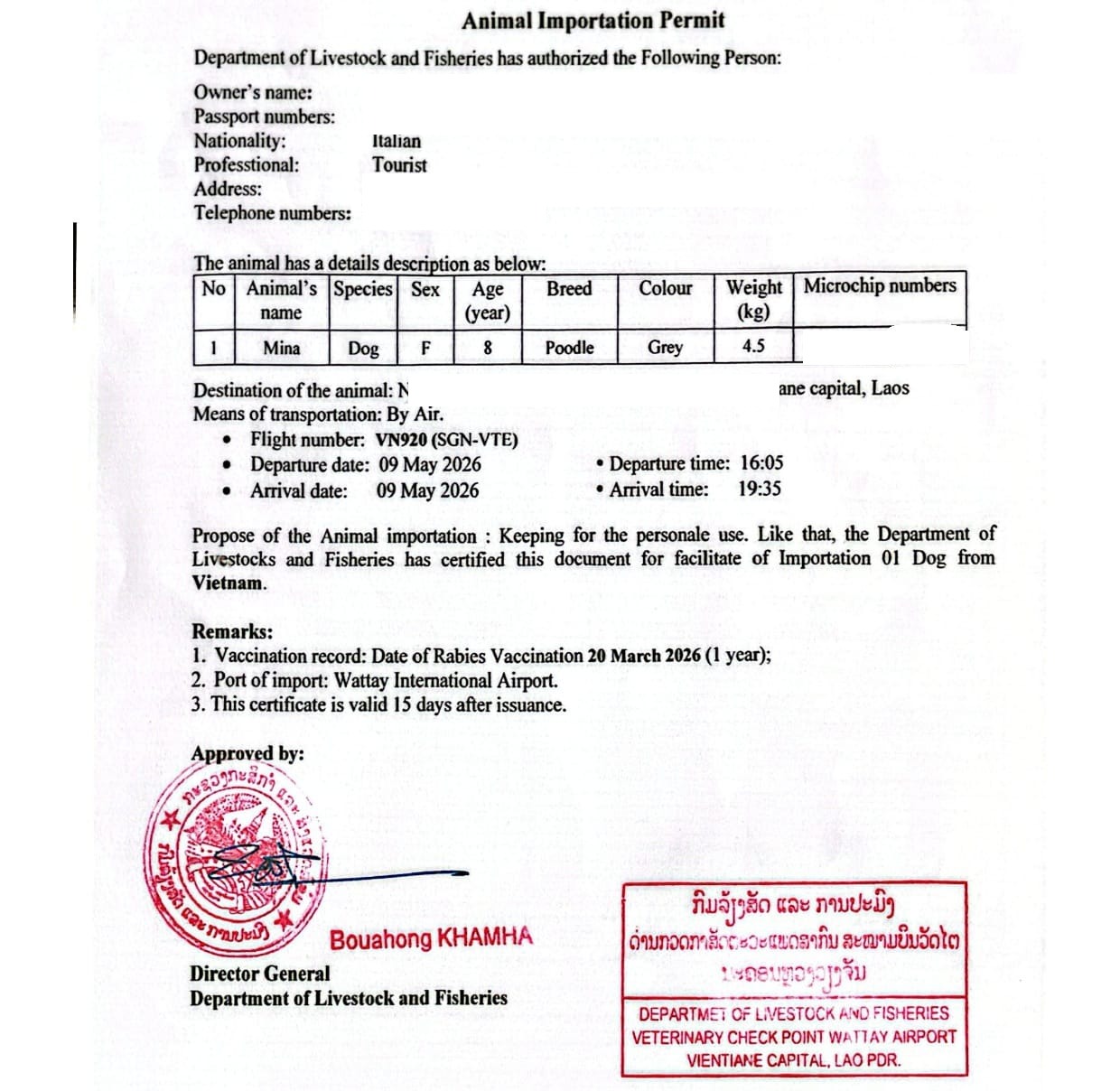
Laos, May 2026. A dog flew from Ho Chi Minh City to Vientiane on Vietnam Airlines VN920 on 9 May 2026. The Department of Livestock and Fisheries issued the permit on 6 May, valid for 15 days and naming Wattay International Airport.
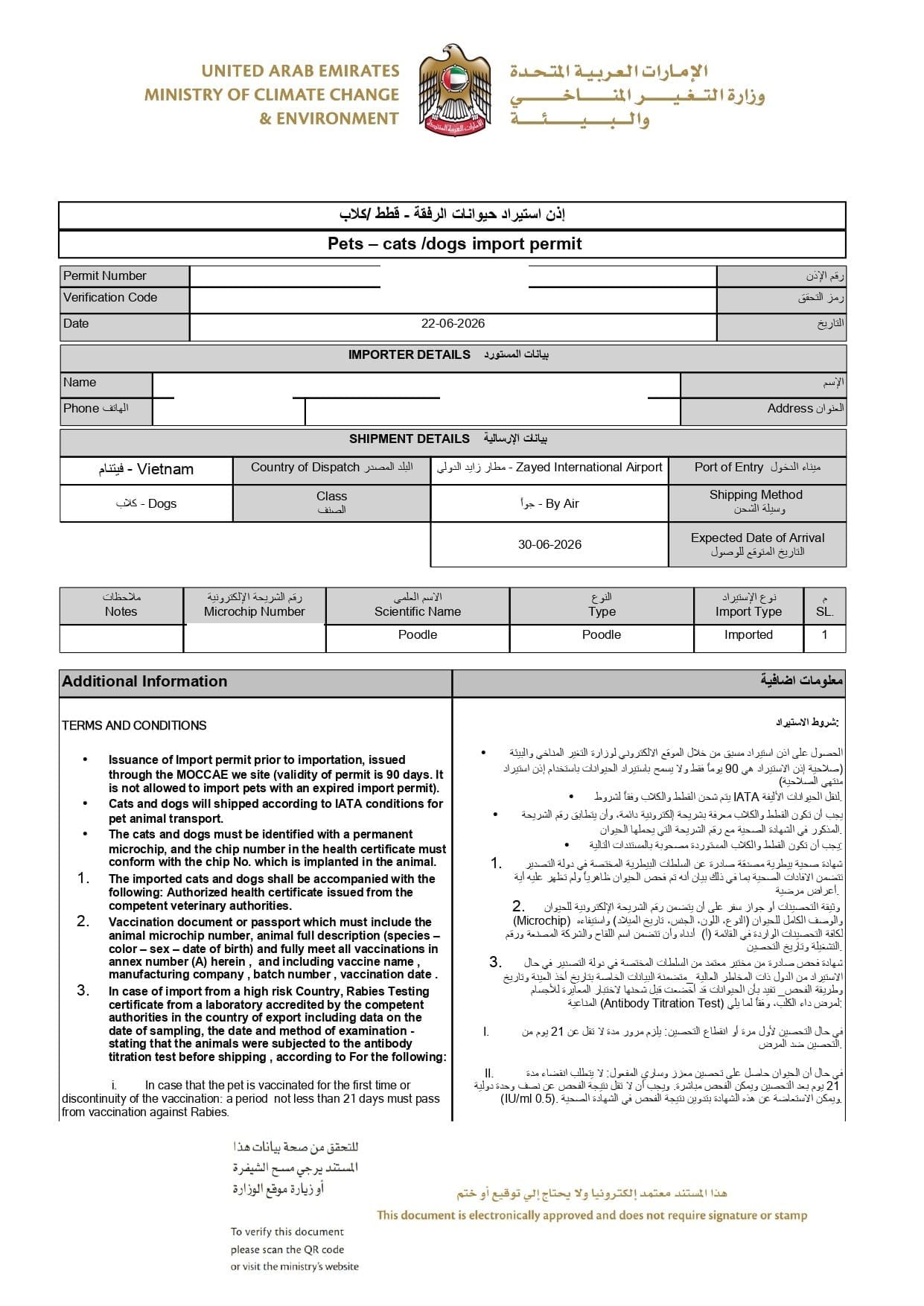
UAE, June 2026. For a dog flying from Hanoi to Abu Dhabi on 25 June 2026, MOCCAE issued the permit on 22 June, valid for 90 days. The full list of papers in that file is in our document checklist for leaving Vietnam.
Do you need a permit to bring a pet into Vietnam?
Not for one or two pets travelling as personal pets. They are declared to the airport’s animal quarantine station with Form 3 (Mẫu 3), and the station issues Form 15a after inspection on arrival.
Three or more pets, or a commercial shipment, need prior approval. The application is Form 19 (Mẫu 19), sent to Vietnam’s Department of Livestock Production and Animal Health. Under Circular 01/2026/TT-BNNMT, the department replies with a written approval within 4 working days. Our page on bringing pets to Vietnam covers the full process.
FAQ about the pet import permit
Can I apply for an import permit before the rabies antibody test result is back?
Usually not. Most permit applications ask for the test result, so the permit comes after it.
Does Vietnam issue the import permit for my destination?
No. The destination’s government issues it. Vietnam issues the export health certificate, Form 13a.
Is Japan’s advance notification the same as an import permit?
Not exactly. It is a notice filed at least 40 days before arrival. Japan’s Animal Quarantine Service then sends an approval to carry with the pet.
What happens if my flight is delayed past the permit’s dates?
Ask the issuing authority to change the dates before the permit expires. Taiwan allows one change, at least 10 days before arrival. Otherwise a new permit is needed.
Does a cat need an import permit for the United States?
No. The US has no import permit for pet cats or dogs. Dogs from Vietnam need a CDC Dog Import Form receipt and an animal care facility booking instead.
Last updated 21 Oct 2026
Compiled by our specialists from the regulations in force on the date above, for reference only. Rules may change after this date. Please verify with the competent authorities or contact us for the most accurate information.
Official sources cited in this guide
- Ministry of Climate Change and Environment (MOCCAE)moccae.gov.ae
- Animal and Plant Health Inspection Agency (APHIA)aphia.gov.tw
- Department of Agriculture, Fisheries and Forestry (DAFF)bicon.agriculture.gov.au
- Animal Quarantine Service (AQS)maff.go.jp
- EU animal health certificatefood.ec.europa.eu
- CDC Dog Import Formcdc.gov