Relocating a dog or cat to the Philippines is a highly structured process governed by the Bureau of Animal Industry (BAI) under the Department of Agriculture. While the Philippines does not enforce a mandatory quarantine for pets arriving with compliant paperwork, the administrative sequence is strict: a single missing endorsement can lead to your pet being turned back at Manila’s Ninoy Aquino International Airport (NAIA) or placed in expensive, long-term quarantine.
Navigating the complex requirements — including the online Sanitary and Phytosanitary Import Clearance (SPSIC) and the Department of Animal Health (DAH) endorsement — requires precise timing. This guide lays out the complete operational pathway for our pet shipping to the Philippines services. For a deep dive into the legal framework and quarantine details, see our companion article on Philippines Pet Import Laws.
The Philippines Pet Import Framework: Key Compliance Factors
Before initiating any travel preparations, pet owners must verify that their dog or cat meets the core health standards set by the BAI. The framework is designed to prevent the introduction of infectious diseases into the archipelago. The critical compliance components include:
- ISO Microchip: Your pet must be identified with a 15-digit ISO 11784/11785 compliant microchip. The microchip must be implanted before the rabies vaccination is administered.
- Age Requirement: The pet must be at least 4 months (16 weeks) old. This accommodates the 12-week minimum age for rabies shots and the mandatory 30-day biological waiting period before travel.
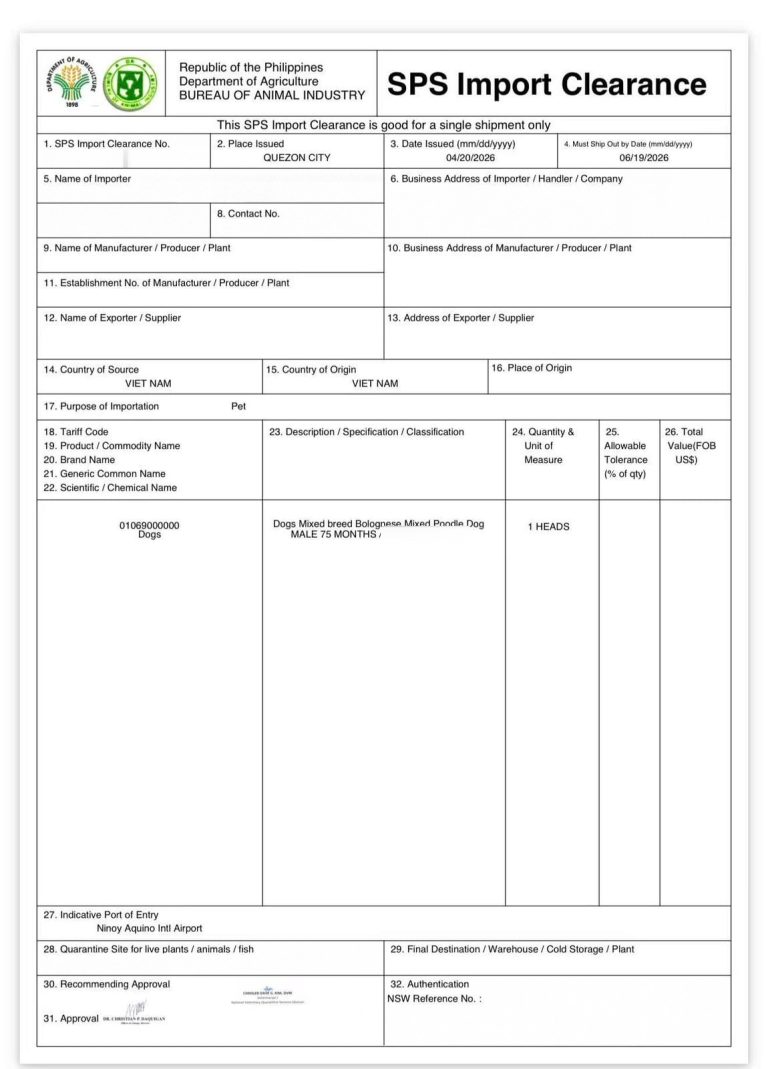
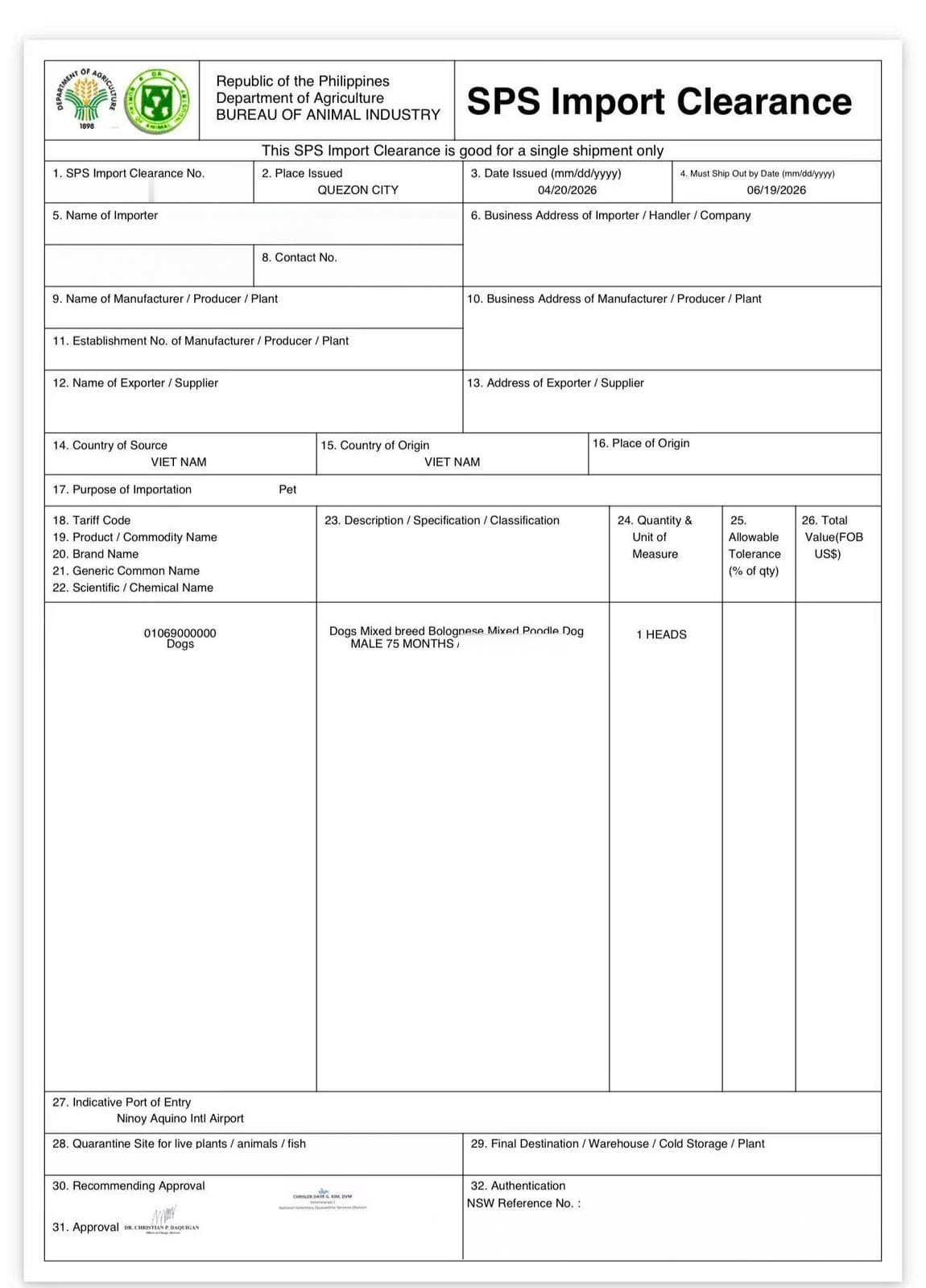
- SPSIC Import Permit: A Sanitary and Phytosanitary Import Clearance must be obtained from the BAI before the pet departs. This permit is valid for 60 days from the date of issue.
- Vaccination Record: Up-to-date vaccinations are required, including Rabies (administered at least 14 days and at most 1 year prior to travel), DHLPP for dogs, and FVRCP for cats.
- Clinical Health Check: An export health inspection must be conducted within 10 days of travel, accompanied by internal and external parasite treatments.
The 5-Step Relocation Pathway to the Philippines
Successfully transporting your pet to the Philippines requires adhering to a strict timeline. Daisy Pet recommends initiating the process at least 45 to 60 days before your target departure date. The standard operational sequence is as follows:
Step 1: Microchip Implantation & Primary Vaccinations
The journey begins at the veterinary clinic. The vet must implant the 15-digit FDX-B microchip and record it in the pet’s health book. Immediately following, the primary rabies vaccine and core combination vaccines (DHLPP for dogs, FVRCP for cats) must be administered. Ensure that all vaccine stickers, batch numbers, and manufacturer dates are signed and stamped by the vet.
Step 2: Apply for the SPSIC Import Permit Online
Once your pet’s vaccinations are complete, you must apply for the SPSIC via the official InterCommerce portal. You will need to upload the pet’s microchip certificate, vaccination records, and owner details. The Bureau of Animal Industry (BAI) typically issues the permit within 3 to 5 working days. The permit is valid for 60 days, so time the application carefully relative to your flight.
Step 3: Clinical Examination and Parasite Treatment
Between 10 and 14 days before the flight, your pet must return to the vet for a final clinical exam. The vet must administer treatments for both internal parasites (endoparasites) and external parasites (ectoparasites). The active ingredients (such as Fipronil or Milbemycin) must be recorded in the health book. For the full scheduling sequence, see our Philippines pet relocation timeline.
Step 4: DAH Endorsement of the Health Certificate
Within 10 days of departure, you must present your pet’s records to the Department of Animal Health (DAH) in Vietnam. The DAH will inspect the clinical records, the SPSIC permit, and issue the official Veterinary Health Certificate (VHC). This certificate must bear the official government stamp and signature, confirming the pet is free from infectious diseases.
Step 5: Airline Booking and Customs Notification
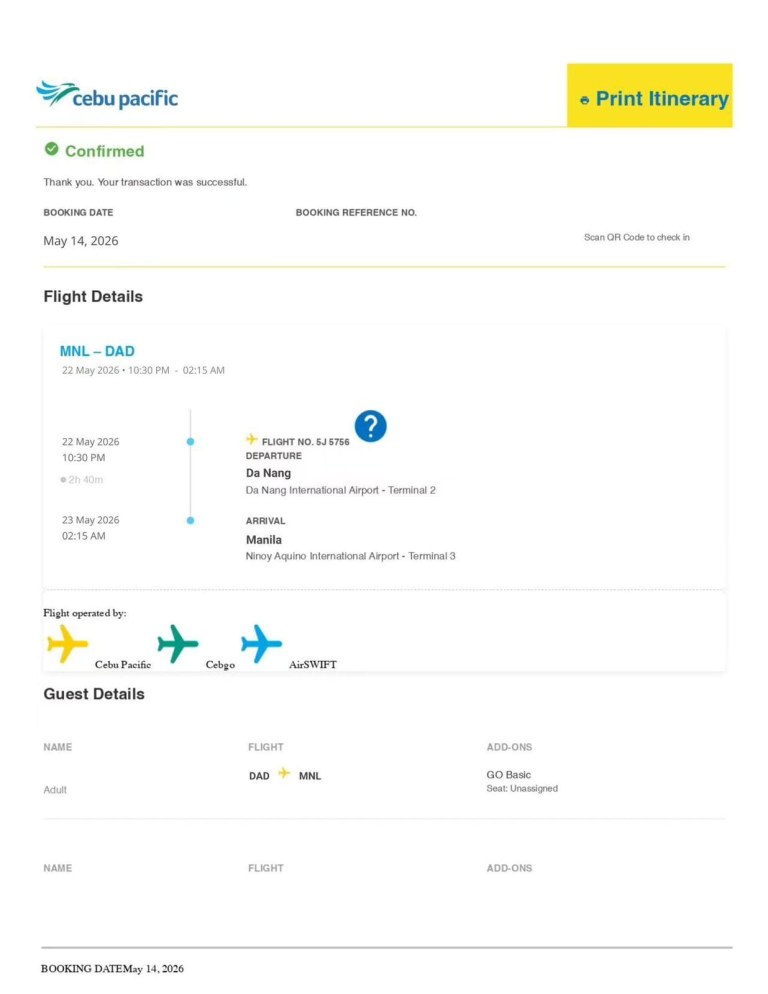
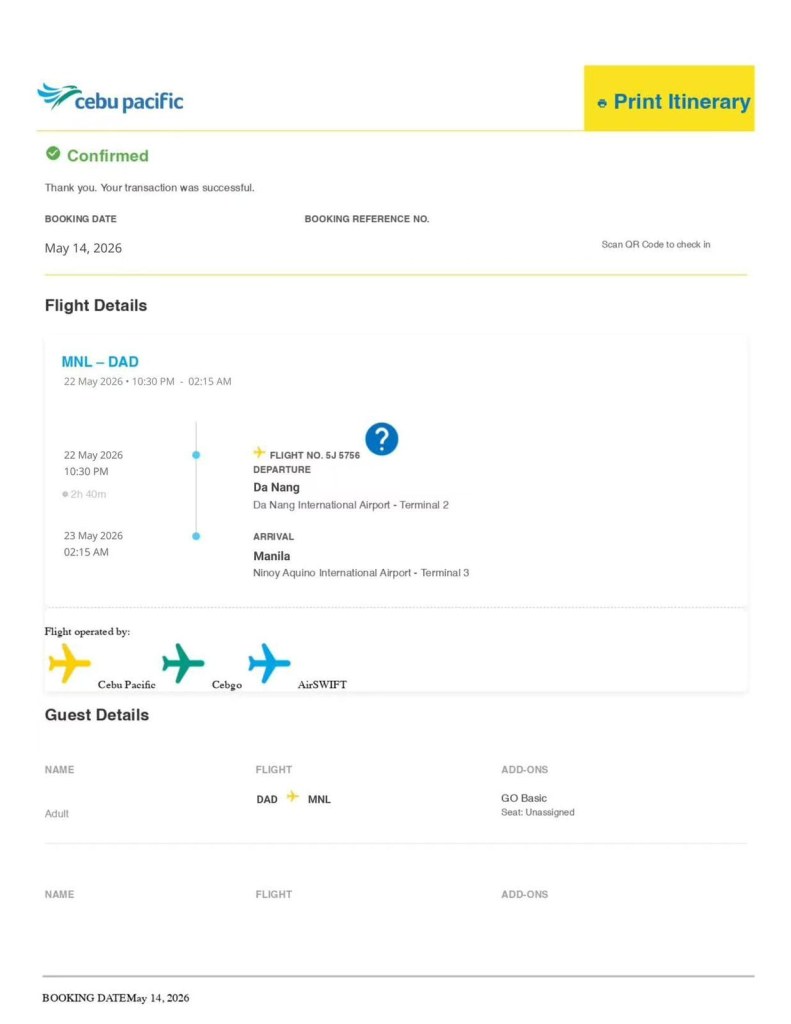
With the VHC and SPSIC in hand, you can confirm your pet’s flight booking. You must also notify the National Veterinary Quarantine Services Division (NVQSD) at Manila airport of your pet’s arrival at least 48 hours in advance. This ensures a quarantine officer is present to clear your pet upon landing. Check out our list of approved airlines for pet transport to the Philippines to secure the best route.
Flight Methods: AVIH Checked Baggage vs. Manifest Cargo
Choosing how your pet flies is a critical logistical decision. There are two primary pathways for transporting pets into the Philippines, each with distinct operational rules:
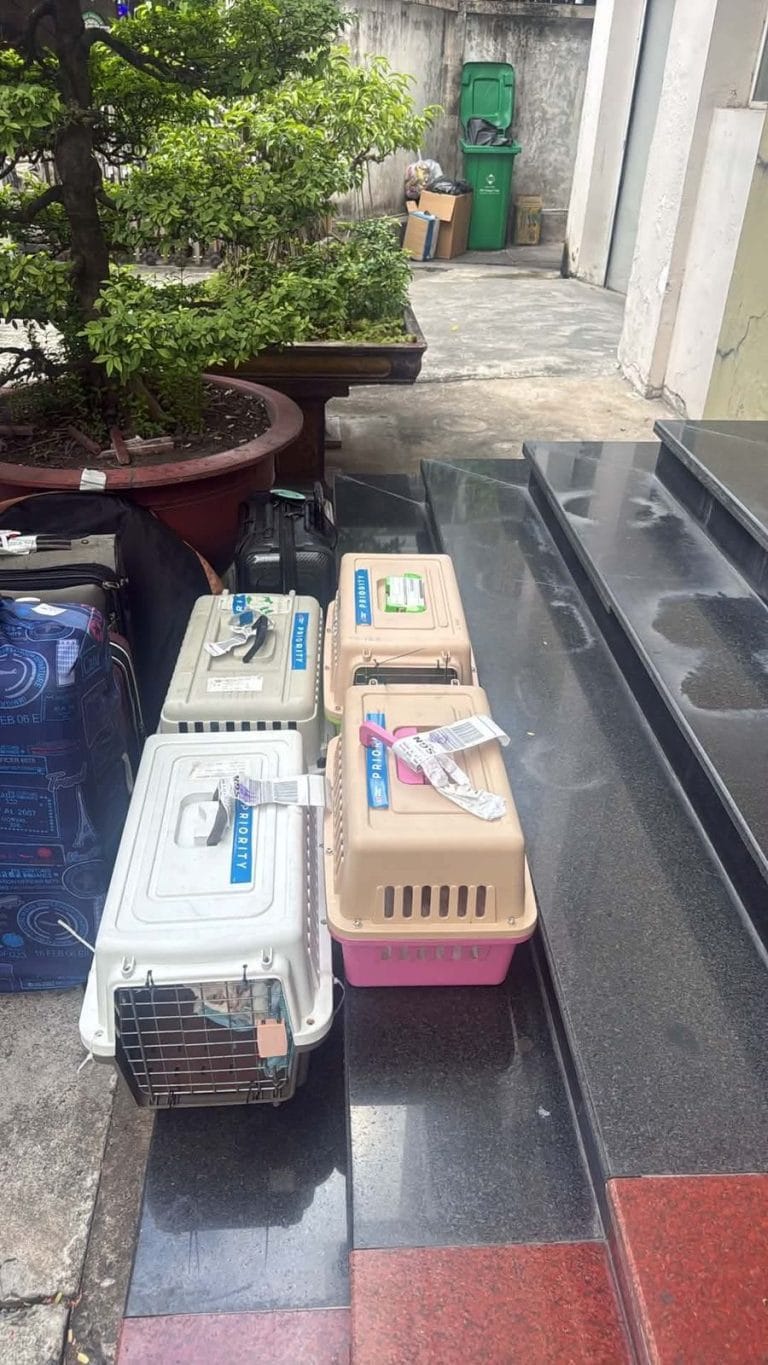
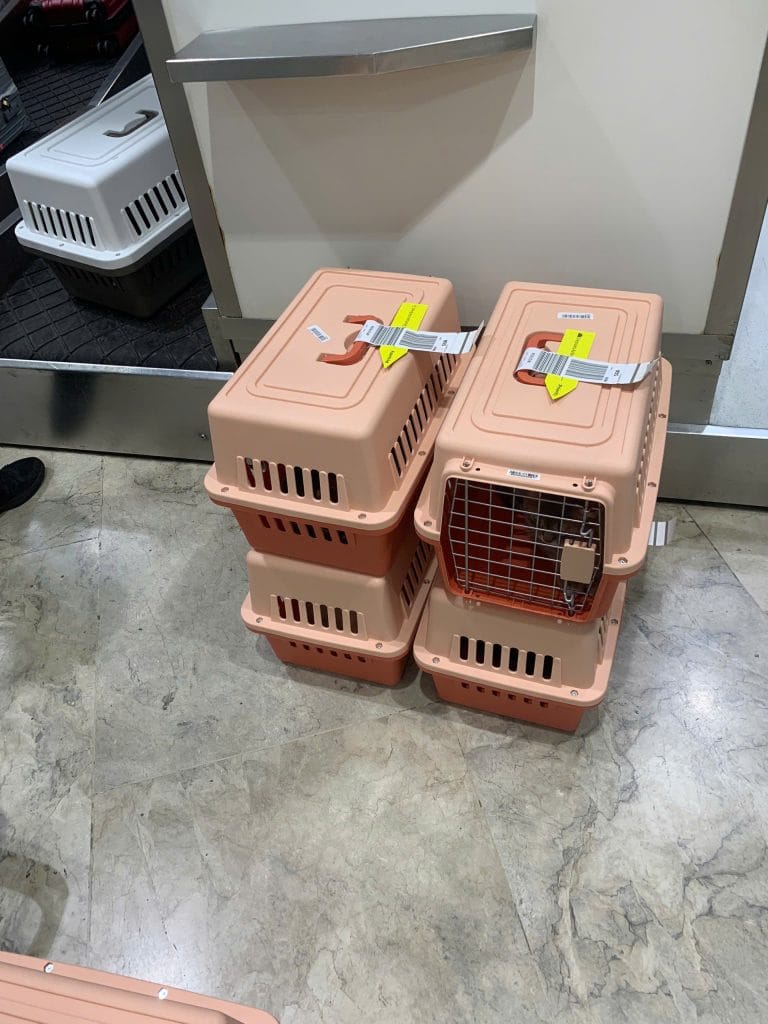
- Checked Baggage (AVIH): If you are flying on the same aircraft, your pet can travel under your ticket as Checked Baggage (AVIH). The pet is checked in at the passenger terminal, flies in a pressurized, temperature-controlled cargo hold, and is retrieved at the baggage claim area at NAIA. This is generally the most cost-effective and low-stress method for pets under 32kg. Check out the pet shipping cost to the Philippines for a complete budget breakdown.
- Manifest Cargo: If your pet is traveling unaccompanied, is extremely large, or is flying on an airline that does not offer AVIH, they must travel as Manifest Cargo. The pet has their own Airway Bill (AWB), is processed through the cargo terminal, and requires customs clearance by a licensed broker. This method is legally required for specific airlines and breeds.
Customs Clearance and Border Quarantine Inspection at NAIA
Upon landing at NAIA in Manila, the pet is transferred to the veterinary quarantine station. An officer from the National Veterinary Quarantine Services Division (NVQSD) will inspect the pet and verify the original document portfolio. You must present the original VHC from Vietnam, the printed SPSIC import permit, and pay the mandatory quarantine inspection fees (typically around PHP 250 to PHP 650 per pet).
If all paperwork is correct, your pet will be released immediately to you. However, if the microchip is unreadable, vaccinations are expired, or the SPSIC is missing, the pet may be quarantined at your expense, returned to the country of origin, or subjected to testing. Working with a professional like Daisy Pet ensures that a local agent is waiting at NAIA to handle these procedures smoothly.
Frequently Asked Questions
Is there a mandatory quarantine for pets entering the Philippines?
No. As long as your pet arrives with a valid SPSIC import permit, a government-endorsed Veterinary Health Certificate (VHC), and matches the microchip records, there is no mandatory quarantine. The pet is released immediately after a successful border inspection at NAIA.
How long is the SPSIC import permit valid for?
The Sanitary and Phytosanitary Import Clearance (SPSIC) issued by the BAI is valid for exactly 60 days from the date of issue. If your travel plans are delayed beyond this period, you must apply for a new permit via the InterCommerce portal.
Can I transport my pet as Checked Baggage (AVIH) with Vietnam Airlines?
Yes. Vietnam Airlines allows dogs and cats to travel as Checked Baggage (AVIH) on select flights to Manila, provided the pet is under their weight limit and the crate conforms to IATA standards. Ensure you book this slot with the airline at least 48 hours in advance.
What is the minimum age for a pet to travel to the Philippines?
Your dog or cat must be at least 4 months old to enter the Philippines legally. This is because the rabies vaccine cannot be administered before 12 weeks of age, and there is a mandatory 30-day waiting period after the vaccination before the pet can travel.
Related: Philippines Pet Import Laws: Complete Regulatory Guide — a deep dive into the official compliance standards, veterinary protocols, and breed restrictions enforced by the BAI.
Last updated 15 Oct 2026
Compiled by our specialists from the regulations in force on the date above, for reference only. Rules may change after this date. Please verify with the competent authorities or contact us for the most accurate information.
Official sources cited in this guide
- Bureau of Animal Industry (BAI)bai.gov.ph