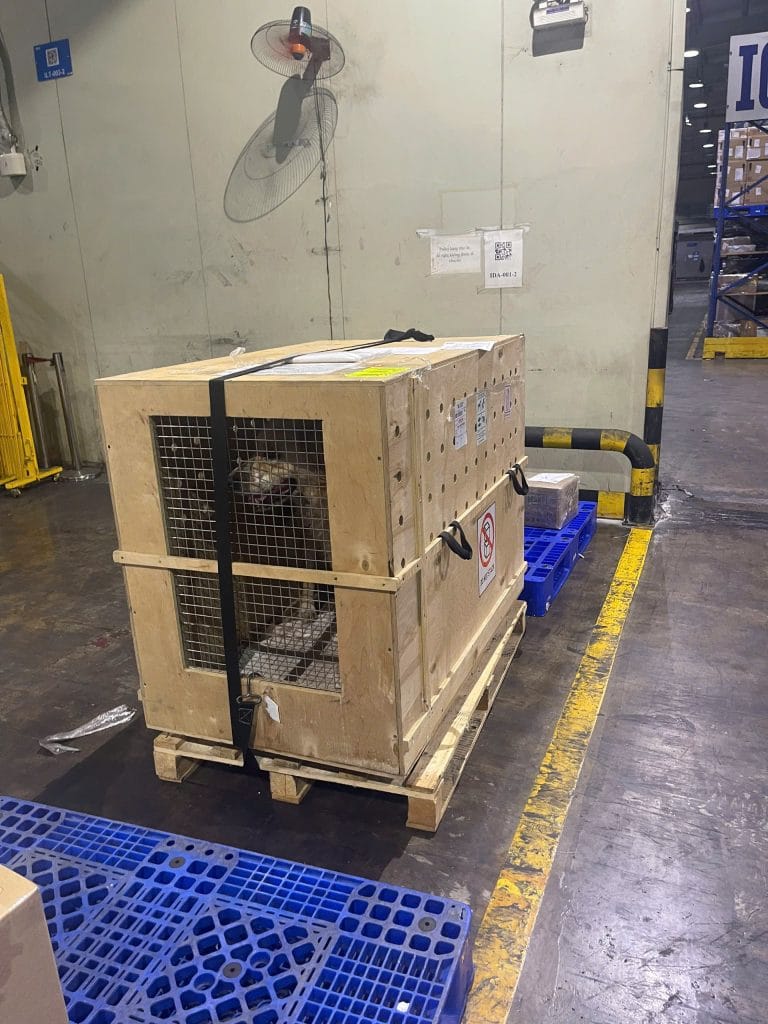
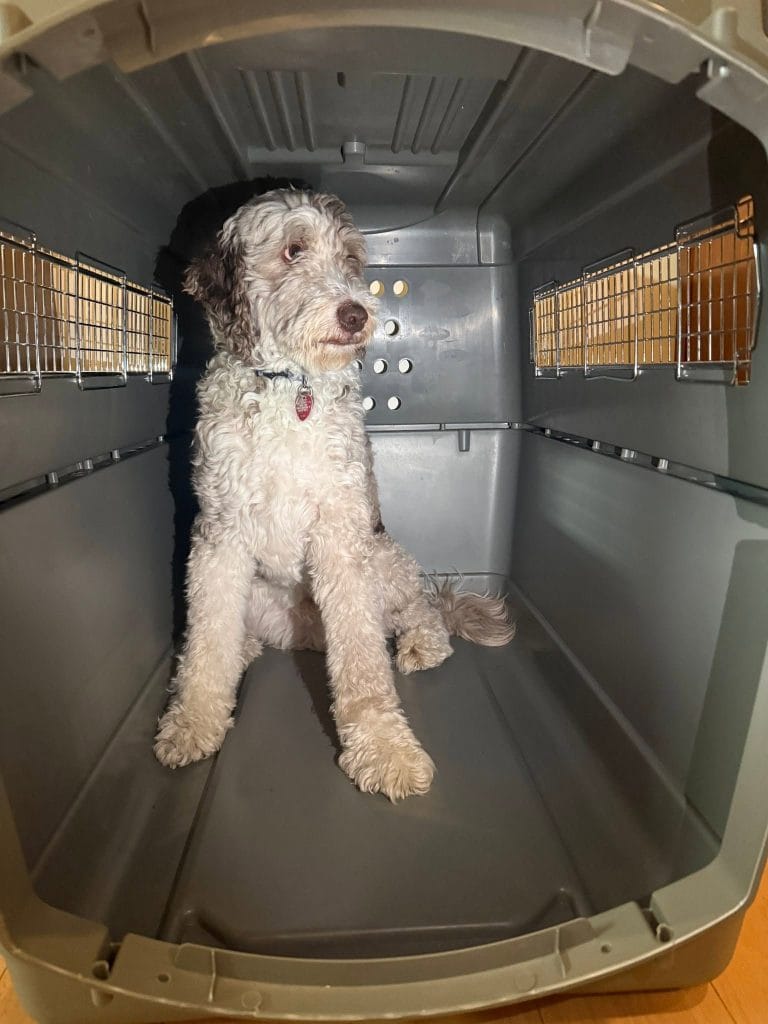
Every crate problem starts in the same place: a bad measurement.
Measure wrong, you buy the wrong crate. Buy the wrong crate, the airline rejects it at the counter. Get rejected, you miss the flight, forfeit the cargo booking, and let the health certificate expire. That chain of failures typically costs $1,000 to $3,000 to undo.
The good news: measuring correctly takes about 5 minutes, a tape measure, and a pet willing to stand still. The hard part is knowing exactly where to measure, because being off by just half an inch in the wrong direction changes the crate size you need. If you haven’t seen the overview of crate types yet, read our guide to the IATA-compliant pet travel crate before you start measuring.
Three Ways to Measure, From Quick to Precise
Method 1: The Eyeball Test (Quick but Risky)
What you need: The crate and a cooperative pet.
Put your pet in the crate and watch:
- Can the pet stand without touching the top? (Count the ear tips if the ears stand upright.)
- Can the pet turn around in a full circle without contorting?
- Can the pet lie down with its legs extended without pressing against the walls?
If all three are a clear yes with visible clearance, you are probably fine. If any of them is borderline, the head almost touching or the turn a bit tight, do not assume it will pass. Airlines don’t grade on a curve.
Limitation: This test depends on your viewing angle, the pet’s posture at that moment, and whether the bedding is already inside. We once had a client send a photo of a dog that “fit perfectly”, then the crate was rejected because the bedding wasn’t in the photo, and once the 2-inch pad went in, the dog could no longer stand upright.
Method 2: The Tape Measure (Reliable)
What you need: A flexible tape measure.
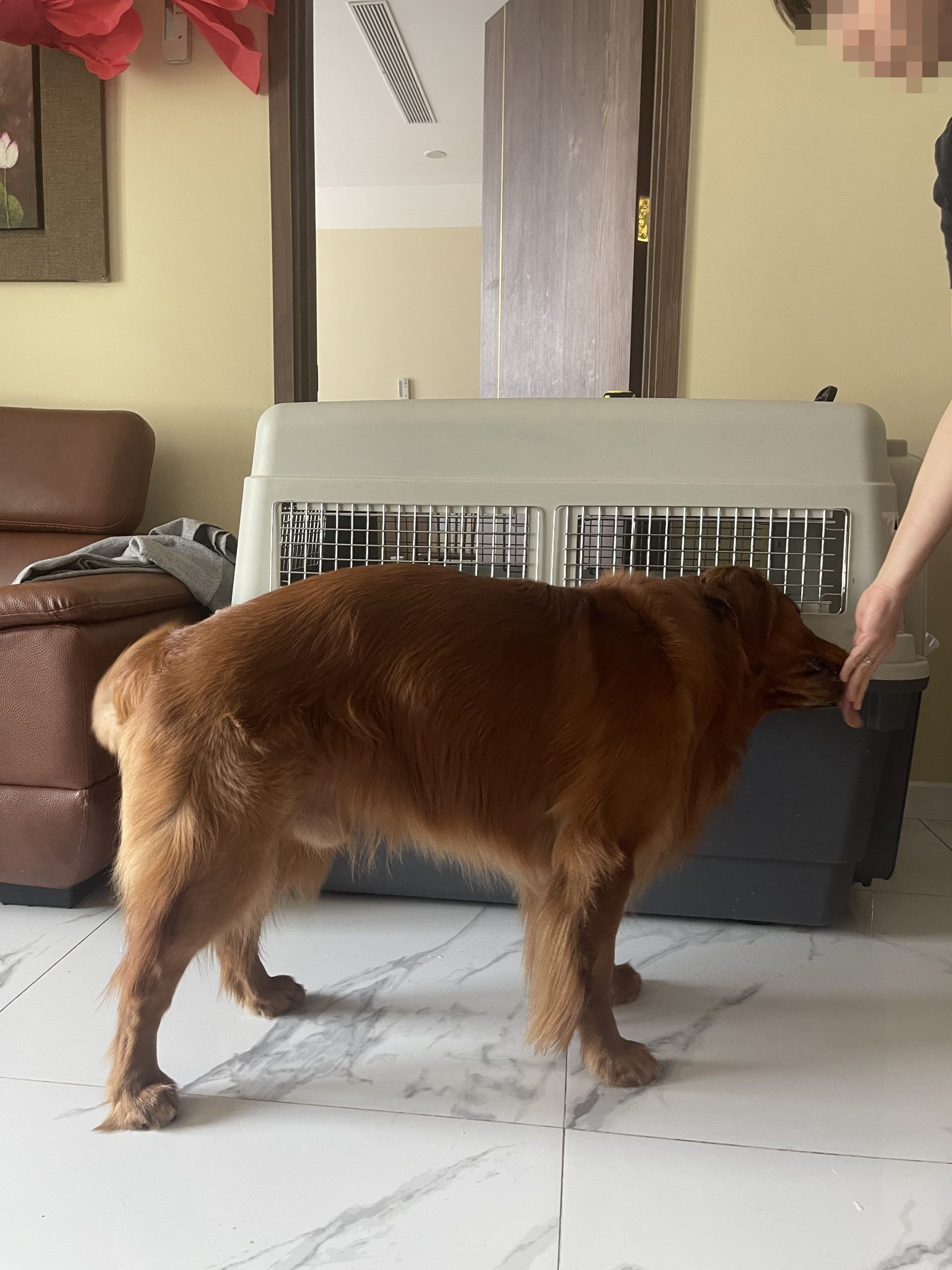
Measure your pet standing naturally on a flat surface, not sitting, not lying down, not excited and stretching.
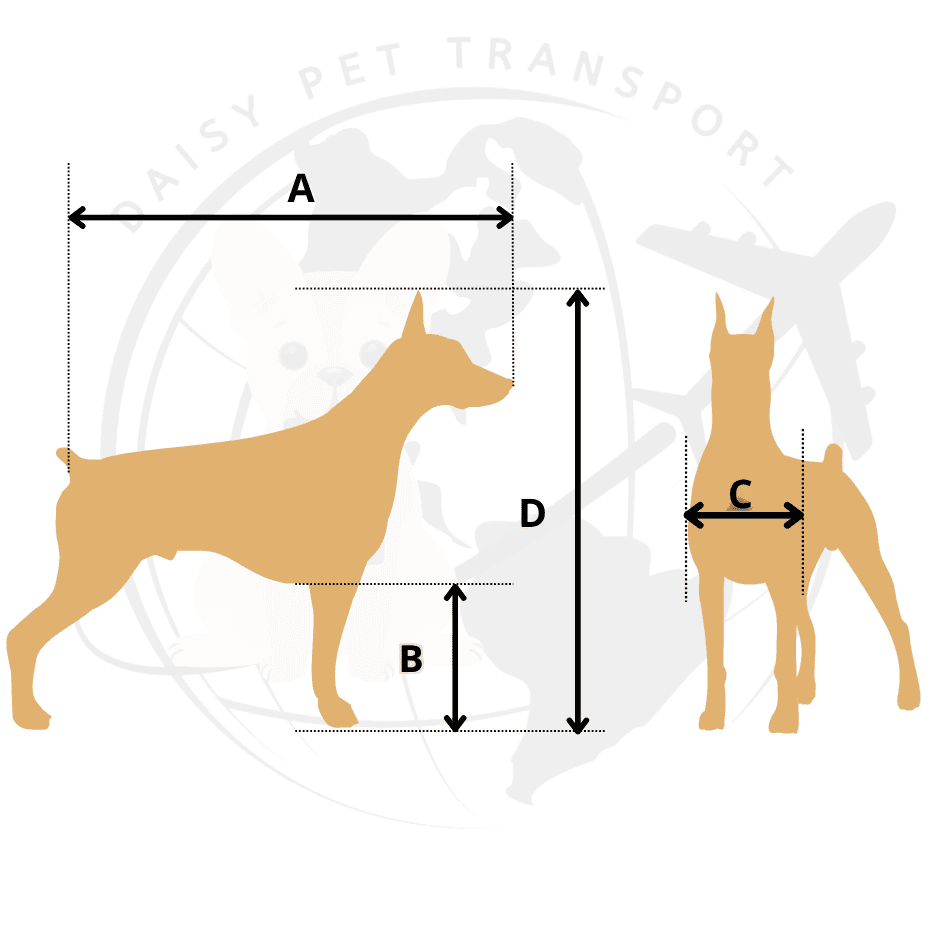
| Measurement | What to Measure | How to Measure | Common Mistake |
|---|---|---|---|
| A (Length) | Nose to base of tail | A straight line along the body. Do NOT include the tail. | Measuring to the tail tip, adding 4 to 8 inches of length |
| B (Leg Height) | Floor to elbow | Front leg, from the floor to the crook of the elbow | Measuring to the shoulder instead of the elbow |
| C (Width) | Widest point of the body | Usually across the shoulders. Measure from behind the pet. | Measuring the chest instead of the shoulders (the chest is usually narrower) |
| D (Standing Height) | Floor to the highest point | Top of the head OR the ear tips, whichever is higher | Forgetting the ears. Erect-eared breeds (German Shepherd, Husky) can add 2 to 3 inches. |
Then compare against the crate’s internal dimensions. Your pet needs at least 1 inch of clearance on each side.
Method 3: The IATA Formula (Precise, and What Airlines Actually Use)
What you need: A tape measure plus the values below.
This is the method set out in the IATA Live Animals Regulations (CR1). It takes measurements A, B, C, and D, adds your bedding thickness, and gives you the minimum internal crate dimensions.
| Crate Dimension | Formula | Example (Medium Dog: A=22″, B=9″, C=8″, D=19″, Bedding=1″) |
|---|---|---|
| Minimum Length | A + ½B | 22 + 4.5 = 26.5″ |
| Minimum Width | C × 2 | 8 × 2 = 16″ |
| Minimum Height | D + bedding | 19 + 1 = 20″ |
This is the absolute minimum the crate must provide. If any single dimension falls short, even by half an inch, the crate does not comply.
⚠️ Snub-nosed breeds (Pug, French Bulldog, English Bulldog, Persian cat, Exotic Shorthair): add 10% to all three calculated dimensions. These pets need more airspace to breathe, especially around the head and muzzle.
The Most Common Trap: Confusing External and Internal Dimensions
This one catches more people than any other measurement error.
When you buy a “40-inch crate” from Petmate or Amazon, that 40 inches is the external length. The usable internal space is usually 1 to 2 inches smaller on each dimension because of wall thickness, the door, and the rim at the base.
A crate marketed as “40 × 27 × 30 inches” externally might measure only 37.5 × 24.5 × 28 inches inside. If your IATA formula says you need 38 inches of length, that “40-inch” crate is actually too short.
Always verify the internal dimensions before you buy. If the manufacturer doesn’t list them, measure the inside yourself or contact the supplier.
How to Measure Accurately When Your Pet Won’t Hold Still
Anyone who has tried to measure a Poodle or a Shiba Inu knows the truth: pets and tape measures don’t get along. Here is what works:
- Make it a two-person job: One person holds and reassures the pet in a standing position. The other measures.
- Use treats: Hold a treat at nose height so the pet stands tall and focused. Measure while its attention is on the treat.
- Measure twice: Take each measurement at least twice and use the larger value. A little too big beats a little too small.
- Photograph the measurement: Lay the tape clearly against the pet and snap a photo. That gives you proof to send the airline or transport company when they need confirmation.
- Pick the right moment: Measure after a walk, when the pet is calm and standing naturally, not right after waking (stiff, prone to stretching) or when excited (jumping, pacing).
The Two Most Common Measuring Mistakes
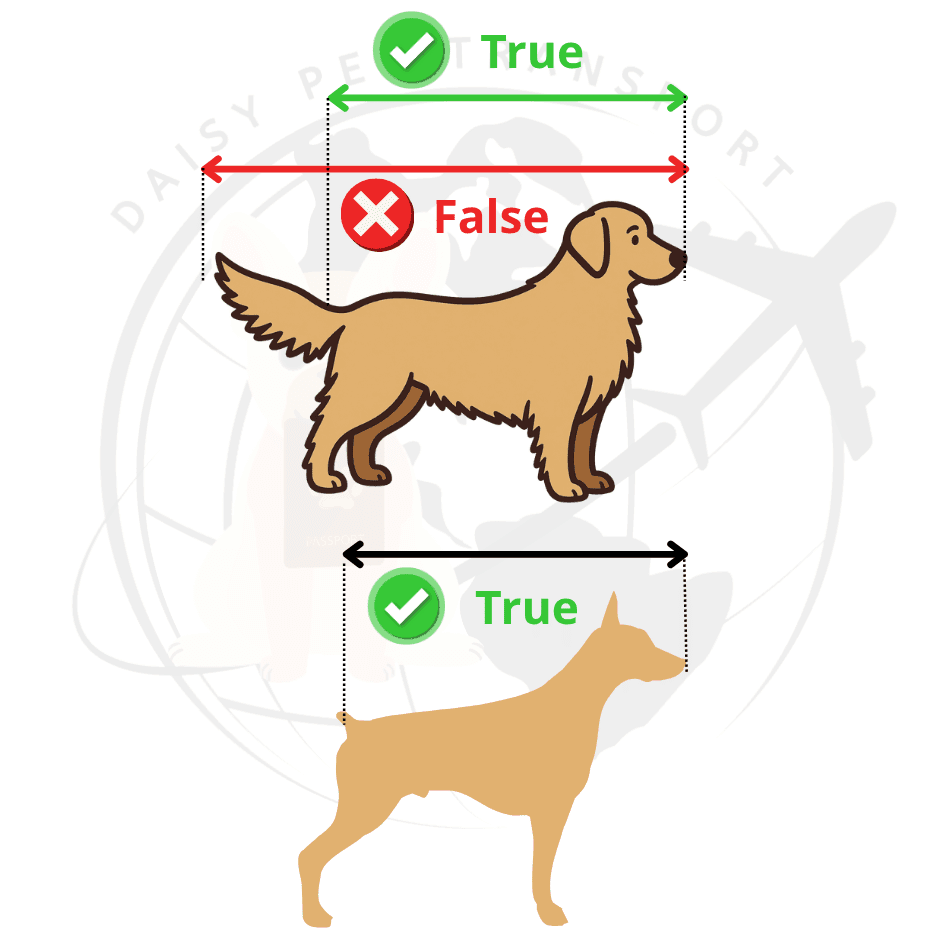
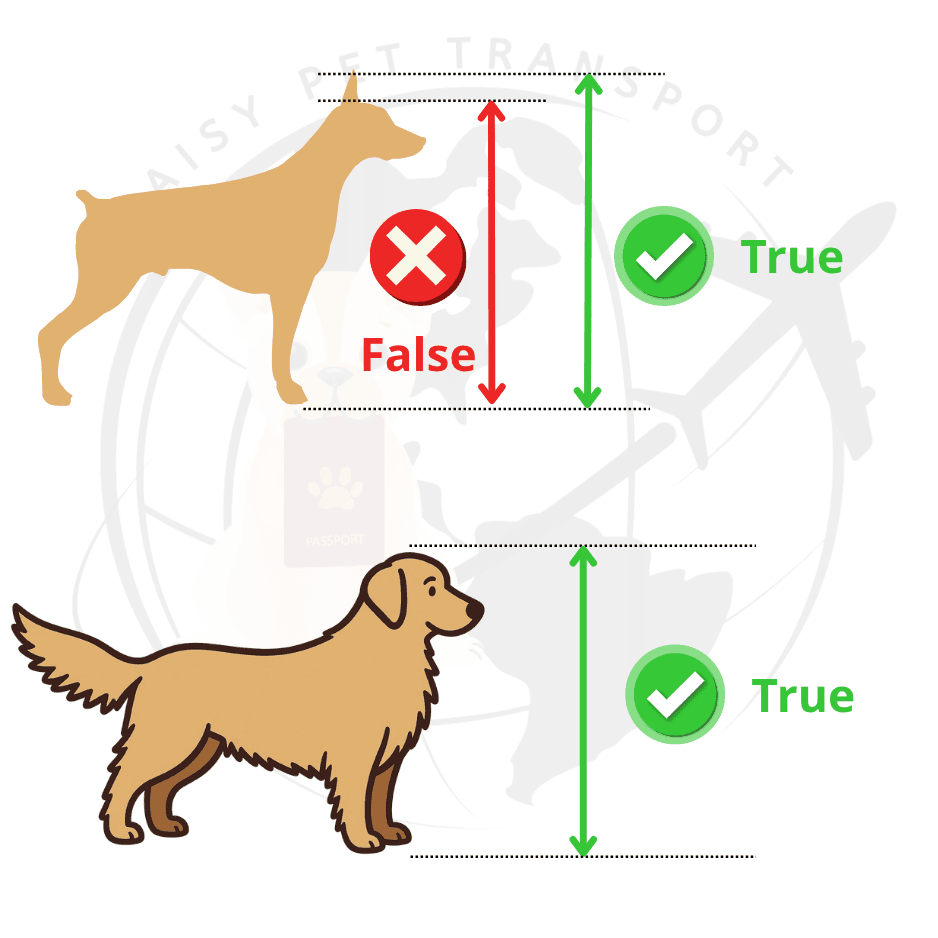
Quick Reference: Measurement to Crate Size
Once you have your IATA formula result, use this chart to find the closest crate size. Always round up, never down.
| Calculated Min. Length | Crate Code | Approx. Internal Length |
|---|---|---|
| Up to 22″ | L60 | ~22″ |
| 22″ to 24.5″ | L70 | ~24.5″ |
| 24.5″ to 29″ | L80 | ~29″ |
| 29″ to 33″ | L90 | ~33″ |
| 33″ to 37″ | L100 | ~37″ |
| 37″ to 45″ | L120 | ~45″ |
| Over 45″ | Custom wooden crate | Built to spec |
For a detailed breed-by-breed chart with freight-cost analysis, see our guide to airline crate sizes by dog breed.
When to Call a Professional
Measure it yourself if you can. But get in touch with us if:
- Your pet lands right between two sizes and you’re not sure which way to go.
- Your pet is a snub-nosed breed, where the 10% buffer has to be exact.
- Your pet is a giant breed (Great Dane, Mastiff) that needs a custom wooden crate.
- Your pet has grown since the last flight and you want to reuse the old crate.
Last updated 15 Oct 2026
Compiled by our specialists from the regulations in force on the date above, for reference only. Rules may change after this date. Please verify with the competent authorities or contact us for the most accurate information.