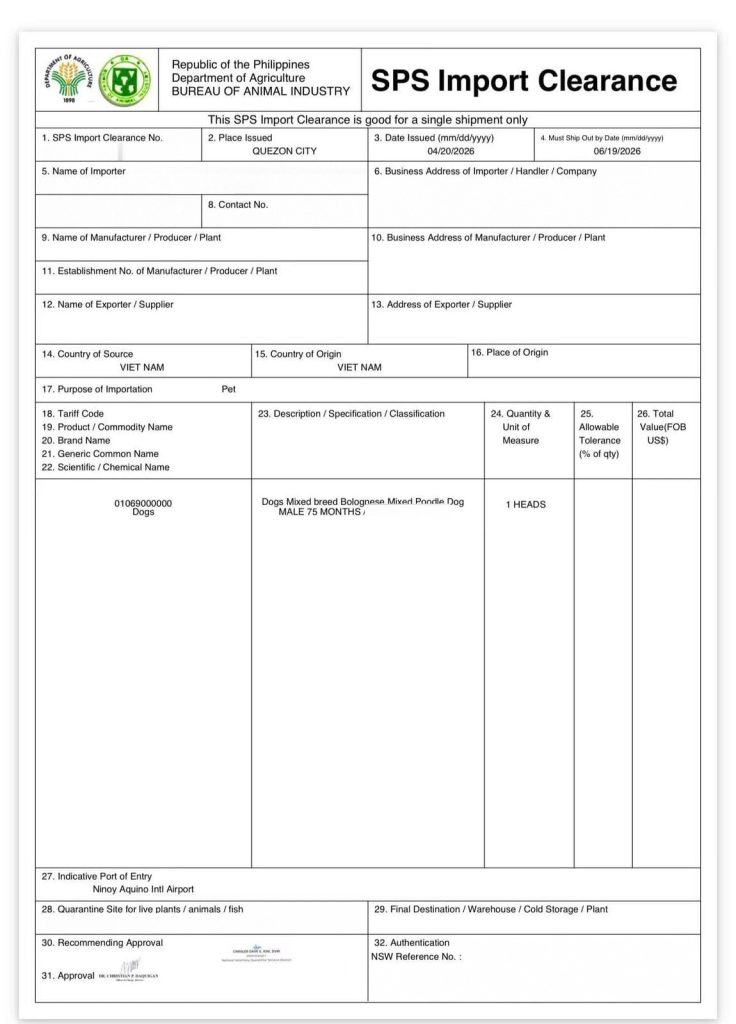
Navigating the biosecurity laws of the Philippines can be challenging for pet owners. The Bureau of Animal Industry (BAI) regulates all animal imports strictly to protect the archipelago from veterinary diseases. However, compared to other strict destinations, the Philippines offers a highly accessible pathway if your paperwork is perfectly executed. The frequently asked questions below address the key regulations, costs, and clinical procedures for dogs and cats traveling from Vietnam.
This quick-reference guide is designed to clarify common misconceptions for our pet shipping to the Philippines services. If you need step-by-step guidance on preparation timelines, please consult our companion Philippines Pet Relocation Timeline or contact the Daisy Pet team directly.
Quarantine & Clearance Regulations
1. Does my pet need to undergo quarantine upon arrival in the Philippines?
No. There is no mandatory quarantine for dogs and cats entering the Philippines from Vietnam, provided that all documents are complete and valid. Upon landing at Ninoy Aquino International Airport (MNL) in Manila, a BAI quarantine officer will perform a physical examination and inspect the original paperwork. If compliant, the pet is released immediately to the owner.
2. What happens if there is an error in my pet’s veterinary paperwork at the border?
If any required document is missing, expired, or contains incorrect microchip numbers, the BAI officer will deny immediate release. The pet will either be placed in a designated quarantine facility at Ninoy Aquino Airport at the owner’s expense, or repatriated back to Vietnam on the next available flight. Daisy Pet ensures a zero-defect document check to completely avoid this risk.
3. Can my pet enter the Philippines through airports other than Manila (MNL)?
Yes. Pets can enter the Philippines through other international gateways, such as Cebu (CEB) or Clark (CRK), provided the SPSIC specifically states the correct point of entry. You cannot change the entry airport after the SPSIC has been issued without applying for a new permit.
Vaccinations & Medical Testing
4. Does a cat or dog need a Rabies Titer Test (RNATT) to enter the Philippines from Vietnam?
No. The Bureau of Animal Industry (BAI) does not require a Rabies Antibody Titer Test (RNATT) for pets traveling from Vietnam to the Philippines under the current Philippines pet import laws. This makes the preparation process significantly faster and less expensive than moving to Schedule III countries like Singapore or rabies-free zones like Australia.
5. Do I need a Rabies Titer Test if I plan to bring my pet back to Vietnam later?
No. Vietnam does not require a titer test to bring your pet back. You only need one if your pet may later move on to a country that requires it (such as the EU, Japan or Australia). In that case, tell us early so the blood can be drawn before you leave Vietnam, which saves months of waiting later.
6. What vaccinations are mandatory for dogs and cats?
Pets must be fully vaccinated at least 30 days prior to departure. Dogs require Rabies and core vaccines (DHPPI protecting against Distemper, Hepatitis, Parvovirus, and Parainfluenza). Cats require Rabies and core vaccines (FVRCP protecting against Feline Viral Rhinotracheitis, Calicivirus, and Panleukopenia). All batch numbers and vaccination dates must be clearly logged in the pet passport.
Import Permits & Government Endorsements
7. What is the SPSIC and how long is it valid for?
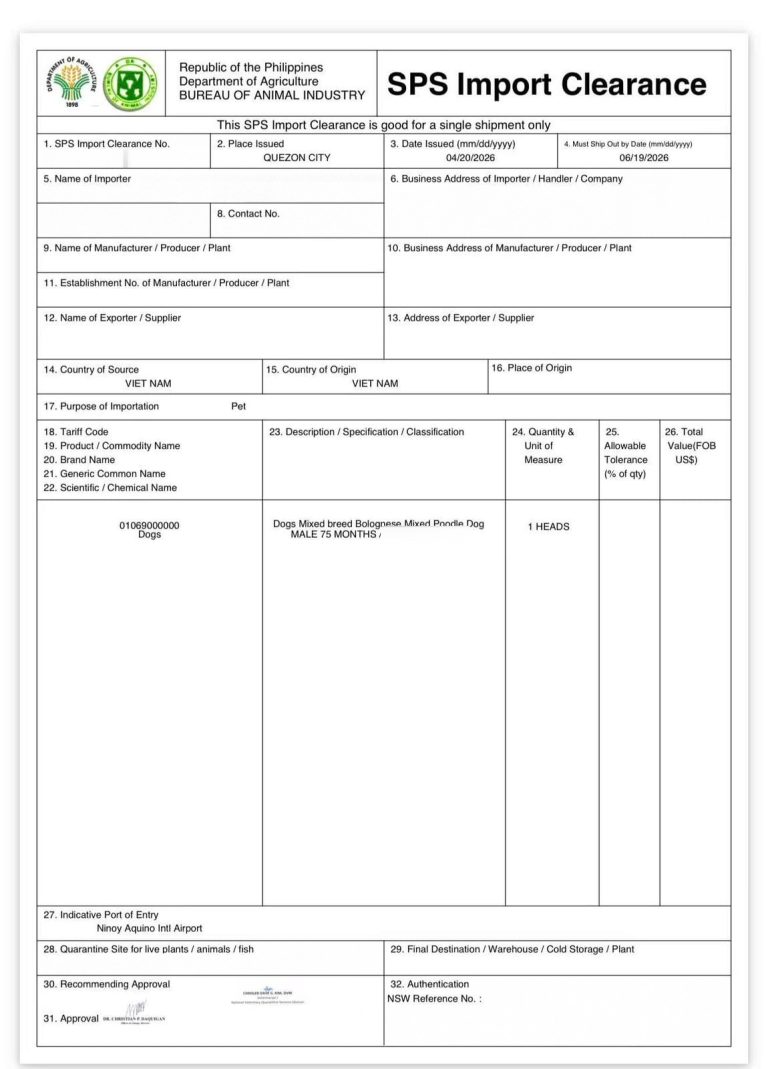
The Sanitary and Phytosanitary Import Clearance (SPSIC) is the official import permit issued online by the Bureau of Animal Industry (BAI). The SPSIC is valid for exactly 60 days from the date of issuance. The pet must land in the Philippines before the expiration date printed on the permit. It is a single-entry document and cannot be reused or extended.
8. How many pets can I import under one SPSIC permit?
A single SPSIC can cover up to three (3) personal pets (dogs or cats). If you are moving more than three pets, you must obtain a commercial import permit from the BAI, which involves different customs procedures and a registered commercial quarantine address in the Philippines.
9. Where do I get the export documents endorsed in Vietnam?
The original clinical records, microchip papers, and vaccine histories must be submitted to the Vietnam Department of Animal Health (DAH) to receive the official endorsed Veterinary Health Certificate (VHC). This endorsement must be completed strictly within 3 days of your flight departure date to be recognized by the airline and BAI authorities.
Airlines & Logistics
10. Can my pet fly in the cabin to the Philippines?
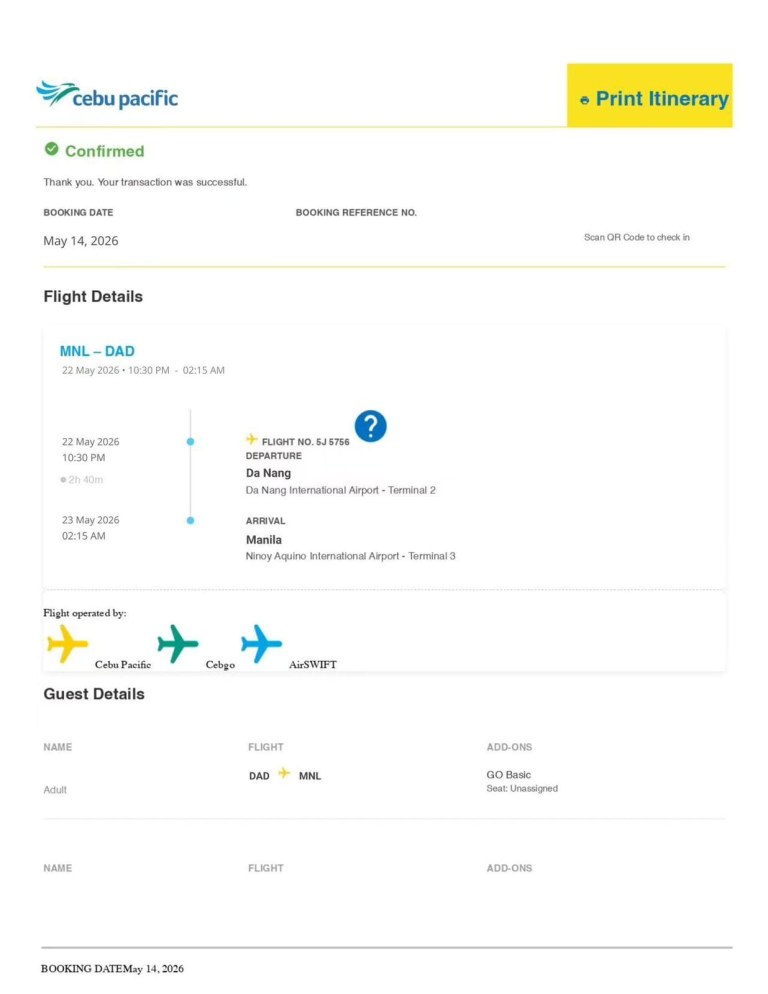
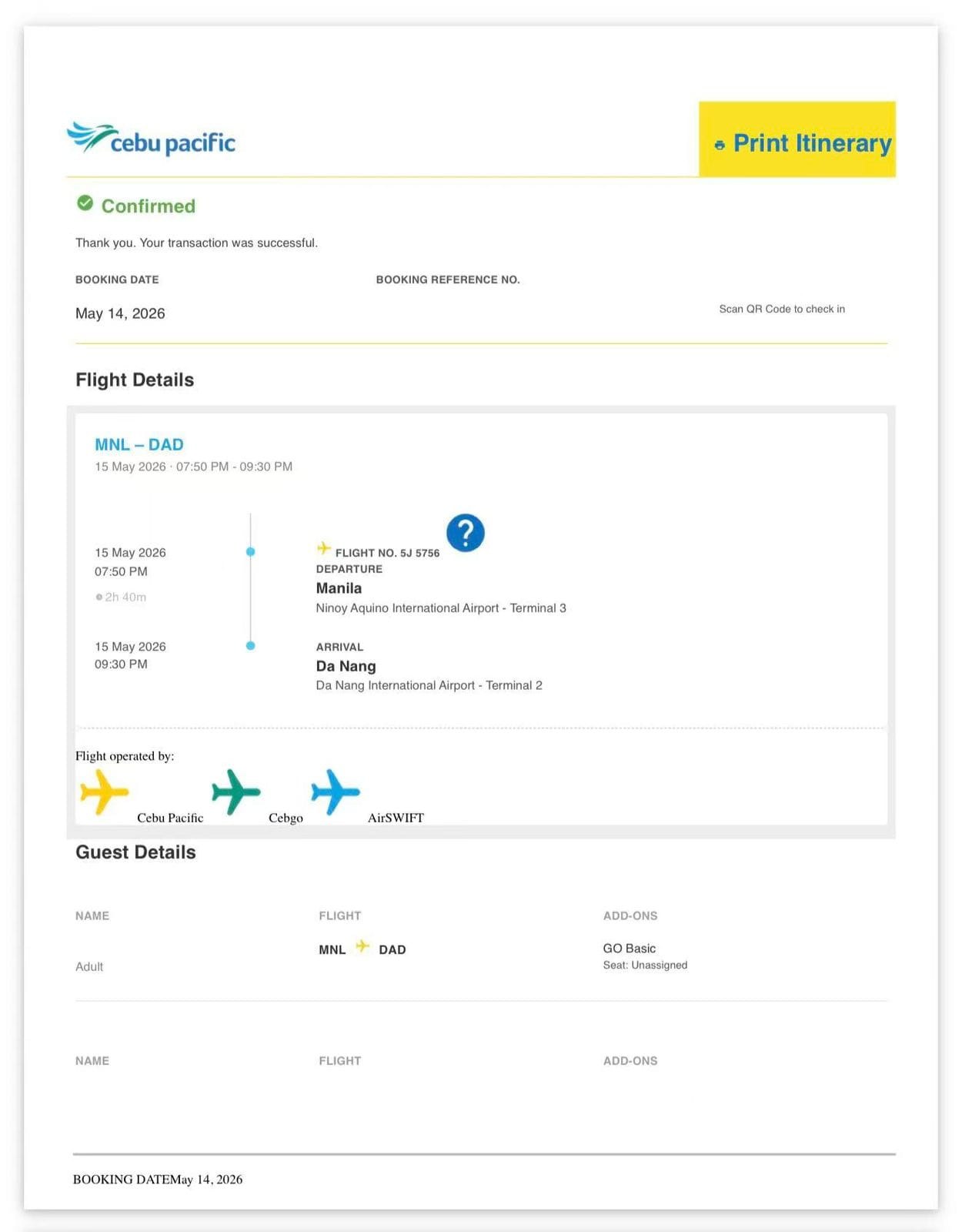
Yes, if your pet is small. Vietnam Airlines, Philippine Airlines and Cebu Pacific all accept small pets in the passenger cabin between Vietnam and the Philippines, each within its own weight, carrier-size and per-flight limits. Vietnam Airlines, for example, accepts dogs and cats aged 10 weeks or older with a combined pet-and-carrier weight of up to 6 kg, a carrier of up to 35 x 30 x 20 cm, a maximum of 2 pets per economy cabin, and a booking made at least 24 hours ahead. Snub-nosed breeds face separate airline restrictions. Pets above the cabin limit must travel under the plane in the pressurized, temperature-controlled cargo hold, either as Checked Baggage (AVIH) or Manifest Cargo. Confirm the cabin rules with your chosen airline before buying a ticket.
11. What is the difference between AVIH and Manifest Cargo?
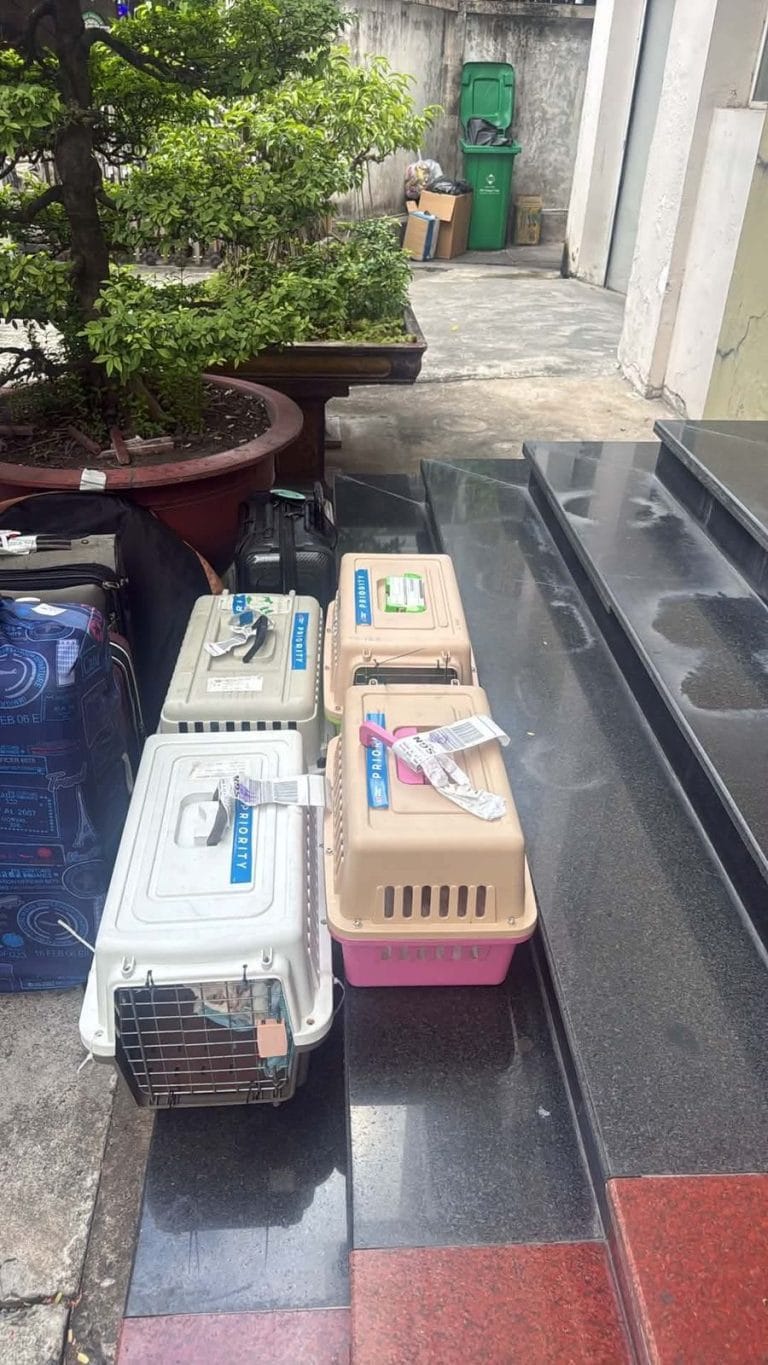
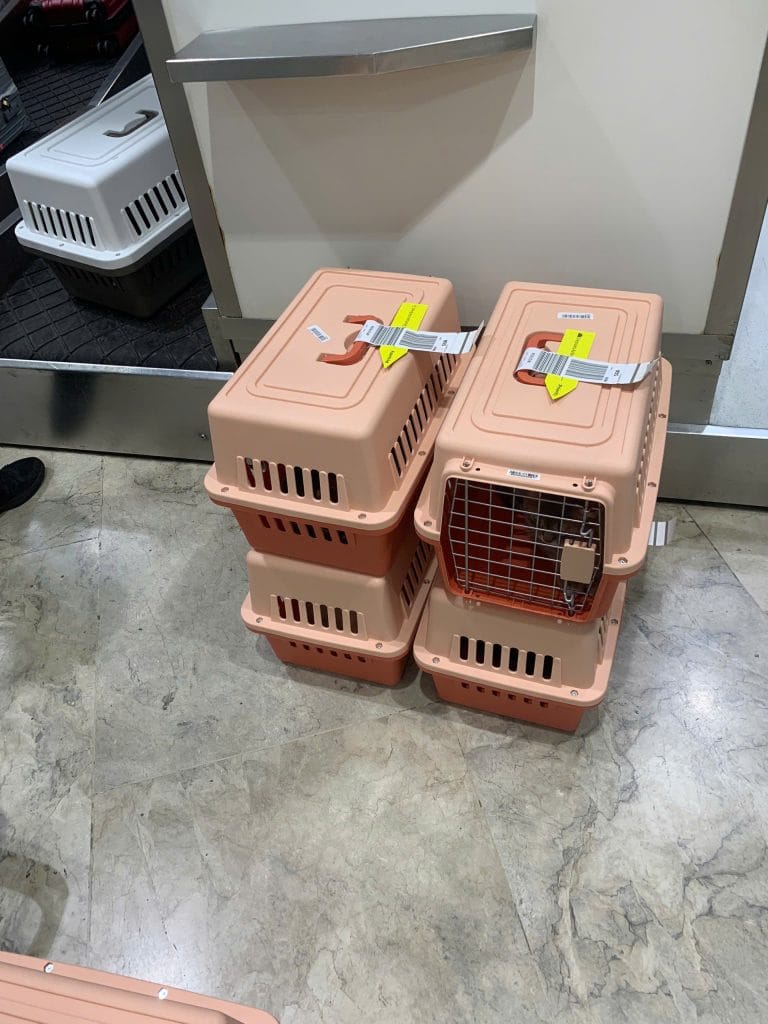
AVIH (Checked Baggage) means the pet travels under the owner’s passenger ticket, and you check them in at the passenger terminal before departure. Manifest Cargo means the pet travels under a separate Air Waybill (AWB) and is checked in at the cargo terminal. Manifest Cargo is required if the pet travels unaccompanied, if the airline does not offer AVIH, or if the total weight exceeds 32 kg. Read more about the budget details in our pet shipping cost to the Philippines guide.
12. Why does Daisy Pet Transport emphasize using a professional agent?
While the Philippines does not impose an absolute “agent-only” clearance rule like Singapore, self-managing the airline bookings, the complex online BAI portal registration, and the precise timing of the DAH endorsement is incredibly stressful. One small mistake in the microchip data or drug dosages on the health certificate can lead to boarding refusal or border detention. We provide a seamless, worry-free relocation experience.
Last updated 20 Oct 2026
Compiled by our specialists from the regulations in force on the date above, for reference only. Rules may change after this date. Please verify with the competent authorities or contact us for the most accurate information.