Canada’s pet import rules sit in an unusual position: strict enough to require documentation from a licensed veterinarian, lenient enough to require no quarantine and no rabies antibody test. That combination confuses many pet owners planning a Vietnam-to-Canada move, because the rules don’t follow the pattern of other developed countries.
For a comprehensive overview of the relocation process, consult our main Pet Shipping to Canada guide. This FAQ addresses the questions our team receives most frequently to help you prepare for a smooth journey.
Does Canada require quarantine for pets from Vietnam?
No. Canada does not quarantine personal pet dogs and cats on arrival from Vietnam. Upon landing at YYZ, YVR, or YUL, your pet goes directly from the cargo hold to a CBSA inspection point. If documents are in order, the CBSA officer releases your pet to you the same day — typically within one to three hours of the flight landing, depending on cargo processing time at the terminal.
This is the single most significant difference between the Canada route and comparable English-speaking destinations. Australia mandates a minimum 10-day quarantine (often 10–14 days in practice) at government-approved facilities, at the owner’s expense. Japan requires a 180-day antibody test preparation and 12 days of import quarantine. Canada requires neither.
Does Canada require a rabies antibody test (RNATT / FAVN test)?
No. Despite classifying Vietnam as a high-risk country for rabies, CFIA does not require a Rabies Neutralizing Antibody Titre Test (RNATT — also called the FAVN test) for personal pet imports. Canada requires only a valid rabies vaccination certificate from a licensed veterinarian.
The practical implication: if your pet has never been vaccinated against rabies (or if their last vaccination has lapsed), you vaccinate, wait 30 days (Daisy Pet’s standard buffer for this route), and travel. No blood draw, no six-month wait for test results, no USDA/CFIA-accredited laboratory. This compresses the minimum preparation timeline to six to eight weeks — compared to six-plus months for countries that mandate the antibody test.
What documents does my pet need to enter Canada?
For personal pet dogs and cats from Vietnam, CFIA’s own requirement comes down to one core document, plus one more your vet and airline will ask for:
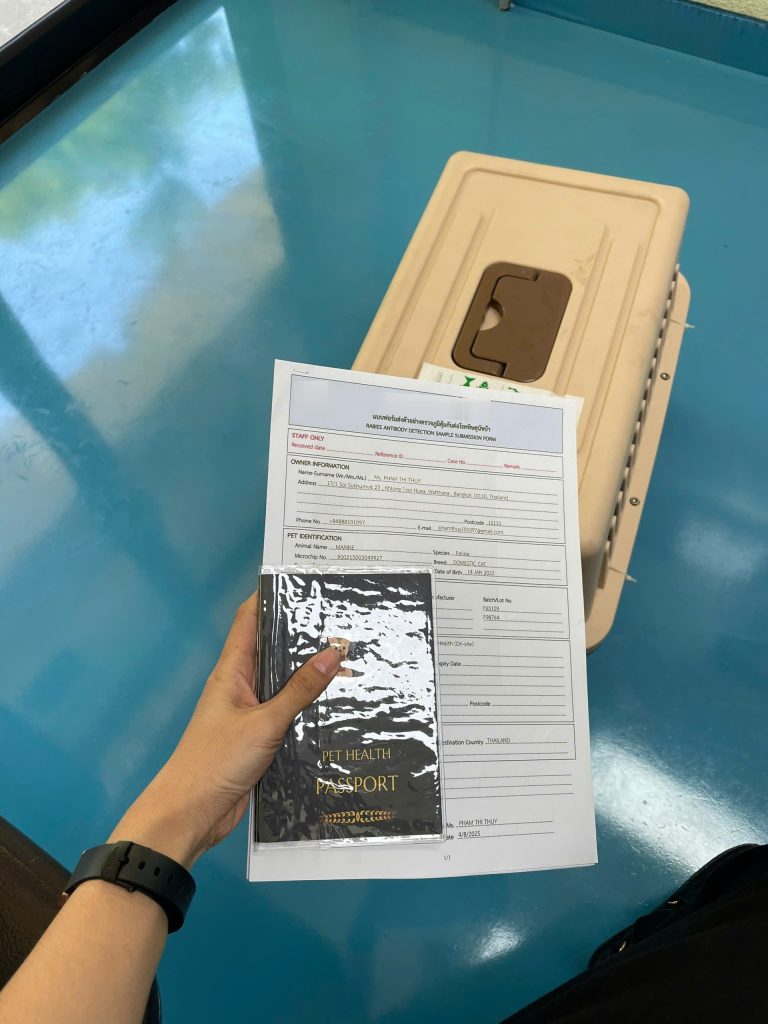
1. Rabies vaccination certificate — the document CFIA actually checks. Issued by a licensed veterinarian. Must be in English or French (a Vietnamese-language certificate is accepted only with an official translation). Must include: the pet’s description (species, breed, color, sex), microchip number, vaccine brand name and batch/serial number, date of vaccination, and expiry date. The expiry date must fall after your planned arrival date in Canada.
2. Animal Health Certificate (Giấy Kiểm Dịch Động Vật Xuất Khẩu). This one isn’t a CFIA import requirement — it’s issued by a licensed Vietnamese veterinarian as part of Vietnam’s own export paperwork, and most airlines require it as a condition of carriage. Confirms the pet is free from clinical signs of disease and fit for transport. Most airlines require this certificate to be issued within 10 days of departure — time this carefully relative to your flight date. Worth carrying anyway, since a CBSA officer may ask to see it alongside the rabies certificate.
You will also need your own government-issued ID (passport) at the CBSA inspection point. There is no additional import permit required for personal pets.
Does my pet need a microchip to enter Canada?
CFIA does not federally mandate microchipping for personal pet imports from Vietnam. However, every commercial airline that accepts pets as cargo — Korean Air, Cathay Pacific, Air China — requires an ISO 11784/11785-compliant microchip as a condition of acceptance. In practice, microchipping is non-optional.
The microchip number must appear on both the rabies certificate and the Animal Health Certificate. Implant the chip before administering the rabies vaccine — the vaccination certificate must reference the chip number that was in place at the time of vaccination. Reversing this order creates a documentation mismatch that can cause airline rejection at check-in.
Can I import a rescue dog from Vietnam to Canada?
Personal pet imports (one or two pets, traveling with or to their owner) are permitted under standard CFIA rules. However, CFIA maintains a strict ban on the commercial importation of dogs from high-risk rabies countries, which includes Vietnam. “Commercial” is interpreted broadly — it covers rescue organizations, shelters, and any entity importing dogs for rehoming, sale, or adoption, regardless of nonprofit status.
If you are an individual relocating and your dog has been your personal pet in Vietnam, this ban does not apply to you. If you are affiliated with a rescue organization importing dogs for adoption in Canada, contact CFIA directly for current guidance — the commercial dog import policy has been actively enforced and any violations carry significant penalties.
Are there breed bans in Canada I should know about?
Canada has no federal breed ban — the federal government does not prohibit any specific breed from entering the country. However, Breed-Specific Legislation (BSL) is enacted at the provincial and municipal level, and two significant restrictions apply:
Ontario: The Dog Owners’ Liability Act prohibits pit bull-type dogs. This covers pit bull terriers, Staffordshire bull terriers, American Staffordshire terriers, and dogs that substantially resemble these breeds. If your dog falls into this category, Ontario is not a viable destination province without a legal exemption.
Winnipeg, Manitoba: Similar breed-specific restrictions apply at the city level.
If your destination is British Columbia, Alberta, Quebec, or most other Canadian provinces and cities, there is no breed ban in place for dogs arriving from Vietnam. Confirm the specific regulations for your destination city and province before finalizing travel arrangements — BSL can change.
Which airlines fly pets from Vietnam to Canada?
There are no direct flights between Vietnam and Canada. All pet shipments travel as Manifest Cargo through at least one connecting hub. The three primary routes are:
Korean Air via Seoul Incheon (ICN): Accepts pets as manifest cargo on both the Vietnam leg and the transpacific segment. SGN/HAN → ICN → YYZ/YVR. Generally considered the most reliable option for this route.
Cathay Pacific via Hong Kong (HKG): Accepts manifest cargo pets. SGN/HAN → HKG → YYZ/YVR. Transit handling at HKG is well-established for live animals.
Air China via Beijing (PEK): Accepts manifest cargo pets. SGN/HAN → PEK → YYZ/YVR. Note that Air China has seasonal embargoes on brachycephalic breeds (flat-faced dogs like French Bulldogs, pugs) — verify acceptance before booking if your dog is a brachycephalic breed.
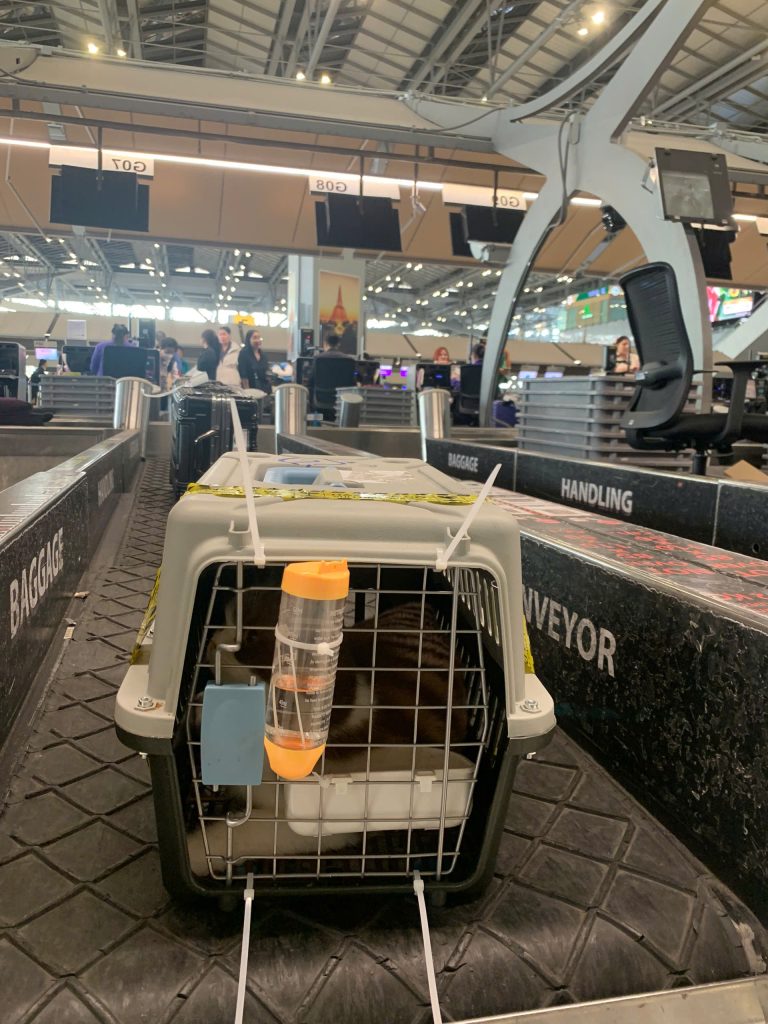
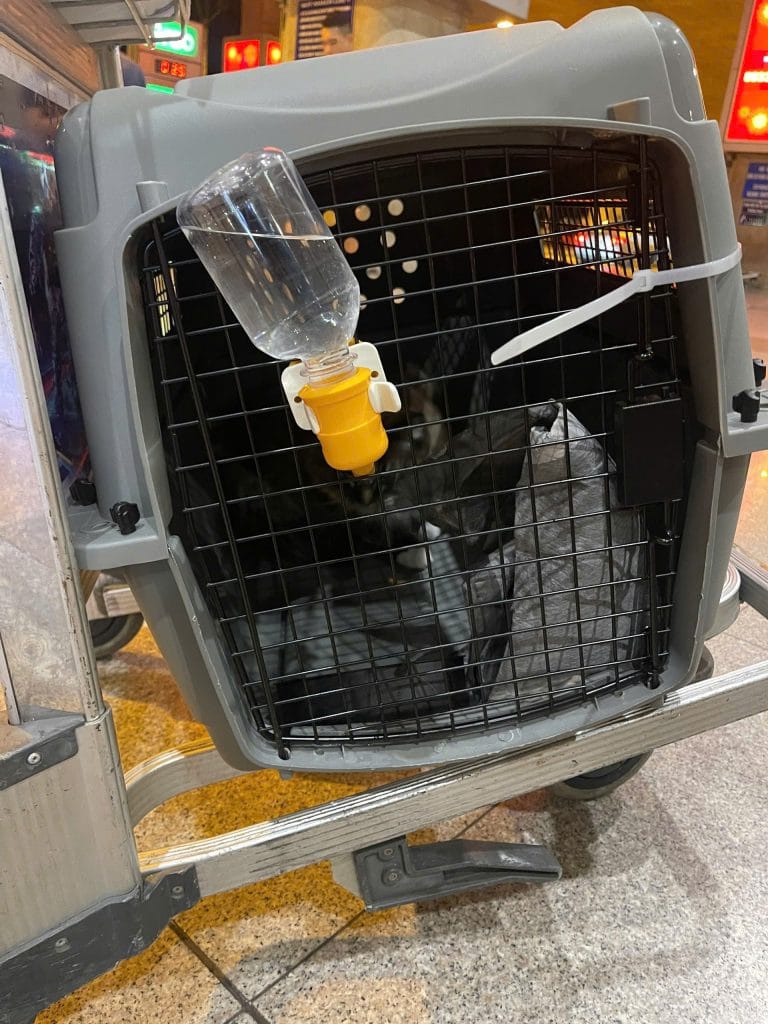
In-cabin and checked baggage options are not available on these long-haul transpacific routes. All pets travel in a climate-controlled, pressurized cargo hold. For a full comparison of routes, airlines, and cargo policies, see our Airlines for Pet Transport Vietnam to Canada guide.
How long does preparation take?
The minimum preparation timeline is six weeks, driven primarily by Daisy Pet’s standard 30-day post-vaccination waiting period. A realistic, comfortable timeline is eight weeks, which allows buffer time for crate training and documentation verification.
Week 1: Microchip + rabies vaccination (30-day wait begins). Weeks 2–4: Airline research, crate procurement, crate training. Week 5: Pre-travel health exam and Animal Health Certificate. Week 6: Confirm airline booking, final document check, departure.
If your pet already has a current, valid rabies vaccination (administered within the last 12 months and not expired), the 30-day wait does not apply and the timeline can compress to as little as two to three weeks. For the complete step-by-step roadmap, see our Pet Shipping Timeline Vietnam to Canada.
What happens if my documents are incomplete or incorrect at the Canadian border?
The CBSA officer at the port of entry reviews documents at arrival. If documentation is incomplete, the officer has several options depending on the nature of the deficiency:
Minor administrative issues (legibility, formatting) may be resolved on-site with a phone call to CFIA. More serious deficiencies — missing rabies certificate, expired vaccination, microchip number mismatch — can result in your pet being held at the cargo terminal at your expense while documentation is corrected. In the most serious cases, CFIA can order the pet returned to Vietnam or humanely euthanized.
The most common documentation error is a mismatch between the microchip number on the health certificate and the chip number on the rabies certificate. Cross-check both documents before departure — this takes five minutes and prevents the most frequent border delay our clients encounter.
How much does it cost to ship a pet from Vietnam to Canada?
Total costs range from approximately USD $1,200 to $5,500 depending on your pet’s size, route, and how much of the logistics you manage yourself. The two largest cost components are airline cargo fees (calculated on volumetric weight) and the IATA-compliant travel crate. Canada adds no quarantine costs on arrival — the only mandatory arrival payment is the CBSA border inspection fee of CAD $36.95 for the first pet (plus GST/HST; CAD $6.16 for each additional pet).
For a full breakdown by pet size and scenario, including full-service vs. self-managed costs, see our Pet Shipping Cost to Canada guide. For a complete explanation of CFIA compliance requirements, see our Canada Pet Import Laws guide. Ready to plan? Contact Our Team for a personalized assessment.
Last updated 16 Aug 2026
Compiled by our specialists from the regulations in force on the date above, for reference only. Rules may change after this date. Please verify with the competent authorities or contact us for the most accurate information.