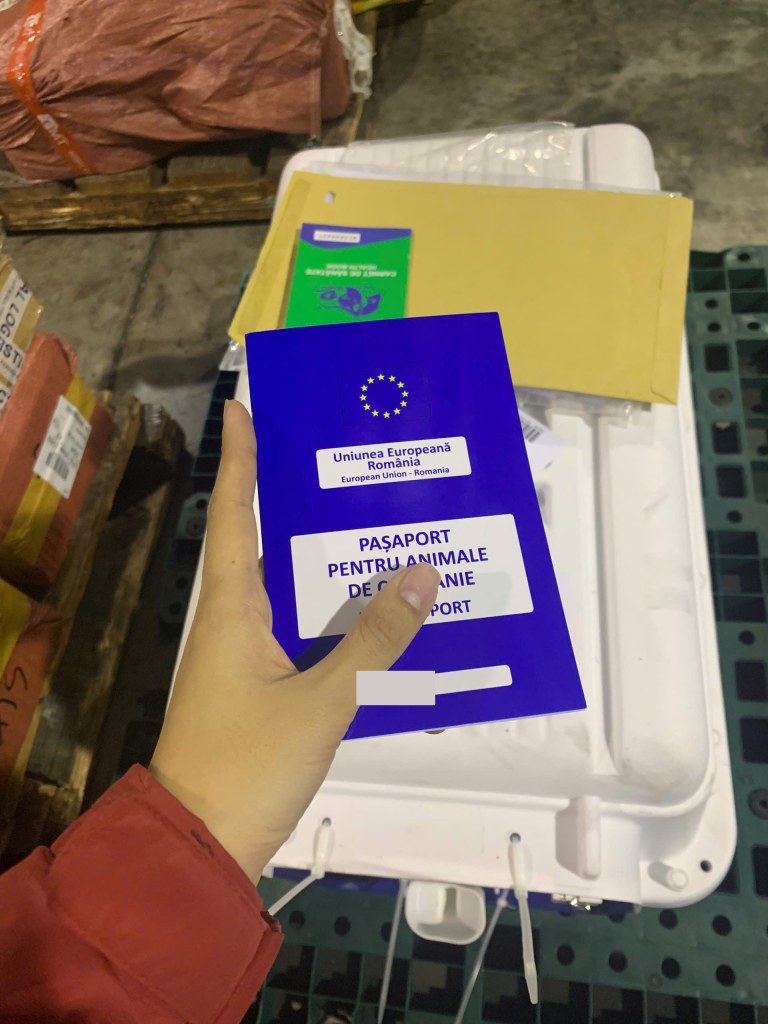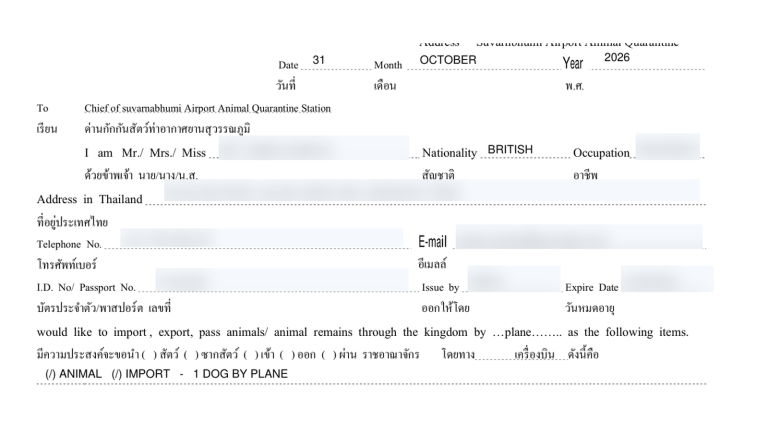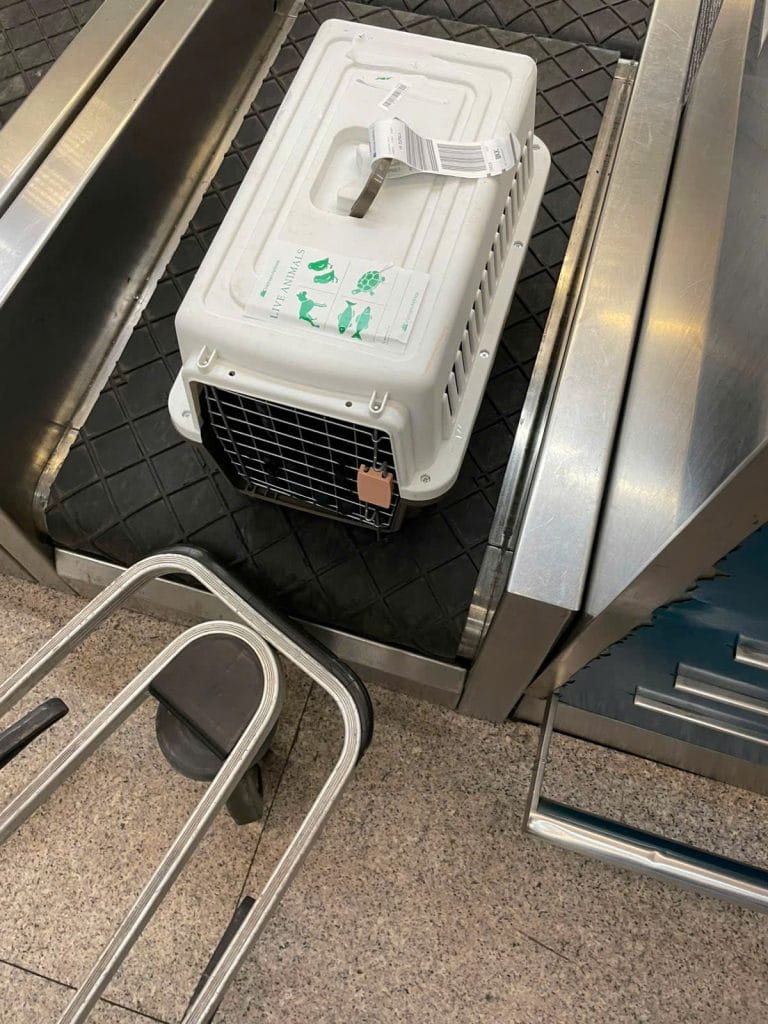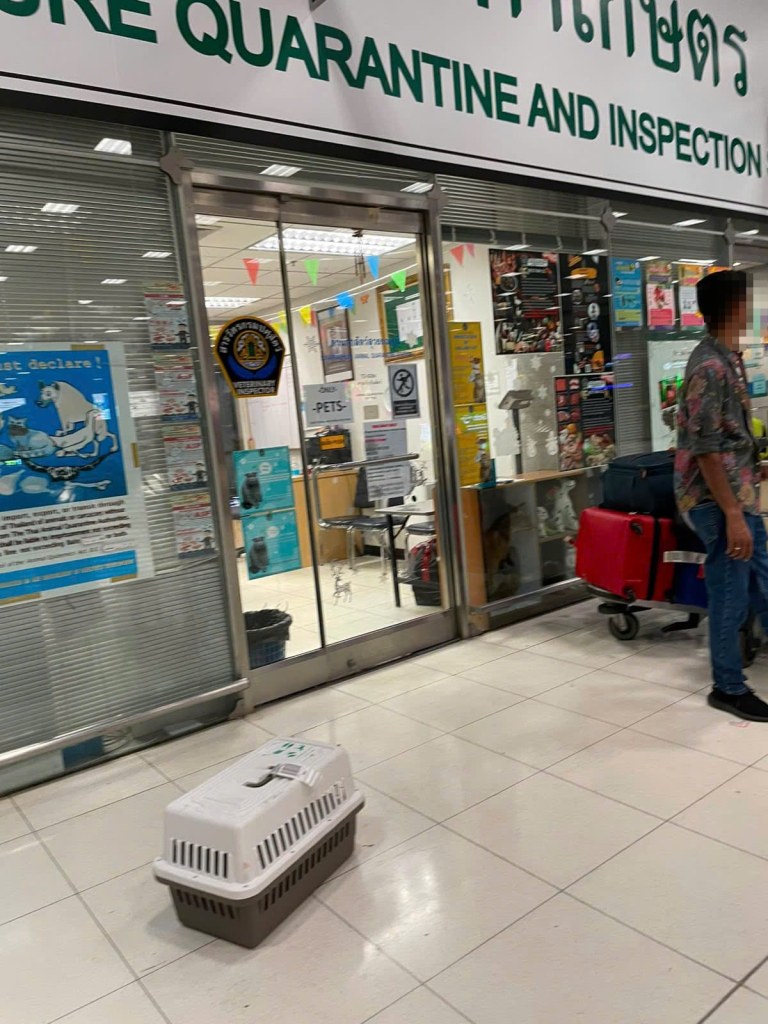
Large and snub-nosed pets can fly to and from Thailand, but fewer airlines accept them. Thai law bans no dog or cat breed. The limits come from airlines, and they exist for safety: short airways and Thailand’s year-round heat. A snub-nosed pet is safest in the cabin if it fits; a large dog needs the right airline, crate and flight time.
Large and snub-nosed pets: quick answers
- Should a snub-nosed pet fly to Thailand? Only after a vet check, and most safely in the cabin if pet and carrier weigh up to about 8 kg. Bangkok is hot all year, so very few airlines take snub-nosed breeds in the hold, and only in cooler months.
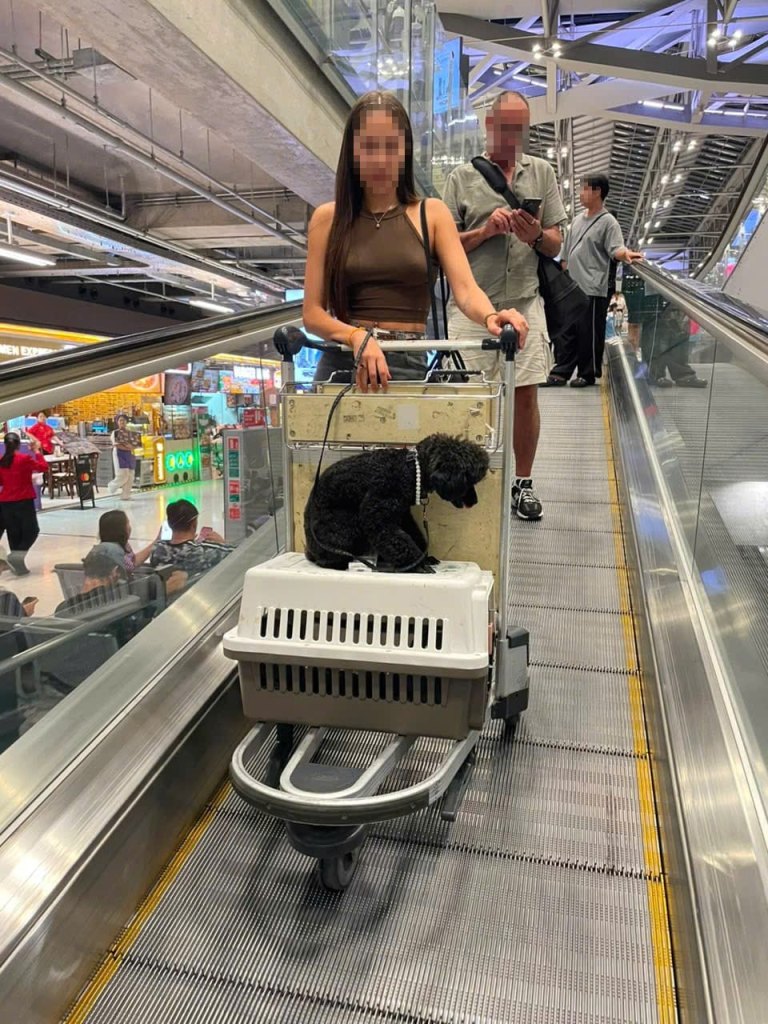
- Which airline takes a 50 kg dog? In the hold with the owner, Qatar Airways and KLM accept up to 75 kg and Thai Airways up to 70 kg, pet and crate together. Heavier dogs fly as cargo.
- Does Thailand ban Pugs or Pit Bulls? No. Thai import law bans no breed, so write the true breed on the import permit application. Airlines set the breed limits. The full entry rules are in our guide to bringing a dog or cat to Thailand.
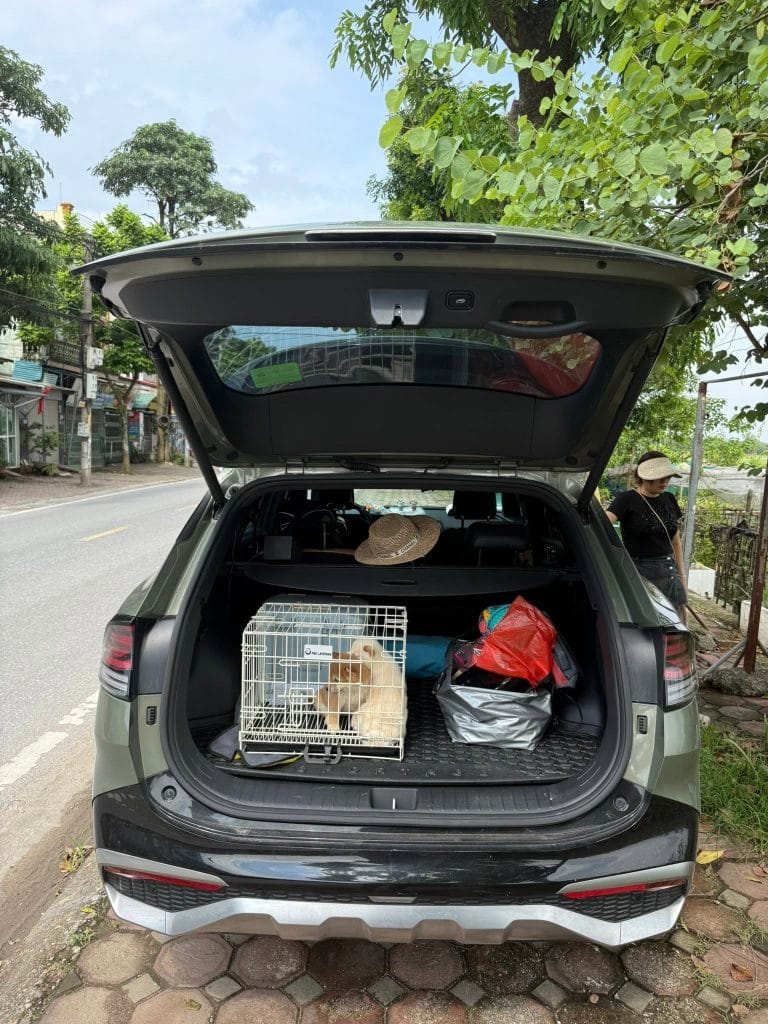
- Can I buy a giant crate in Thailand? Large crates are hard to find off the shelf. Order early or have one built.
- Should I sedate my dog for the flight? No. IATA advises against sedating pets for air travel. Our guide on sedating pets before a flight explains why.
Why snub-nosed pets face extra limits on Thailand flights
Snub-nosed (brachycephalic) dogs and cats have short airways. They cool down by panting, and a short airway makes panting less effective. Heat and stress raise the risk of breathing trouble in a closed crate.
Thailand adds heat. Bangkok is hot in every month: Thai Meteorological Department records show daytime highs of 31 to 35°C at Suvarnabhumi all year, and nights rarely cool below 23°C. Many airlines stop loading pets in the hold above about 29°C on the ground. For snub-nosed breeds, some airlines set the line lower, at 27°C or even 21°C.
The breed itself is only part of the risk. A pet’s own airway, weight and fitness matter as much. Our guide to flying a flat-faced dog or cat explains the BOAS assessment vets use to grade breathing.
Which airlines still accept snub-nosed pets to or from Thailand?
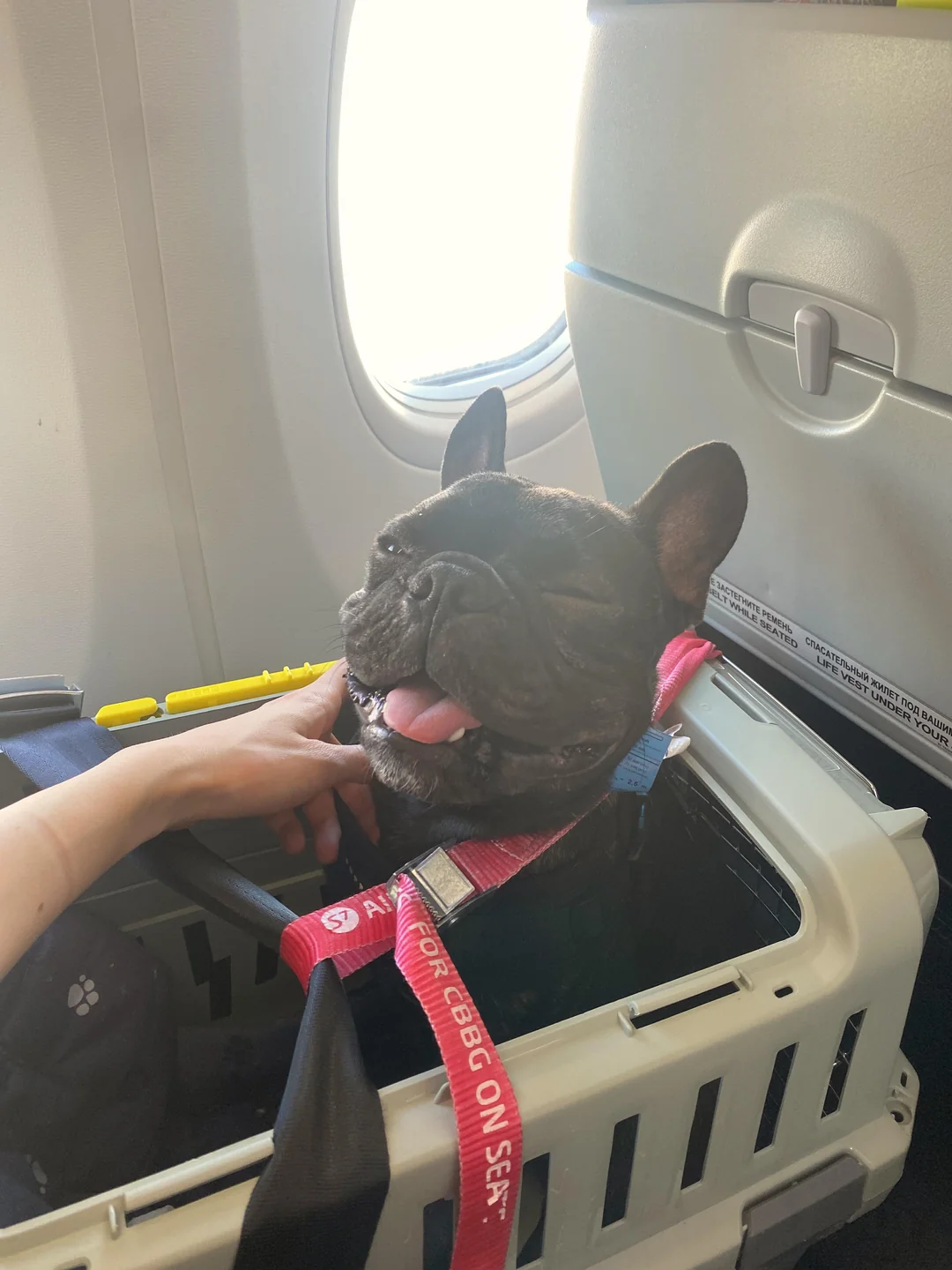
For a snub-nosed pet, the cabin is the main door. These airlines carry dogs and cats in the cabin on Thailand routes, and generally accept snub-nosed breeds there, within the weight limit for pet and carrier together:
- Up to 8 kg: Turkish Airlines, Lufthansa, SWISS, KLM, Finnair and Etihad (on Etihad’s own flights via Abu Dhabi).
- Up to 7 kg: Korean Air.
In the hold, the door is almost closed. Thai Airways, Qatar Airways, Singapore Airlines, Lufthansa, SWISS, Austrian and Korean Air do not carry snub-nosed breeds in the hold, and KLM refuses most of them there. EVA Air refuses them all year on any trip through Southeast Asia. Bangkok Airways refuses Persian, Exotic, Himalayan, Burmese and British Shorthair cats in the hold, and Vietnam Airlines refuses Persian, Exotic, Himalayan and Burmese cats in any form, even in the cabin.
Between Vietnam and Thailand, a snub-nosed pet has almost no direct flight: Vietnam Airlines refuses the snub-nosed breeds on its list in any form, even in the cabin, and Thai Airways takes no snub-nosed breeds and no checked pets on its Vietnam flights.
A few cargo options open only in the cool months, under strict conditions:
- Turkish Cargo: a crate one size larger, ventilation on four sides, a signed waiver, and below 27°C at both ends. In Bangkok, that means night flights between November and February.
- Etihad Cargo: snub-nosed breeds only from 1 November to 1 March.
- Emirates SkyCargo: opened a winter window from November 2025 to April 2026. By 1 November 2026, it had not announced a window for 2026/27.
A cargo window does not make the flight safe by itself. The vet check below decides whether your pet should use it.
Should a snub-nosed pet fly at all?
Sometimes the safest answer is to wait, or not to fly. A vet who knows the breed should examine the pet first. The check looks at breathing at rest and after light exercise, the nostrils, weight and heart. Some vets grade the airway with a BOAS assessment.
Three situations call for a pause:
- Noisy breathing at rest: snoring or gasping while calm means the airway is already working hard.
- Overweight: extra weight narrows the airway further. A few weeks of weight loss can lower the risk.
- Hot season only: if the only route open is a daytime flight in April or May, a later date in the cool months is safer.
A vet’s fit-to-fly letter does not override an airline’s breed list. It is a safety check for you. Our guide to the fit-to-fly vet check lists what the vet examines and when to book it.
Large dogs: which airlines take them?
A dog of 40 to 60 kg with its crate can fly with its owner only on airlines with a high hold limit, such as Qatar Airways and KLM at 75 kg, or Thai Airways at 70 kg on wide-body aircraft. Above that, or for strong breeds that some airlines carry only in a reinforced crate, the dog flies as manifest cargo. Our guide to airlines that allow pets to Thailand lists the hold limit of each airline by departure country.
Why aircraft size matters for giant crates
A giant crate must pass through the door of the aircraft’s cargo hold. On the Airbus A320, the forward hold door is 1.82 m wide and 1.24 m high, according to Airbus. The largest standard plastic crate fits through it. The Boeing 737 is tighter: its hold door is about 84 cm high, so it takes crates up to about size 500. Wide-body aircraft such as the Boeing 777, 787 and Airbus A350 have larger hold doors.
The door is only one limit. Each airline also sets its own crate and weight limits per aircraft. Thai Airways, for example, does not carry checked pets on its A320s at all. For a giant breed, the realistic routes are long-haul wide-body flights, or a cargo booking on a flight the cargo agent has checked for that crate.
Inside Thailand the limits are tighter. Many domestic routes use the A320, and the Bangkok Airways and Nok Air crate limits rule out the largest crates, so for a giant dog going from Bangkok to Chiang Mai the road is often the only option. Our guide to domestic flights with pets in Thailand compares flights, pet taxis and car ferries.
Crates for large dogs: size 700 and custom-built crates
The largest standard plastic crates are known as size 700, around 122 × 81 × 89 cm on the outside. A giant breed measured with the IATA formula can need more height or length than that. Strong breeds can also be too powerful for a plastic shell, and some airlines require a reinforced wooden crate for named breeds.
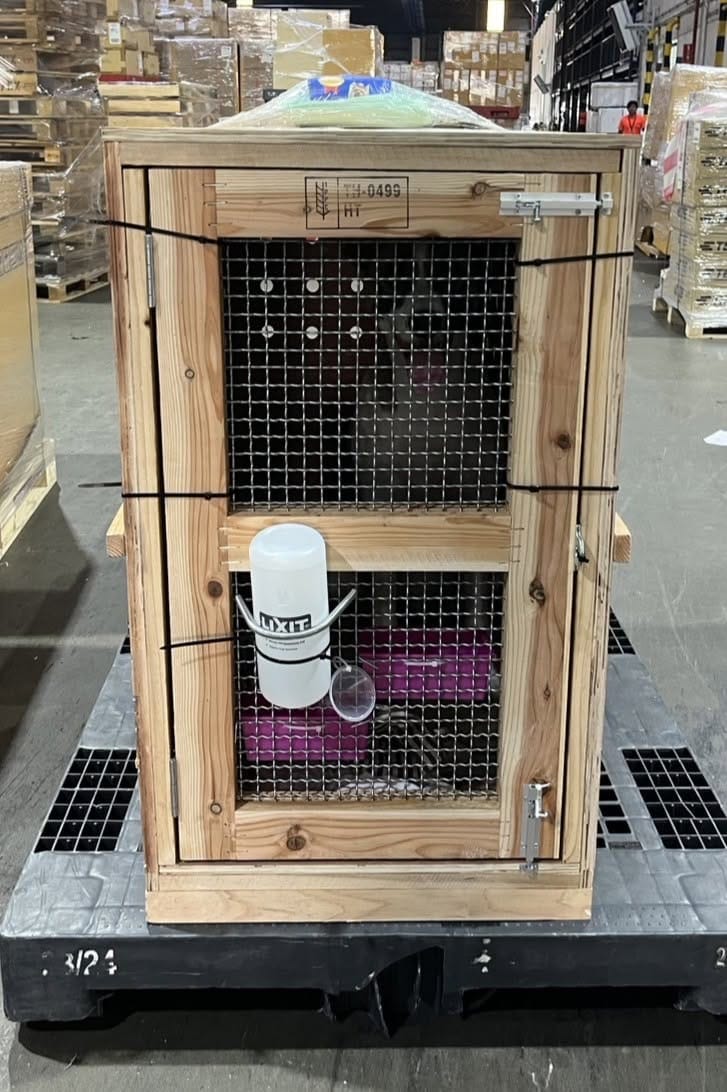
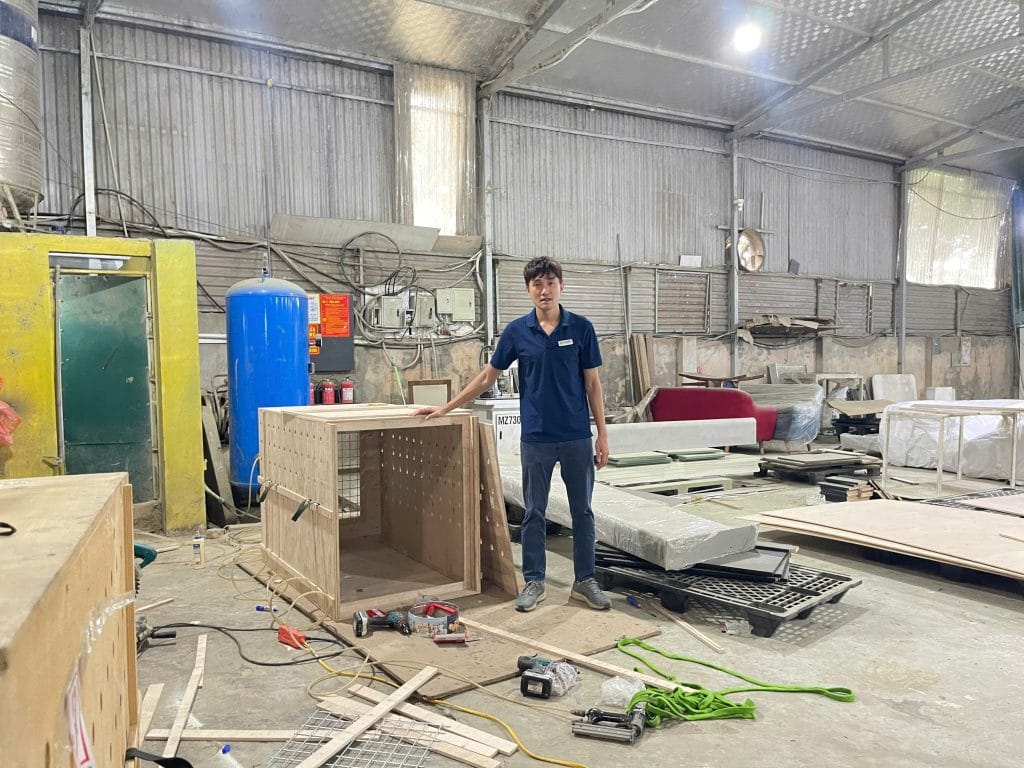
A crate built to the dog’s measurements solves both problems. Size it before the airline booking, because the crate decides which aircraft can take the dog. The rules for wood, ventilation and door bolts are in our guide to wooden dog crates for air travel, and the full IATA standard is on the IATA pet crate page.
The crate also drives the price. Cargo is charged on the greater of the actual weight and the volumetric weight: length × width × height in cm, divided by 6,000 on most airlines. A size 700 crate of 122 × 81 × 89 cm works out at about 147 kg chargeable, even if the dog and crate weigh 60 kg. Trimming a few centimetres the dog does not need can cut the bill. Our Thailand pet relocation cost guide shows how the freight line fits into the total.
Buying or borrowing a large crate in Thailand
Large crates are hard to buy off the shelf in Thailand. Size 700 crates mostly come through import sellers online, with long delivery times and frequent stock-outs. Owners who ask on expat forums for a shop with giant crates in stock often get no answer. We found no public crate rental service.
Two habits avoid a last-minute problem. If your dog is flying into Thailand, the crate comes from the departure country, so this only matters for the return trip: keep the crate. If your dog is leaving Thailand, measure it and order the crate at least three to four weeks before the flight. A custom-built crate needs heat-treated wood with an IPPC mark for international flights, as the IATA standard requires.
Senior pets and sedation
No airline we checked sets a maximum age for pets. Heart, breathing and kidney problems matter more than age, so an older pet needs a vet check at least a month before the flight. IATA advises against sedation, because sedatives affect breathing and balance at altitude. Our guide to pet travel safety explains how vets and airlines judge whether an older pet should fly.
Leaving Thailand with a large or snub-nosed pet
The same airline rules apply in the other direction. A snub-nosed pet leaving Bangkok has the best chance in the cabin, for example on Etihad to Abu Dhabi or on European airlines that fly nonstop from Bangkok. A large dog needs a wide-body flight with a high hold limit, or cargo.
The destination adds its own rules. The UK, for example, accepts pets only as manifest cargo on approved routes. In Thailand, the export permit and health certificate come from the quarantine station at the airport the pet leaves from, on weekdays only. The Thailand pet relocation page covers moves in both directions.
Large and snub-nosed pets in Thailand: FAQ
Can a French Bulldog fly to Thailand?
Yes, most safely in the cabin if dog and carrier weigh up to 8 kg, on an airline that accepts cabin pets. Thai Airways and Qatar Airways do not carry French Bulldogs in any form.
Can a Persian cat fly to Thailand?
Yes, in the cabin on an airline that accepts cats in the cabin and does not list the breed. Vietnam Airlines refuses Persian, Exotic, Himalayan and Burmese cats in any form, even in the cabin, and Bangkok Airways refuses Persian cats in the hold.
What is the biggest dog that can fly to Thailand with its owner?
Up to 75 kg with the crate on Qatar Airways, KLM and Finnair, and 70 kg on Thai Airways. A heavier dog flies as manifest cargo.
Is there an age limit for pets flying to Thailand?
No airline we checked sets a maximum age. Thailand requires pets to be at least 4 months old. An older pet needs a vet check before the flight.
Sources: IATA, Live Animals Regulations, Container Requirement 1; Airbus, A320 aircraft characteristics; Thai Airways, Pets as checked baggage. Checked October 2026.
Last updated 2 Nov 2026
Compiled by our specialists from the regulations in force on the date above, for reference only. Rules may change after this date. Please verify with the competent authorities or contact us for the most accurate information.
Official sources cited in this guide
- Live Animals Regulations, Container Requirement 1iata.org
- A320 aircraft characteristicsaircraft.airbus.com
- Pets as checked baggagethaiairways.com