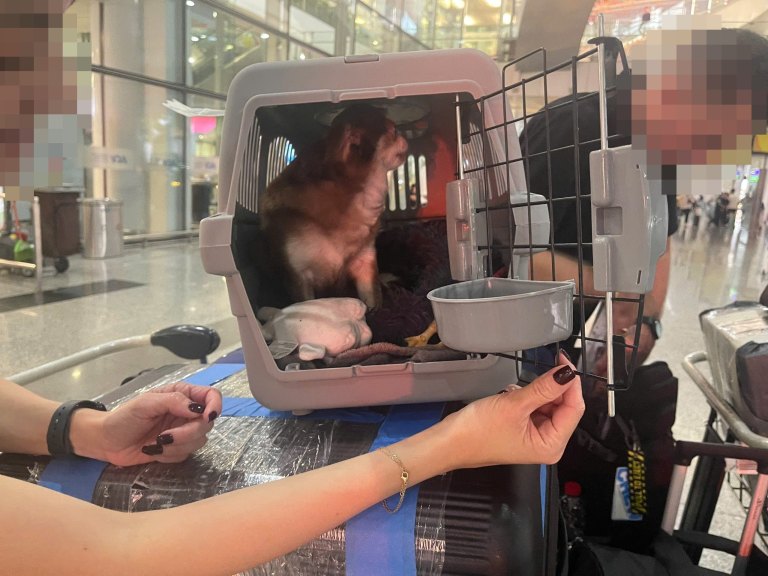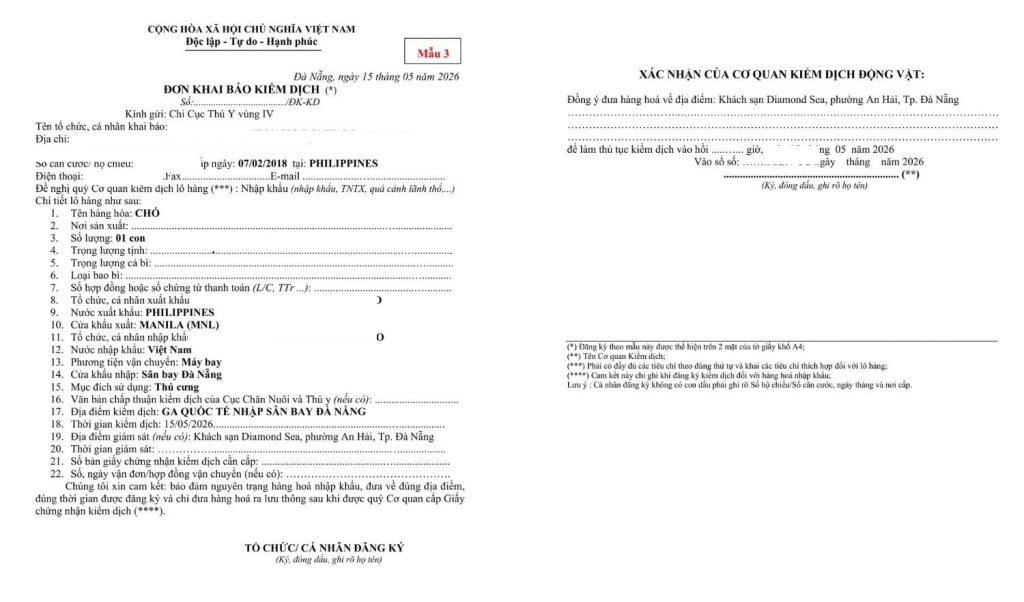
Form 3 (Mẫu 3) is the document that starts your pet’s entry into Vietnam. It is how the airport quarantine station learns that an animal is on its way, and every inspection, certificate and customs step that follows is built on it. A Form 3 that is filed correctly and on time keeps the arrival smooth; one with an error, or filed too late, can delay your pet’s release or send it back.
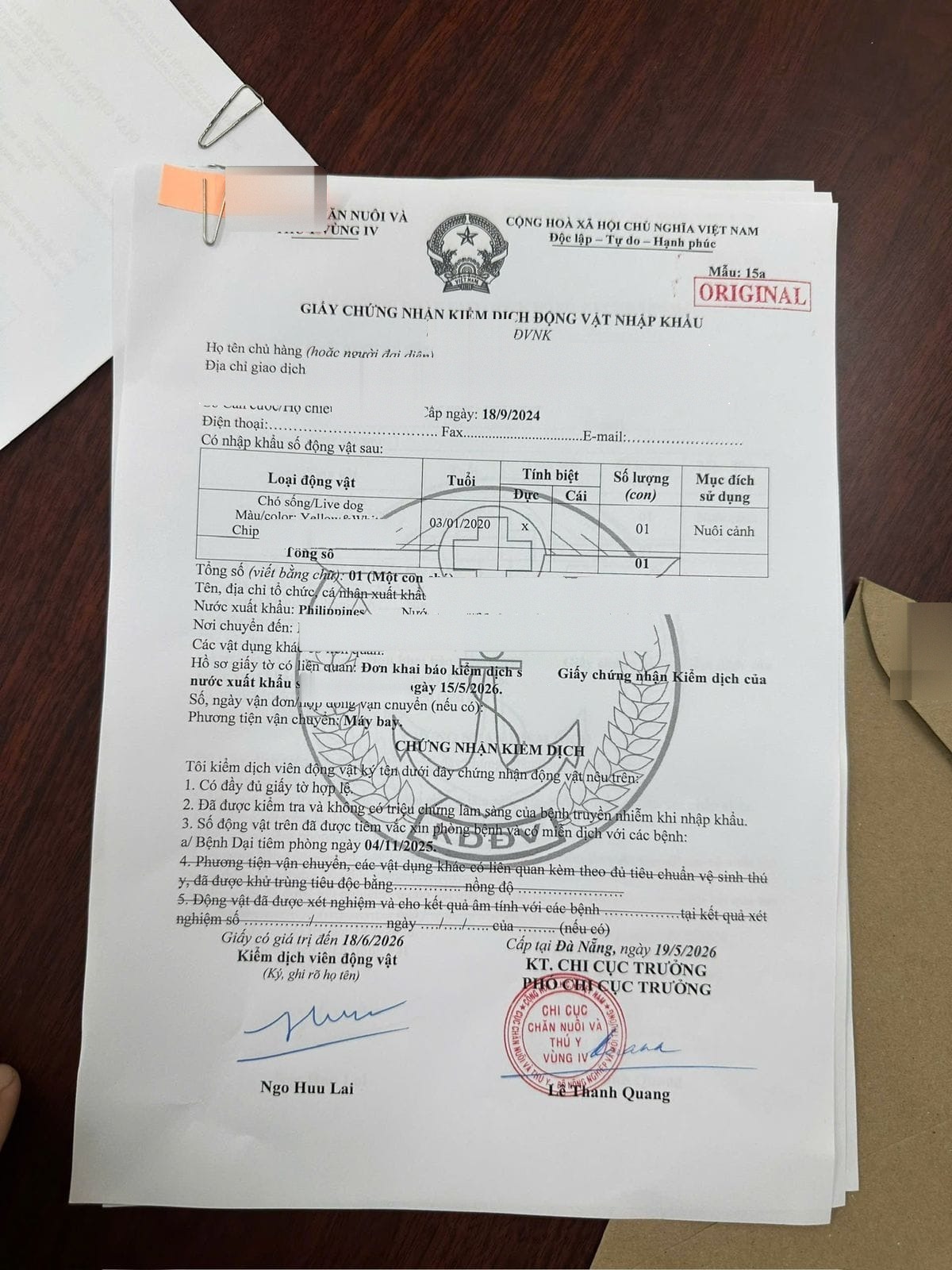
Form 3 and Form 15a are two different documents. Form 3 is the quarantine declaration form you file to ask for an inspection; it is not an import permit. Form 15a (Mẫu 15a), the Import Animal Quarantine Certificate, is what the station issues after the officer checks your documents, scans the microchip and examines your pet.
This guide follows the order in which you will meet each step: what Form 3 is, the documents it needs, what happens when your pet arrives, where it sits in the full import roadmap, and the best time to file.
Last updated: October 2026. Source: Circular 01/2026/TT-BNNMT of the Ministry of Agriculture and Environment.
1. What Is Form 3 (Mẫu 3)? Vietnam’s Pet Quarantine Declaration Explained
Form 3 is the quarantine declaration form required under Circular 01/2026/TT-BNNMT of the Ministry of Agriculture and Environment (Articles 10, 11 and 14). It tells Vietnam’s quarantine authority that an animal is about to enter the country and asks for it to be inspected.
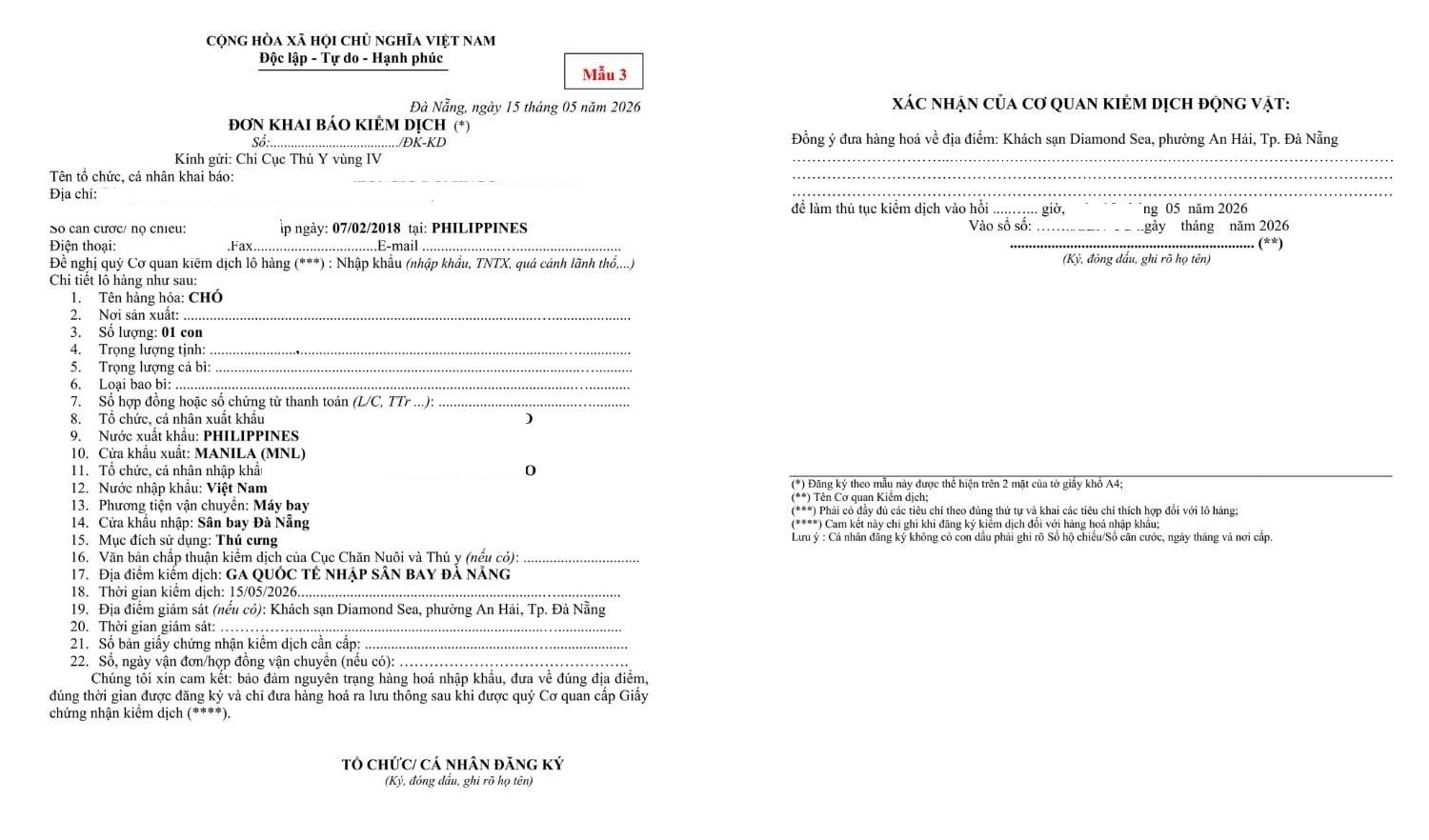
- Purpose: to declare the animal and request a quarantine inspection on arrival.
- Who files it: the owner or an agent, with the quarantine station of the arrival airport, together with the export country’s health certificate.
- What the station does with it: it confirms the declaration on the form itself, with its stamp, a register number and the agreed place and time of inspection.
- What it is not: an import permit. Vietnam issues no import permit in advance for 1–2 personal pets.
Note: if you are bringing 3 or more animals, you must also get approval from the Department of Livestock Production and Animal Health under Form 19 (Mẫu 19) before filing Form 3. Form 3 has a box for that approval, which stays blank for 1–2 personal pets.
In short, Form 3 is the input of the quarantine process. Its output is Form 15a (Mẫu 15a), the Import Animal Quarantine Certificate that the station issues once the inspection passes (Section 3).
2. Documents to File With Form 3
Required by regulation (Article 10.3): Form 3, plus a copy of the export country’s quarantine certificate; the original is shown at inspection. Because the export certificate must already exist, Form 3 is always filed late in the process. In practice, the file includes:
- The owner’s passport. Form 3 has a place for a company seal; an individual has no seal, so writes a passport or ID number there instead.
- An address in Vietnam (for a short stay, the hotel).
- The pet passport or vaccination booklet, with the rabies section.
- The export country’s health certificate.
- Other documents the export country issues, such as Australia’s Permit to Export Animals (valid 72 hours).
- The owner’s flight ticket (traveling with the owner) or the air waybill (cargo).
- For 3+ animals: the Form 19 approval from the Department of Livestock Production and Animal Health.
The microchip number must match exactly across every document.
Key Notes on Whose Name Goes on Form 3
Who does the paperwork and whose name appears on the documents are two separate questions:
- Pet traveling with you: the owner’s name is the simplest choice, and you can file Form 3 yourself. If an agent files it for you, the form either shows your name with “C/O” (care of) the agent, or names the agent’s staff member who files it; practice varies.
- Cargo: it is usually best to name the transport company as consignee on the air waybill and on Form 3. You can be named yourself, but you will then have to come to the cargo terminal to sign the release papers, which often takes 2–6 hours and a stack of forms. Either way, an owner cannot open the customs declaration personally; that has to be done by a company or licensed agent, so cargo imports go through an agent.
- When the export country decides: some countries issue the export health certificate only in the owner’s name, and the consignee on the air waybill must match it. Our Turkey to Hanoi cargo case shows how this plays out.
3. What Happens When Your Pet Arrives: Inspection and Form 15a
On the day your pet lands, the process runs in this order:
- Form 3 is on file and confirmed. The station already holds your declaration and has confirmed the place and time of inspection (see Section 5 for when to file).
- Inspection. The quarantine officer checks your documents against the declaration, scans the microchip and examines your pet.
- Form 15a is issued. Once the inspection passes, the station issues Form 15a, the Import Animal Quarantine Certificate. It confirms that the pet has valid documents, was examined and showed no clinical signs of infectious disease, and it lists the rabies vaccination date. The certificate is valid for 60 days (Article 24.5.b of Circular 01/2026/TT-BNNMT) and is usually issued on the day of landing.
- Fees and customs. You pay the quarantine fee and import tax, then customs releases the pet. For a pet traveling with you this usually takes 1–3 hours.
If your pet travels as cargo, the steps are the same, with a few differences:
- An agent files Form 3 with the air waybill before the flight lands (3+ pets need Form 19 approved first).
- Customs also examines the animals after Form 15a is issued.
- Release typically takes 2–6 hours after landing, and terminal charges apply (see our cost to ship a pet to Vietnam guide).
What Happens If a Check Fails?
There is no fixed list of outcomes: the officer decides case by case, based on the documents and the pet’s condition. The outcome can be a delayed release while documents are corrected, return to the export country, quarantine or, for an animal with a dangerous infectious disease, destruction near the border gate under Article 14.5 of Circular 01/2026/TT-BNNMT.
4. The Full Import Roadmap: Where Form 3 Fits
Form 3 has to be filed with a copy of the export health certificate, so it can never be the first step. Every import to Vietnam follows the same three stages, in this order:
| Stage | What it involves |
|---|---|
| 1. Export country | Depends on the export country: typically an ISO microchip, a rabies vaccination (at least 30 days before the flight, under 12 months old on arrival), a government-endorsed export health certificate, and an export permit where required. |
| 2. Airline & flight mode | A confirmed booking and the flight mode: in-cabin, checked baggage (AVIH) or cargo. Some export countries decide this for you: Australia only lets pets leave as cargo. |
| 3. Vietnam | File Form 3 with the airport quarantine station. On arrival: document check, microchip scan, clinical exam, then Form 15a, quarantine fee and import tax, and customs release. Shipments of 3+ pets also need Form 19 approved first. What Vietnam itself checks is listed in the pet import to Vietnam requirements. |
| Preparation timeline | A structured 30-day schedule from Day 1 to Day 30, see our pet import timeline. |
5. The Best Time to File Form 3
The safest time to file Form 3 is about 48 hours before landing. The regulation itself sets no fixed number of days; it distinguishes two groups:
- 1–2 pets traveling with the owner (companion animals, travel or work trips, not on the prohibited list): Article 14.1.a allows the declaration to be made directly at the border quarantine office.
- Unaccompanied cargo and shipments of more than 2 animals: under Article 11.2, the declaration is filed before the shipment reaches the border, and the office has one working day to confirm it (Article 11.2.b).
In practice there are three ways to handle the timing:
- File about 48 hours before landing (earlier if that falls on a weekend or public holiday). This is the safest option: if a document has a problem, there is still time to fix it before your pet arrives. Daisy Pet files in person at the airport quarantine station, the unit that inspects the pet on landing.
- File on the day of arrival. Necessary when the export documents are issued very close to the flight, as in Australia. It works, but it leaves no time to correct a mistake.
- Declare at the airport on arrival yourself. Allowed for 1–2 pets traveling with the owner, but it carries the most risk: an error found at the counter cannot be fixed on the spot, and the pet may face return, quarantine or, in the worst case, destruction.
Where to File Form 3: Airport Quarantine Offices (SGN, HAN, DAD)
The regulation allows several channels, including the National Single Window, the public service portal, post, email, fax and in-person filing. File with the office covering your arrival airport (the Regional Animal Health Office, officially named the Regional Animal Health and Production Office on Vietnamese forms):
- Tan Son Nhat (SGN), Ho Chi Minh City: Regional Animal Health and Production Office No. VI and its Tan Son Nhat Airport Animal Quarantine Station.
- Noi Bai (HAN), Hanoi: Regional Animal Health and Production Office No. I and its Noi Bai Airport Animal Quarantine Station.
- Da Nang (DAD): Regional Animal Health and Production Office No. IV. Confirm officer availability before a night arrival.
6. Common Form 3 Mistakes
- Microchip mismatch: one wrong digit between the chip, the health certificate, the vaccination record and Form 3.
- Rabies timing: the vaccine must be given at least 30 days before the flight and be no more than 12 months old on the day you enter Vietnam. Vietnam does not accept a 3-year vaccine once the dose is older than 12 months.
- No government endorsement: a health certificate signed only by a private vet, without the export country’s official endorsement (for example the USDA APHIS seal for the US, see our USA to Vietnam guide).
- Filing too late: no time left to correct an error before landing.
- Wrong office: filing with Office I (Hanoi) for a pet landing at Tan Son Nhat (Office VI).
- Skipping Form 19: bringing 3 or more animals with only Form 3 (see our guide to importing 3 or more pets).
Any of these can lead to a failed check; the possible outcomes are explained in Section 3.
7. FAQs: Vietnam Pet Import Form 3 & Form 15a
Is Form 3 an import permit for my pet?
No. Form 3 (Mẫu 3) is a quarantine declaration that asks the airport quarantine station to inspect your pet. Vietnam issues no import permit in advance for 1–2 personal pets. The document that clears your pet is Form 15a (Mẫu 15a), issued only after the officer checks the documents, scans the microchip and examines the animal.
Can I file Form 3 myself?
Yes, if your pet travels with you in the cabin or as checked baggage: you can file Form 3 in your own name and attend the inspection. Cargo is different: an unaccompanied pet needs an electronic customs declaration that only a company or licensed agent can file, so cargo imports go through an agent.
When should I file Form 3?
The regulation sets no fixed number of days. Filing about 48 hours before landing is the safest option, because any error can still be fixed before your pet arrives. In urgent cases Form 3 can be filed on the day of arrival, but that leaves no time to correct a problem.
Where do I file Form 3?
With the quarantine office that covers your arrival airport: Regional Animal Health and Production Office No. VI and its Tan Son Nhat Airport Animal Quarantine Station for Ho Chi Minh City (SGN), Regional Animal Health and Production Office No. I and its Noi Bai Airport Animal Quarantine Station for Hanoi (HAN), and Regional Animal Health and Production Office No. IV for Da Nang (DAD).
Can I file Form 3 online?
Yes. The regulation allows several channels, including the National Single Window, the public service portal, post, email, fax and in-person filing. Daisy Pet files in person at the airport quarantine station, the unit that inspects the pet on landing.
Can I clear a cargo pet without a customs broker?
No. An unaccompanied cargo pet needs an electronic customs declaration, and an individual owner cannot open it personally: it has to be filed by a company or licensed agent. You can still be named as consignee, but the agent handles the customs side, so cargo imports go through an agent.
What is Form 19, and do I need it?
Form 19 (Mẫu 19) is an advance import registration that the Department of Livestock Production and Animal Health must approve before Form 3 is filed. It applies only to shipments of 3 or more animals. Personal imports of 1–2 pets skip it entirely.
Will my pet be quarantined after Form 3 is filed?
Not for personal imports of 1–2 pets with complete, valid documents: after the inspection, Form 15a is issued and your pet usually goes home the same day. Shipments of 3 or more animals may be placed in isolation, depending on the case.
What fees are paid on arrival?
A quarantine fee, set by the Ministry of Finance fee schedule, and import tax, both settled before customs release. Cargo shipments also carry terminal handling and storage charges.
What happens if my pet fails the inspection?
There is no fixed list of outcomes. The quarantine officer decides case by case, based on the documents and the pet’s condition. Outcomes range from a delayed release while documents are corrected, to return to the export country, quarantine or, for an animal with a dangerous infectious disease, destruction.
Last updated 15 Oct 2026
Compiled by our specialists from the regulations in force on the date above, for reference only. Rules may change after this date. Please verify with the competent authorities or contact us for the most accurate information.
Official sources cited in this guide
- Circular 01/2026/TT-BNNMTdatafiles.chinhphu.vn