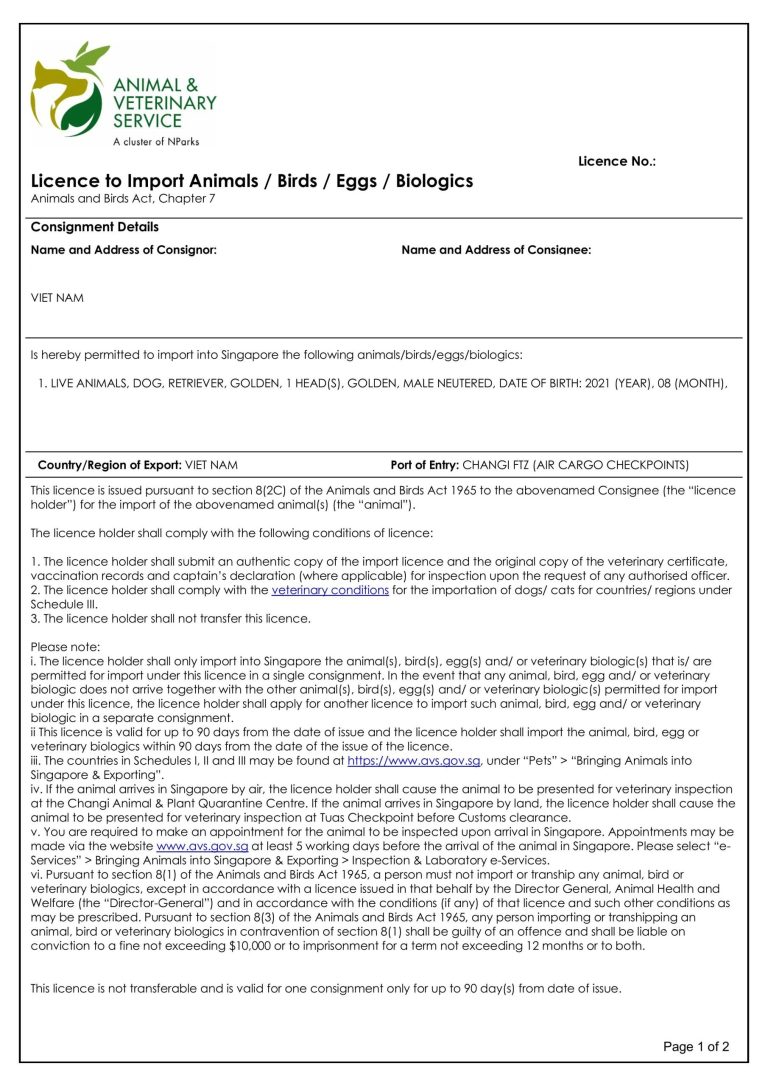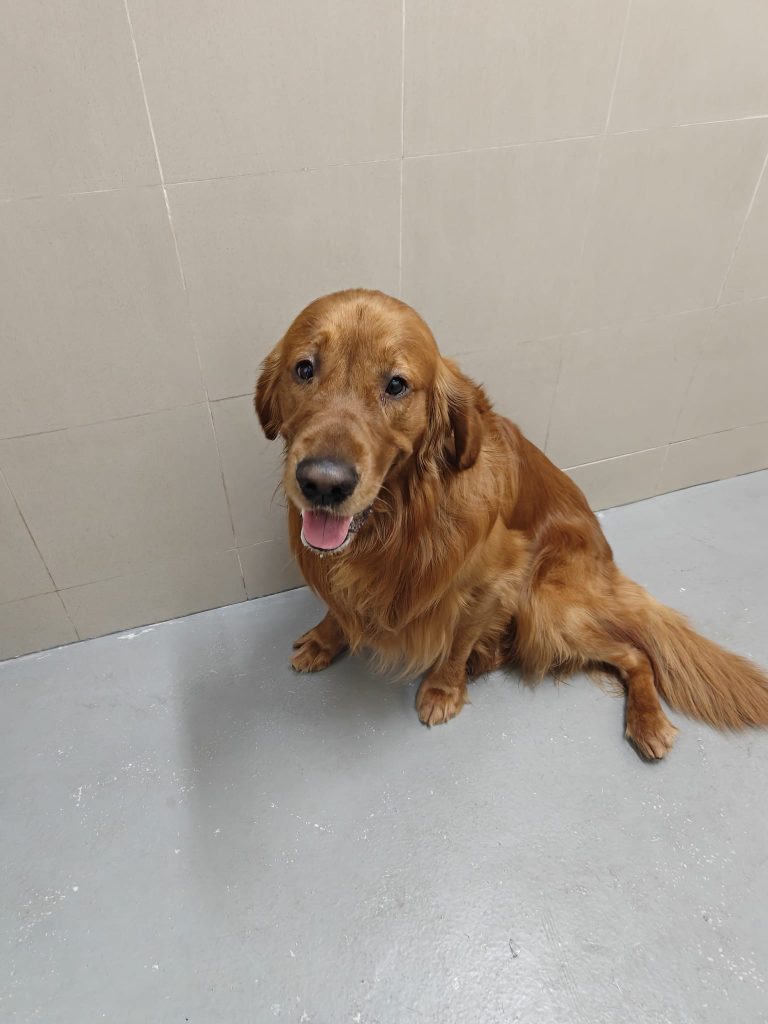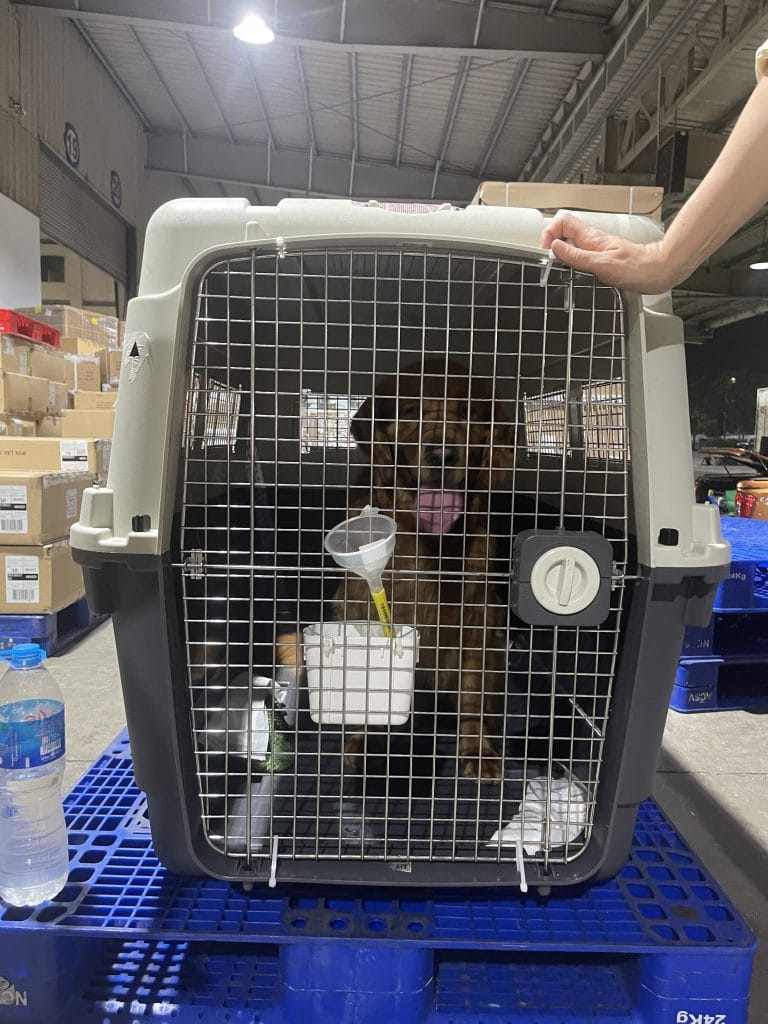
Most pet owners start planning a Singapore move by researching flights. That is the wrong sequence. Singapore’s Animal & Veterinary Service (AVS) administers one of the most rigorous pet import frameworks in the world — and for Vietnam, which is classified as a Schedule III country, the preparation clock starts at least 4–5 months before the flight. Understanding each legal requirement before day one is not optional: a single missed step restarts the clock.
This guide covers every binding requirement in the 2026 AVS framework for dogs and cats arriving from Vietnam. For a step-by-step operational timeline, see our complete 8-step timeline guide. For a full cost breakdown, see our Singapore pet relocation cost guide 2026.
Part 1: Schedule III Classification — Why Vietnam Faces the Strictest Pathway
AVS divides all territories into three tiers based on their rabies risk profile. Vietnam’s Schedule III designation triggers the full set of requirements with no shortcuts:
| Classification | Category A/B (Low Risk) | Schedule III (Vietnam) |
|---|---|---|
| Example countries | Australia, UK, New Zealand, Hong Kong | Vietnam, USA, Thailand, China |
| Quarantine | None or 10 days maximum | Mandatory 30 days at AQC |
| RNATT required? | No | Yes — with 90-day pre-export window |
| Minimum preparation | 4–6 weeks | 4–5 months (minimum) |
Unlike Japan, where a pet that meets every requirement is usually released after an arrival inspection of under 12 hours, or Taiwan, where the 7-day quarantine is waived if the rabies blood sample was drawn at least 180 days before arrival, Singapore requires all Schedule III pets to undergo physical quarantine at a government-operated facility. There is no legal pathway to bypass this for pets from Vietnam, regardless of how complete the documentation is.
Part 2: Step 1 — ISO Microchip (Day 1, Non-Negotiable First Action)
The microchip must conform to ISO standard 11784/11785 (15-digit transponder). The sequence is legally binding:
- Microchip must be implanted BEFORE any vaccinations. If the rabies vaccine was administered even one day before the chip was implanted, AVS declares that vaccination legally invalid. The rabies course must be restarted from zero after chipping.
- Record the chip number immediately and precisely. Photograph the chip card on implantation day. The 15-digit number must appear identically on every document in the file — RNATT report, vaccination booklet, Health Certificate, PALS licence, and Import Permit. A single digit error causes immediate document rejection at CAPQ Changi.
Part 3: Step 2 — Mandatory Vaccinations
Singapore is one of the few countries requiring both rabies AND core combination vaccines for import — the EU, USA, and Japan require only rabies. The full mandatory list:
| Species | Required vaccines |
|---|---|
| Dogs | Rabies + Canine Distemper (CDV) + Canine Hepatitis (CAV-2) + Canine Parvovirus (CPV) |
| Cats | Rabies + Feline Rhinotracheitis (FVR) + Calicivirus (FCV) + Panleukopenia (FPV) |
| Validity requirement | All vaccines must be within the manufacturer’s stated immunity period at the time of export |
Documentation standard: Request your veterinarian to record the product name, batch number (lot number), and expiry date for every vaccine administered. AVS officers at CAPQ frequently reject vaccination booklets where only stickers were affixed without handwritten batch number confirmation.
Part 4: Step 3 — RNATT Rabies Antibody Titer Test
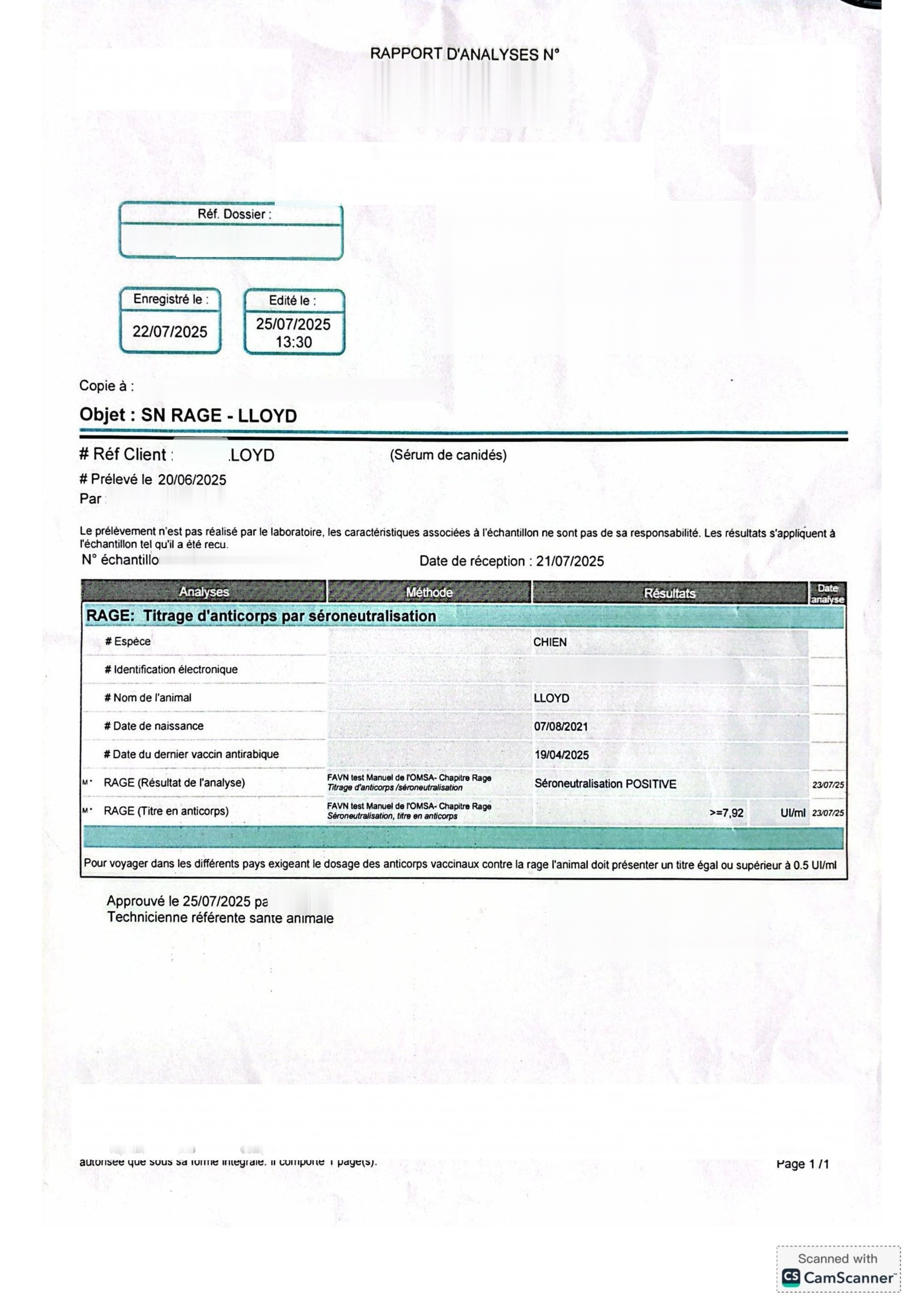
The Rabies Neutralising Antibody Titer Test (RNATT) is the biological cornerstone of the Schedule III pathway. The result must confirm a neutralising antibody level of ≥ 0.5 IU/ml.
The three timing rules — all mandatory:
- Rule 1 — 30-day wait: Blood must be drawn at least 30 days after the rabies vaccination. Drawing before this window invalidates the test.
- Rule 2 — 90-day pre-export: The blood draw must occur at least 90 days before the pet’s flight date. This is the hard constraint that determines the entire minimum timeline. There are no waivers for this rule for Schedule III countries.
- Rule 3 — 12-month validity: The RNATT result remains valid for 12 months from the blood draw date. If the flight is delayed beyond 12 months, the test must be repeated.
Because Vietnam has no WOAH-approved titer test laboratory, blood samples must be shipped to an approved laboratory overseas. Processing takes 3–4 weeks. Plan for the international shipping time when calculating the timeline.
If the RNATT result fails (below 0.5 IU/ml): A rabies booster is required, followed by a 30-day wait and a new blood draw. The 90-day pre-export clock resets from the new draw date. This is why reviewing a pet’s vaccination history before the first blood draw is critical.
Part 5: Step 4 — AQC Quarantine Slot Booking (Book in Week 1)
This is consistently the most surprising challenge for pet owners — not the paperwork. The Animal Quarantine Centre (AQC), located at 2 Jalan Lekar, Singapore 698919 (near Choa Chu Kang MRT), is Singapore’s only authorised quarantine facility — and demand routinely exceeds supply.
As of 1 June 2026, the earliest available slots are: Dogs — August 2026 | Cats — November 2026. During peak relocation season (August–December), slots are fully booked 3–4 months in advance. Book in Week 1 of your preparation process, not after RNATT results arrive.
Key operational facts:
- AQC bookings are made through the QMS (Quarantine Management System) at qms.avs.gov.sg. Pet owners can book directly — no agent is required to access QMS. The owner or their agent creates an account and submits the application.
- After submitting, AVS processes the application within 5 working days. If AVS requests additional information, the owner must respond within 3 days or the slot is released.
- Once confirmed, the deposit must be paid within 3 working days — otherwise the slot is automatically cancelled.
- Deposit amount: 10 days of quarantine fees plus the airport transport fee. Example: 1 dog, air-conditioned room, arriving from Vietnam → estimated deposit SGD 425 (= 10 × SGD 35 + SGD 75).
- Cancellation policy: Deposit is refundable if cancelled more than 30 days before arrival. Non-refundable if cancelled 30 days or fewer before arrival.
- Amendment fees: Changes made more than 30 days before arrival — first amendment free, SGD 65 from the second change. Changes made 30 days or fewer before arrival — SGD 65 per change.
- The QMS booking confirmation is a mandatory prerequisite for the Import Permit application.
Shared housing options (cost-saving):
- Cats: Up to 3 cats can share one cattery — significant cost saving for multi-cat households.
- Dogs: Shared kennel for up to 3 dogs — email qms@nparks.gov.sg before arrival to request.
Photo requirements when booking via QMS:
- Pets aged 1 year or under: must upload front, back, and side photos, plus tooth photos (incisors, canines, premolars, molars).
- Mixed-breed dogs: must upload clear colour photos for AVS to verify the pet is not a banned breed.
AQC quarantine fees (current rates — before 1 December 2026):
| Room type | Current daily rate | Rate from 1 Dec 2026 | 30-day total (current) |
|---|---|---|---|
| Fan-fitted room | SGD 26 / day | SGD 36 / day | ~SGD 855 |
| Air-conditioned room | SGD 35 / day | SGD 44 / day | ~SGD 1,125 |
| Airport → AQC transport | SGD 75 (one-way) | SGD 75 (one-way) | Billed with AQC invoice |
| Rabies vaccination at AQC (if required) | SGD 68 | — | Only if vaccination records insufficient |
For a complete guide to the QMS booking process, see our article on how to book an AQC quarantine slot in Singapore.
Part 6: Step 5 — Two-Step Licensing: PALS Licence + Import Permit
Singapore requires a licensing sequence unique in Asia — no other country on Daisy Pet’s destination list uses this dual-step approach:
Step 5A — PALS Licence (Pet Animal Licensing System):
Important prerequisite: Before applying for PALS for the first time, the owner must complete the free Pet Ownership Course (online, via the AVS website). Without this course completion, the PALS application will be rejected.
Once the course is done, register the pet under the owner’s name in Singapore via pals.avs.gov.sg. The output document is formally called the Dog Licence (or Cat Licence), issued under the Animals and Birds Act, Chapter 7. For a complete walkthrough of the registration process, see our step-by-step PALS registration guide.
Dog Licence fee options (sterilised dogs):
- 1-year licence: SGD 15
- 2-year licence: SGD 25
- One-time permanent licence: SGD 35
- Non-sterilised dog: SGD 90/year
Cat Licence fee: Sterilised cats receive a FREE, one-time lifetime licence. Unsterilised cats are currently fee-exempt during the transitional period until 31 August 2026.
Payment is accepted via PayPal, MasterCard, VISA, GIRO (10% rebate), and AXS stations. Cash and cheques are not accepted.
Step 5B — Import Permit via GoBusiness: Only once the PALS Licence and AQC booking confirmation are in hand can you apply for the Import Permit through the GoBusiness Licensing Portal. Critical rules:
- Apply at least 30 days before the pet’s arrival date.
- Normal processing: approximately 2 working days — fee: SGD 50.
- Express processing: 1 working day — fee: SGD 100.
Part 7: Step 6 — DAH Export Health Certificate (2–7 Days Before Flight)
The Export Health Certificate must be:
- Issued by a government-approved veterinarian in Vietnam following a clinical examination of the pet.
- Officially endorsed (stamped) by the Department of Animal Health (DAH) — Vietnam’s competent authority.
- Issued between 2 and 7 days before the flight date. The certificate cannot be issued earlier than 7 days before the flight, and must be completed at least 2 days before departure. Time the clinical examination precisely.
At the same time: Book the pre-arrival inspection at CAPQ (Changi Animal & Plant Quarantine) at least 5 days (calendar days, not working days) before the pet’s arrival. Failure to pre-book CAPQ is a common cause of avoidable complications at the Singapore border.
Part 8: Step 7 — CAPQ Inspection at the Changi Animal & Plant Quarantine Station
On arrival in Singapore, your pet first clears CAPQ — the Changi Animal & Plant Quarantine Station, the AVS border checkpoint at Changi Airport. Two critical rules effective 1 April 2026 govern flight scheduling:
- No Saturday arrivals: From 1 April 2026, applications for arrival via air on Saturdays are not accepted. Pets must arrive Monday through Friday only. This directly affects your flight booking decisions.
- Transfer window: Pets are transferred from CAPQ to AQC only during 10:00 AM – 10:30 AM (Monday–Friday). Flights should arrive early enough for inspection to complete before 10:00 AM — otherwise the pet may remain overnight at CAPQ.
Upon landing at Changi, the pet is directed to the CAPQ station where an AVS officer inspects all original documents. The complete required set:
- Import Permit (original, from GoBusiness)
- PALS Dog Licence / Cat Licence (original)
- DAH Export Health Certificate (original, within 2–7 day validity window)
- Original RNATT laboratory report (within 12-month validity)
- Vaccination booklet with batch numbers confirmed
- Customs In-Payment permit (9% GST on declared pet value)
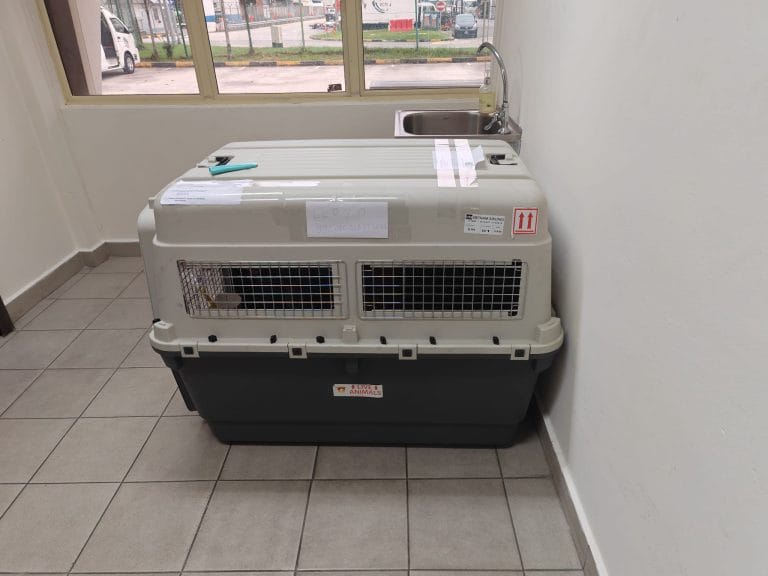
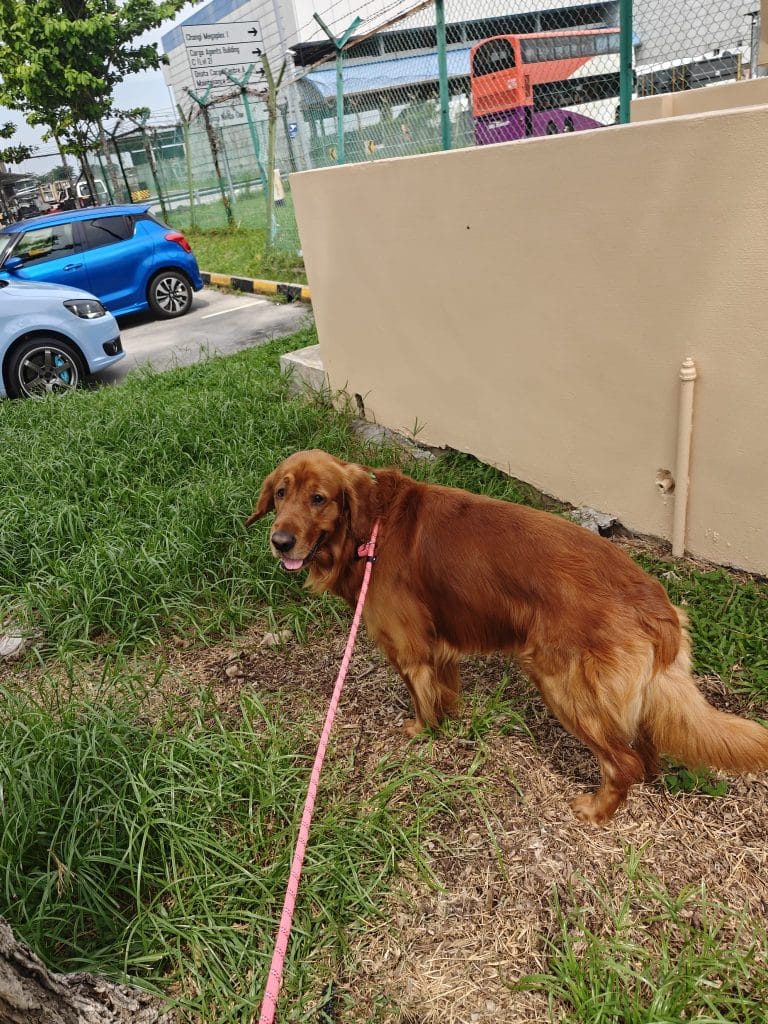
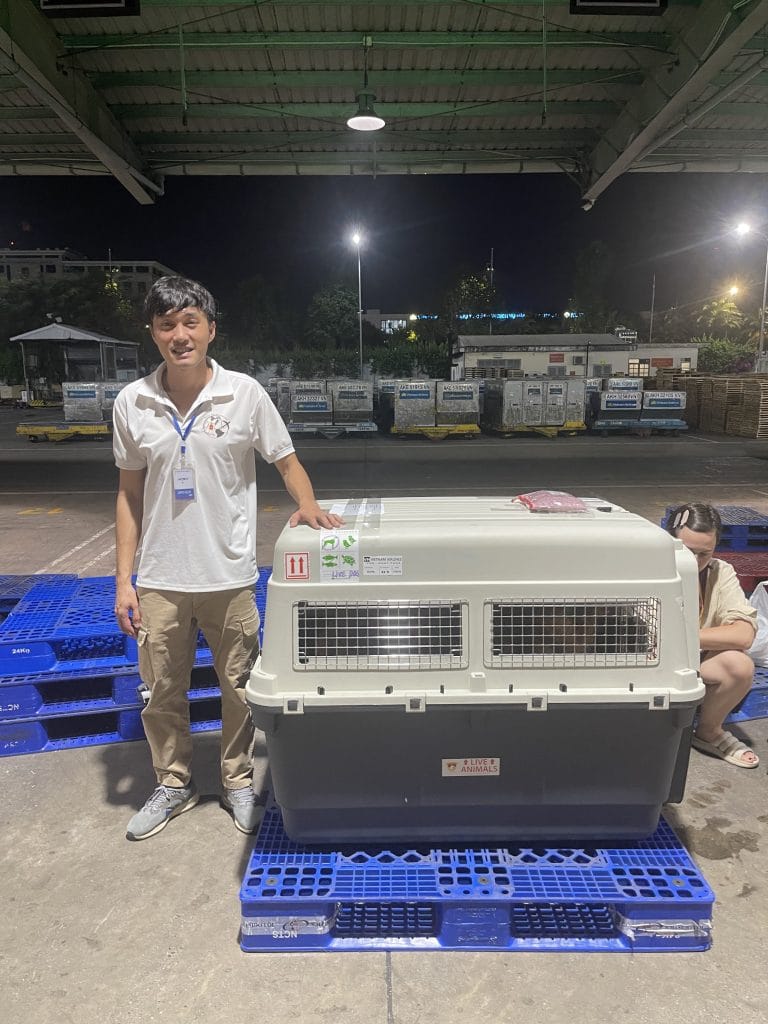
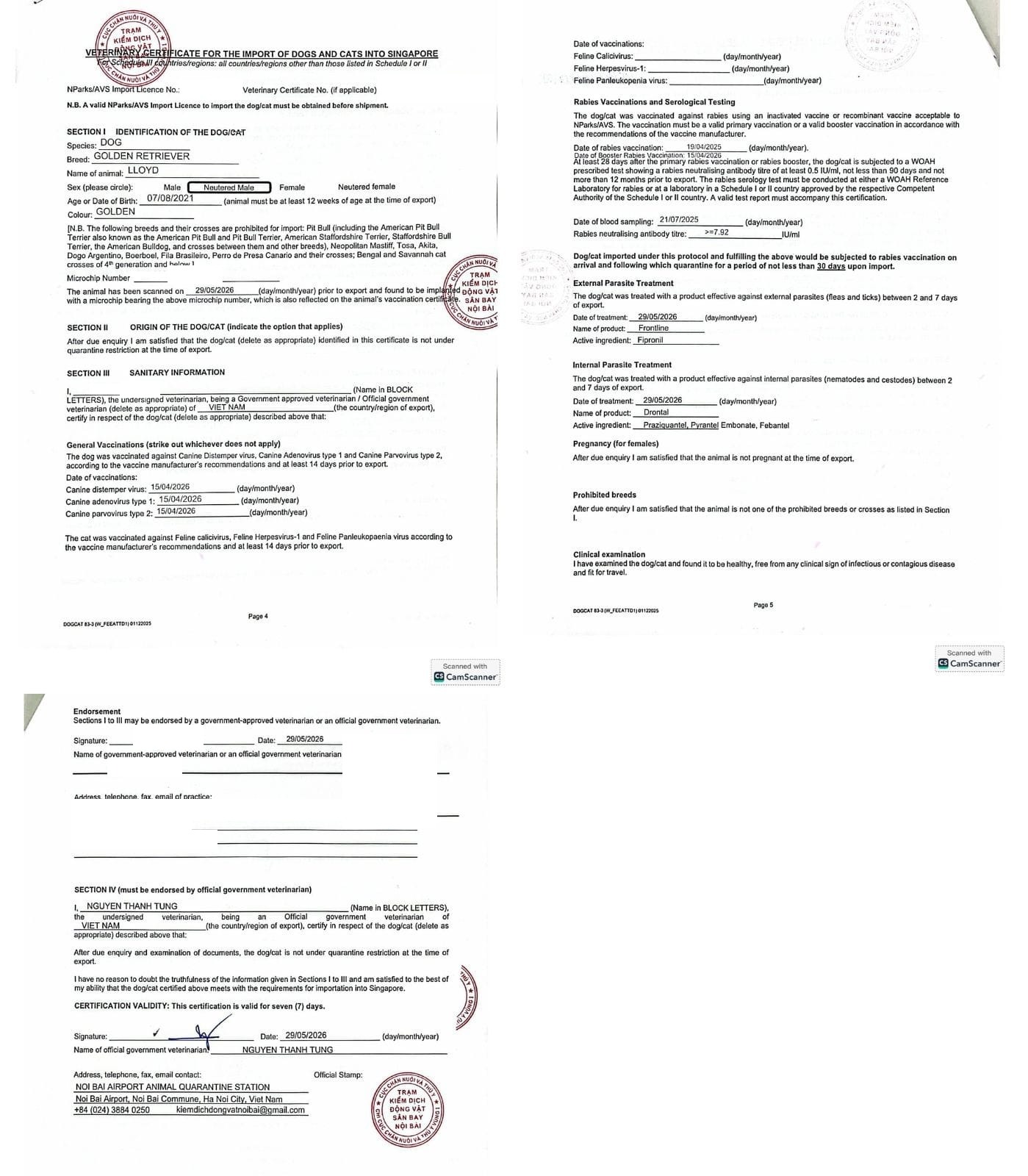
From April 2026, only AVS-recognised agents may conduct clearance procedures at CAPQ Changi on behalf of the owner. After clearance, the pet is transported to AQC (SGD 75 transfer fee). See our guide on airlines that transport pets from Vietnam to Singapore for flight options. To see all these requirements applied in a real relocation case, follow Lloyd’s Golden Retriever journey from document preparation through AQC clearance.
Part 9: Step 8 — Mandatory 30-Day Quarantine at AQC
Every pet from Vietnam must complete a minimum 30-day physical quarantine at AQC — no exceptions, no home quarantine option, no reduction based on document quality. Quarantine starts from the day of admission to AQC, not from the flight date.
Owners may visit their pets during designated visiting hours. Visiting schedule:
- Tuesday & Thursday: 3:00 PM – 5:00 PM
- Saturday: 2:00 PM – 5:00 PM
- Sunday, Monday, Friday, and public holidays: closed for visits
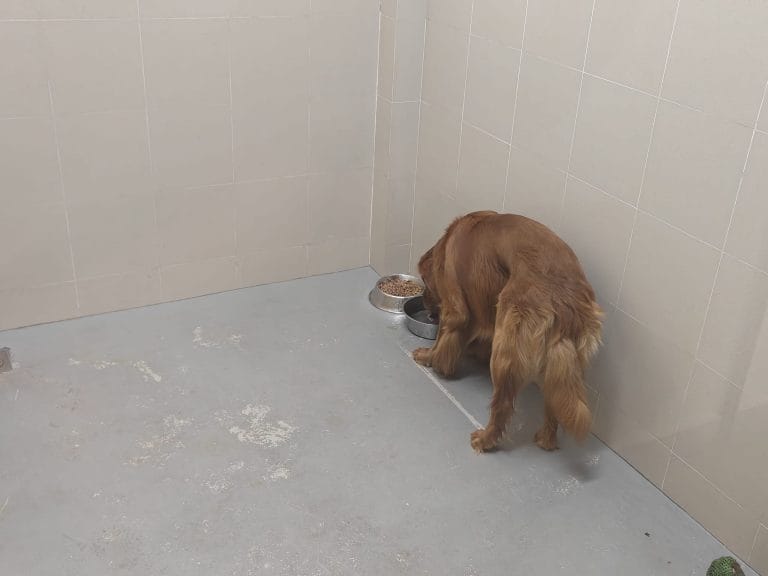
Pets cannot leave the AQC premises at any point during quarantine. Exercise yard (15 minutes, free) and grooming room (30 minutes, free) are available — pre-book with AQC. For a full account of what the 30-day stay involves — from arrival procedures to daily routine to the release process — see our guide on Singapore’s 30-day AQC quarantine experience. See also our detailed guide on what happens during AQC quarantine for visiting rules, facility conditions, and the release process.
Part 10: Customs & GST 9%
Singapore treats imported pets as goods for customs purposes. A 9% Goods and Services Tax (GST) is levied on the declared commercial value of the pet. This is a Singapore-specific requirement not found in most other destination countries.
A Customs In-Payment permit must be obtained and presented at CAPQ before the pet’s arrival. This permit documents the declared value and confirms GST payment. Daisy Pet manages this permit as part of the full-service package.
Part 11: Breed-Specific Legislation (BSL)
Singapore enforces one of the strictest breed restriction frameworks in Asia under the Animals and Birds Act, Chapter 7:
Part 1 — Completely banned (no import under any circumstances): Pit Bull (all variants including American Pit Bull Terrier, Staffordshire Bull Terrier, American Bulldog), Akita (both Japanese and American Akita), Neapolitan Mastiff, Tosa, Dogo Argentino, Fila Brasileiro, Boerboel, Perro de Presa Canario, and all crosses involving these breeds. No exemption process exists.
Part 2 — Specified Dogs (permitted with mandatory conditions): Bull Terrier, Doberman Pinscher, Rottweiler, German Shepherd Dog (and related breeds including Belgian Malinois, East European Shepherd), Mastiff variants (Bull Mastiff, Cane Corso, Dogue de Bordeaux), and their crosses. All Specified Dogs must be: muzzled in public, kept on a strong leash, covered by third-party liability insurance (minimum SGD 100,000), have completed AVS-designated obedience training, and the owner must hold a banker’s guarantee of SGD 2,000 (Bull Terrier, Doberman, Rottweiler, German Shepherd, Belgian Malinois) or SGD 5,000 (Mastiff variants). See our full Specified Dogs requirements for the complete conditions checklist.
HDB restriction: Even if a breed is legally permitted into Singapore, breeds not on the HDB Approved Breeds List (~62 small-to-medium breeds) cannot be kept in HDB flats (public housing, ~80% of Singapore residences). Verify your breed against the HDB list before booking flights. See our full guide on banned and restricted dog breeds in Singapore.
Part 12: Cat-Specific Rules (2024 Updates)
Cats from Vietnam are subject to the identical import process as dogs: microchip, core vaccines (FVR/FCV/FPV + rabies), RNATT blood test, AQC slot booking, PALS Cat Licence, Import Permit, DAH Health Certificate, and mandatory 30-day quarantine at AQC. Cats have one breed restriction: Bengal and Savannah crosses of the first to fourth generation (F1–F4) are banned, so a Bengal or Savannah needs documentary proof that it is at least a fifth-generation (F5) cross.
Multi-cat cost saving: Up to 3 cats can share one cattery at AQC — a significant cost reduction for households relocating multiple cats. Book via QMS and note the sharing request in your application.
2024 regulatory update for cats in HDB: From September 2024, Singapore officially permits cats in HDB flats — up to 2 cats per flat. Cats must be sterilised, microchipped, and registered under PALS. Cat owners who owned cats prior to 1 September 2024 must license them via PALS by 31 August 2026.
Frequently Asked Questions
Can the 4-month minimum timeline be shortened?
No. The 90-day pre-export RNATT rule is a biological constraint set by AVS with no waivers for Schedule III countries. If your pet already has a valid microchip and current rabies vaccination, you may save 4–6 weeks by proceeding directly to the blood draw — but the 90-day clock still runs from the draw date.
What is the Dog Licence and how is it different from the Import Permit?
The Dog Licence (issued via PALS) is proof of ownership registration within Singapore — it licenses you to keep the pet at your Singapore address. The Import Permit (issued via GoBusiness) is the official authorisation to bring the pet into Singapore. Both documents are required, and the PALS licence must be obtained first.
Can I manage the Singapore import process myself without an agent?
Pet owners can book AQC quarantine slots directly via QMS (qms.avs.gov.sg) — no agent account is required. However, from April 2026, only AVS-recognised agents may conduct CAPQ clearance procedures at Changi Airport. At minimum, a recognised agent is legally required for the final clearance step.
What happens if my pet’s RNATT result fails?
A rabies booster is required, followed by a 30-day minimum wait and a new blood draw. The 90-day pre-export clock restarts from the new draw date. This typically adds 4–5 months to the timeline. Review your pet’s vaccination history with a vet before the first RNATT draw to minimise this risk.
Do I need to fly on a specific day of the week?
Yes. From 1 April 2026, CAPQ does not accept pet arrivals by air on Saturdays. Flights must be scheduled Monday through Friday. Additionally, the CAPQ-to-AQC transfer window is 10:00–10:30 AM on weekdays — flights arriving too late may leave your pet overnight at CAPQ.
Related: Pet Shipping from Vietnam to Singapore: 2026 Complete Guide — full overview covering AVS regulations, preparation timeline, quarantine requirements, and cost breakdown.
Last updated 20 Oct 2026
Compiled by our specialists from the regulations in force on the date above, for reference only. Rules may change after this date. Please verify with the competent authorities or contact us for the most accurate information.
Official sources cited in this guide
- Animal & Veterinary Service (AVS)nparks.gov.sg
- qms.avs.gov.sgqms.avs.gov.sg
- pals.avs.gov.sgpals.avs.gov.sg