Many owners assume breed restrictions are just an airline being picky about which animals it “likes.” That’s not what’s happening. Every domestic carrier in Vietnam—Vietnam Airlines, Vietjet, and Bamboo Airways—restricts certain breeds for the same underlying reason: some dogs and cats carry a real, measurable risk of injury or death during air travel, and the airline is the one legally and operationally responsible if something goes wrong mid-flight.
The restricted lists aren’t identical across the three carriers, but they follow the same logic. Once you understand that logic, you can predict which breeds are likely to be restricted even before checking a specific list.
These are airline lists, not import law: a breed an airline refuses may still be allowed into another country, and a breed the airline accepts may still be banned at the destination border. For country-by-country import bans, see dog breeds banned from import.
Why Airlines Restrict Certain Breeds
Flying exposes an animal to changing air pressure, low humidity, engine noise, and—depending on the aircraft—temperature swings on the ground before and after the flight. Most healthy pets handle this without issue. Two physical traits make that much harder:
- Short, compressed airways. Breeds with a flattened skull shape have a narrower respiratory system to begin with. Even though cargo holds are pressurized and temperature-controlled, oxygen levels are still slightly lower than at sea level—enough to push a compromised airway into real distress.
- Size, strength, or bite risk. Large or powerful breeds can damage a standard crate under stress, which creates a safety risk for ground handling staff loading and unloading live animals.
Brachycephalic (Short-Nosed) Breeds
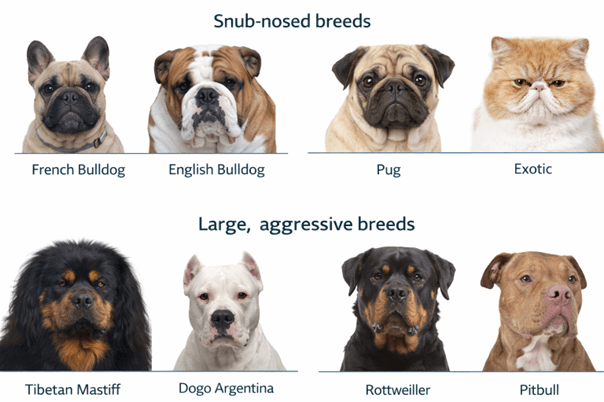
This group tops every airline’s restricted or heavily cautioned list, on every domestic carrier:
- French Bulldog: the breed with the highest reported rate of in-flight respiratory incidents. Most carriers refuse it outright as checked baggage.
- English Bulldog & American Bulldog: an extremely narrow palate structure means high heatstroke risk even in mild temperatures.
- Pug: prone to panic-induced airway blockage under stress.
- Boxer, Boston Terrier, Shih Tzu: on Vietnam Airlines’ refused list.
- Pekingese, Shar Pei, Chow Chow, Cavalier King Charles Spaniel, Lhasa Apso: refused by Vietnam Airlines in every mode; other carriers may restrict them by temperature.
On the cat side: Exotic Shorthair (sometimes called “the Pug of cats”), Persian (thick coat plus a short airway makes self-cooling especially hard), and Himalayan and Burmese cats are all on Vietnam Airlines’ refused list, along with the Exotic and Persian.
Large and High-Risk Breeds
The second group is about size and force rather than airway structure. Vietnam Airlines does not carry Pit Bull, American Staffordshire Terrier, Staffordshire Bull Terrier, Rottweiler (and mixes), Dogo Argentino, Fila Brasileiro, Tosa (and mixes) or any Mastiff, Tibetan Mastiff included — not in the cabin, not as checked baggage, not as cargo. A reinforced crate does not change that. Doberman and Cane Corso are not on its list; dogs this size usually exceed the 32 kg checked-baggage limit (pet + crate) and travel as cargo in a reinforced crate. Bamboo Airways publishes a similar list that also names American Bully, Laika, Kangal, Ovtcharka and Wolfdog. As of October 2026, though, Bamboo runs very few domestic flights and its hotline is often unreachable, so it may no longer accept pets in practice even though its pet policy page is still online. Confirm directly with the airline before planning around it. This category is largely irrelevant for Vietjet’s Sky Pet service, since it only carries pets in the cabin under a 7 kg total weight limit—a limit that already excludes every breed on this list regardless of any separate ban.
What About Mixed Breeds?
A common question: “My dog is mixed, not purebred—does the restriction still apply?” Airlines and check-in staff apply a visual assessment at check-in, not a pedigree check:
- If the dog visibly shows a shortened skull or flattened muzzle inherited from a Bulldog or Pug parent, the same brachycephalic restriction applies.
- If the dog has the muscular build and head structure typical of Pitbull or Rottweiler lines, staff can decline the dog. Vietnam Airlines names Rottweiler and Tosa mixes on its list, so a stronger crate is not an option there.
How the Three Domestic Airlines Compare
| Vietnam Airlines | Vietjet | Bamboo Airways | |
|---|---|---|---|
| Service type | Cabin (PETC) + Checked baggage (AVIH) | Cabin only (Sky Pet)—no checked baggage on domestic routes | Cabin (PETC) + limited checked baggage, depending on aircraft |
| Brachycephalic breeds | Refused in every mode, cabin included (official list) | Owners are advised to reconsider; the airline can refuse at check-in | Refused per Bamboo’s own published list (close to Vietnam Airlines’ list) |
| Large/aggressive breeds | Pit Bull types, Rottweiler, Dogo, Fila, Tosa and all Mastiffs refused in every mode | Not applicable—the 7 kg cabin-only limit already excludes these breeds | Pit Bull types, Rottweiler, Tosa, all Mastiffs, American Bully, Kangal, Wolfdog and others refused per its list |
If Your Pet Is on a Restricted List
A restricted breed doesn’t automatically mean the pet can’t travel—it means standard checked baggage or cargo isn’t the safe option. Two paths work in practice:
Be wary of any operator who offers to get a restricted breed through as ordinary checked baggage instead of one of the two paths below — that shortcut usually means falsifying the breed on paperwork, a practice we break down in our investigation into pet transport fraud in Vietnam.
In-Cabin Travel for Small Restricted Breeds
For brachycephalic pets under the cabin weight limit (6 kg on Vietnam Airlines, 7 kg on Vietjet, including the carrier), flying in the passenger cabin removes the risk almost entirely—cabin temperature and pressure stay stable, the same as for the humans on board. On Vietnam’s domestic flights this route is narrow: Vietnam Airlines’ list applies in the cabin too, and Vietjet can refuse these breeds at check-in.
Reinforced Crates for Large Breeds
For large dogs that do need checked baggage or cargo, a standard plastic crate isn’t the fix. What’s required is a reinforced crate—wood-frame or metal, built to IATA Container Requirement 82 (CR-82) standards, with a multi-point locking latch. This only applies to breeds the airline accepts — a reinforced crate does not get a breed on Vietnam Airlines’ list on board.
For a breed no airline will take, the remaining route is by road. How a move in a climate-controlled car works, and what paperwork it still needs, is covered on our page on domestic pet transport in Vietnam.
Frequently Asked Questions
Are breed restrictions the same across all three domestic airlines?
No. All three restrict brachycephalic breeds, but the checked-baggage/cargo restrictions on large or powerful breeds mainly apply to Vietnam Airlines and Bamboo Airways, since Vietjet’s Sky Pet service only carries pets in the cabin under 7 kg.
Does a mixed-breed dog get evaluated differently?
No. Staff assess mixed breeds by visible physical traits—flattened muzzle, muscular build—at check-in, applying the same restriction as the closest purebred match.
Last updated 17 Oct 2026
Compiled by our specialists from the regulations in force on the date above, for reference only. Rules may change after this date. Please verify with the competent authorities or contact us for the most accurate information.